Acts 16:9
Note: This discourse contains some blank pages, which have been omitted from this transcription.
Page 1:
Acts 16:9
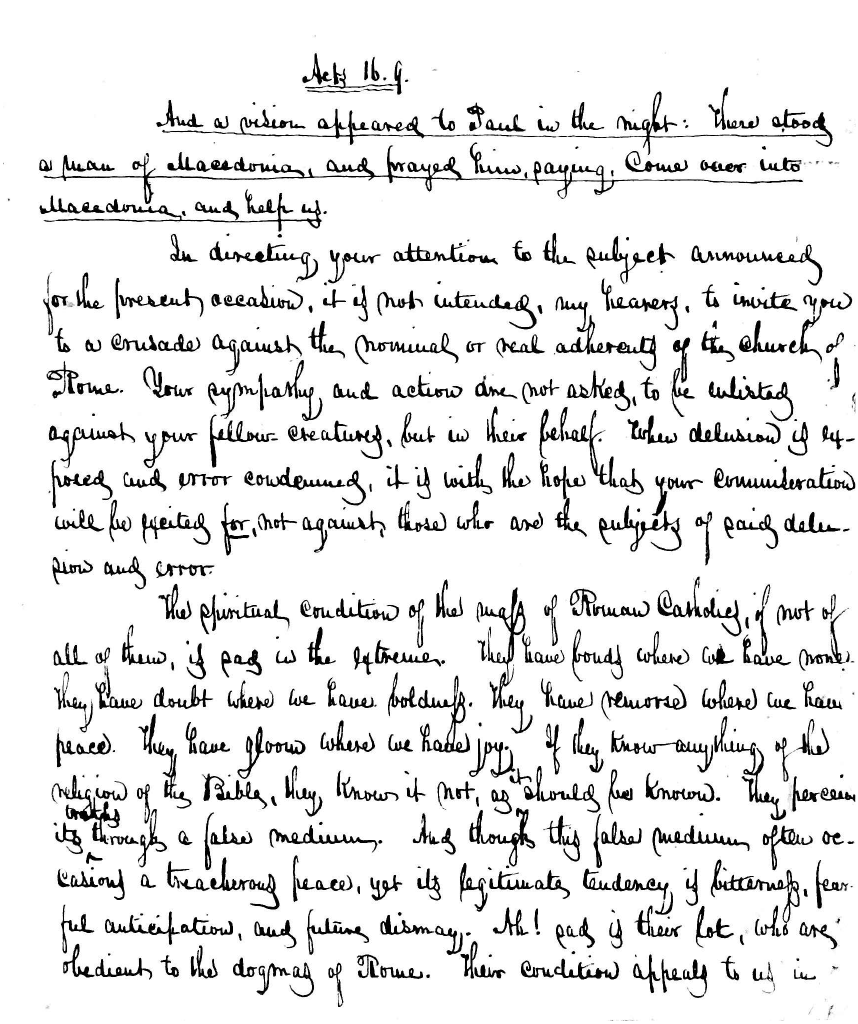
And a vision appeared to Paul in the night. There stood a man of Macedonia, and prayed him, saying, Come over into Macedonia, and help us.
In directing your attention to the subject announced for the present occasion, it is not intended, my hearers, to invite you to a crusade against the nominal or real adherents of the church of Rome. Your sympathy and actions are not asked, to be enlisted against your fellow creatures, but in their behalf. When delusion is exposed and error condemned, it is with the hope that your commiseration will be excited for, not against, those who are the subjects of said delusion and error.
The spiritual condition of the mass of Roman Catholics, if not of all of them, is sad in the extreme. They have bounds where we have none. They have doubt where we have boldness. They have remorse where we have peace. They have gloom where we have joy. If they know anything of the religion of the Bible, they know it not as it should be known. They perceive its truths through a false medium. And though this false medium often occasions a treacherous peace, yet its legitimate tendency is bitterness, fearful anticipation, and future dismay. Ah! sad is their lot, who are obedient to the dogmas of Rome. Their condition appeals to us in
Page 2:
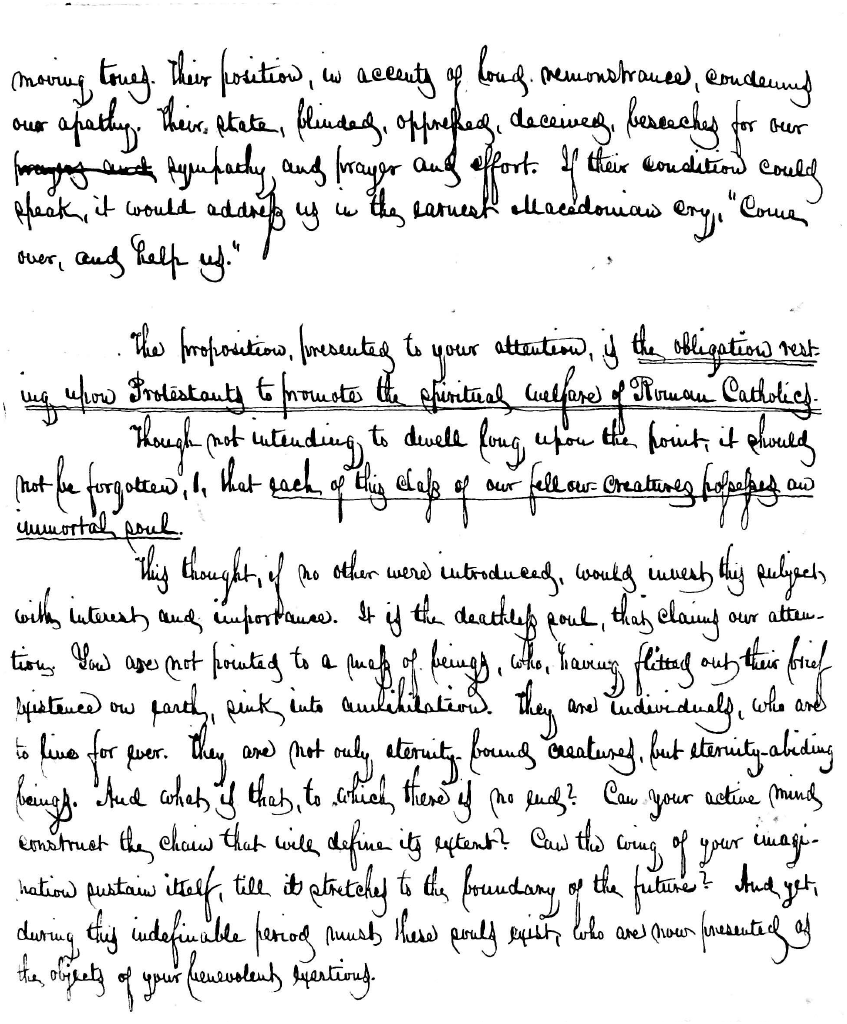
moving tones. Their position, in accounts of long remembrance, condemns our apathy. Their state, blinded, oppressed, deceived, beseeches for our sympathy, and prayer and effort. If their condition could speak, it would address us in the earnest Macedonian cry, “Come over, and help us.”
The proposition, presented to your attention, is the obligation resting upon Protestants to promote the spiritual welfare of Roman Catholics.
Though not intending to dwell long upon the point, it should not be forgotten, 1, that each of this class of our fellow-creatures possesses an immortal soul.
This thought, if no other were introduced, would invest this subject with interest and importance. It is the deathless soul, that claims our attention. You are not pointed to a mess of beings, who, having fitted out their brief existence on earth, sink into annihilation. They are individuals, who are to live for ever. They are not only eternity-bound creatures, but eternity-abiding beings. And what is that, to which there is no end? Can your active mind construct the chain that will define its extent? Can the wing of your imagination sustain itself, till it stretches to the boundary of the future? And yet, during this indefinable period must these souls exist, who are now presented as the objects of your benevolent exertions.
Page 3:
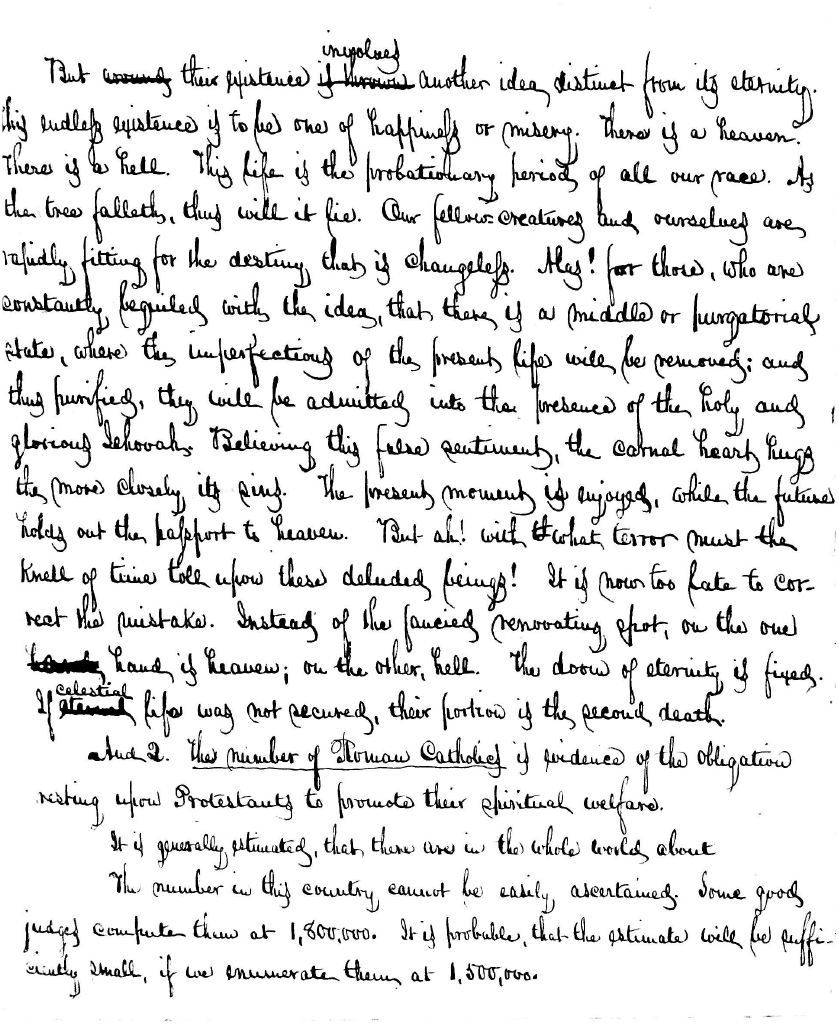
But their existence involves another idea distinct from its eternity. This endless existence is to be one of happiness or misery. There is a heaven. There is a hell. This life is the probationary period of all our race. As the tree falleth, thus will it lie. Our fellow-creatures and ourselves are rapidly fitting for the destiny that is changeless. Alas! for those, who are constantly beguiled with the idea that there is a middle or purgatorial state, where the imperfections of the present life will be removed; and thus purified, they will be admitted into the presence of the holy and glorious Jehovah. Believing this false sentiment, the carnal heart hugs the more closely its sins. The present moment is enjoyed, while the future holds out the passport to heaven. But ah! with what terror must the knell of time tell upon those deluded beings! It is now too late to correct the mistake. Instead of the fancied renovating spot, on the one hand, is heaven; on the other, hell. The doom of eternity is fixed. If celestial life was not secured, their portion is the second death.
And 2. The number of Roman Catholics is evidence of the obligation resting upon Protestants to promote their spiritual welfare.
It is generally estimated that there are in the world about [sic]
The number in this country cannot be easily ascertained. Some good judges compute them at 1,800,000. It is possible, that the estimate will be sufficiently small, if we enumerate them at 1,500,000.
Page 4:
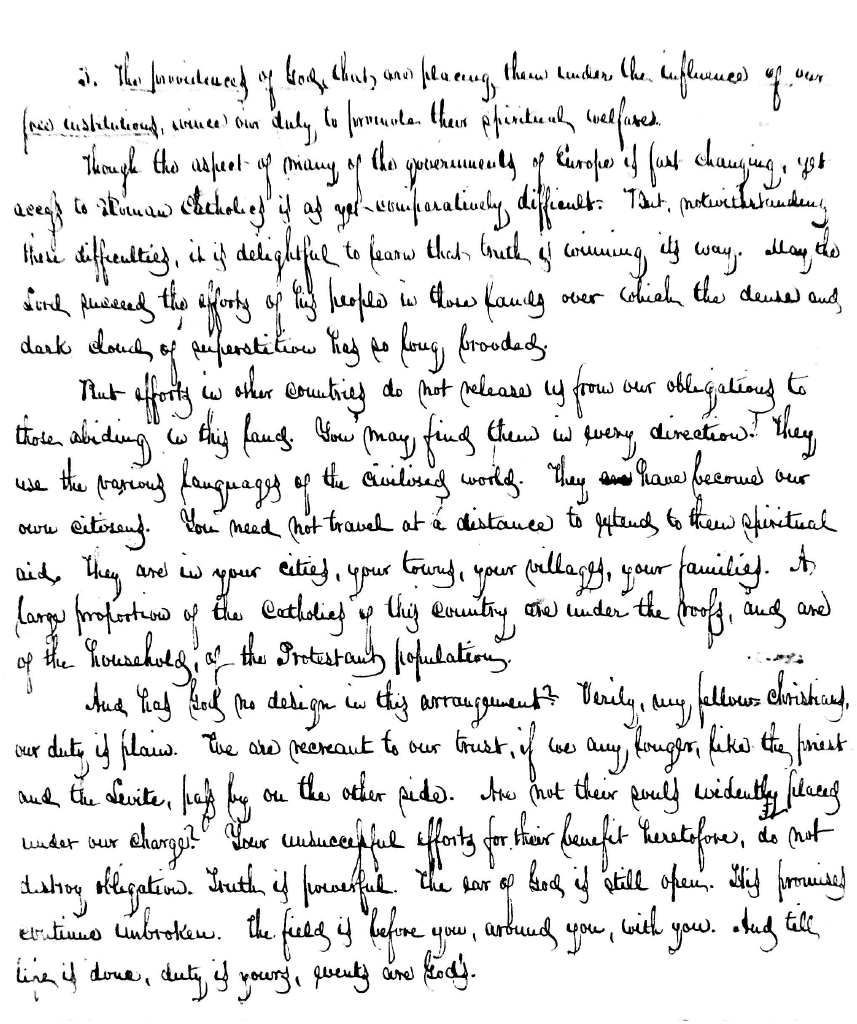
3. The providences of God, that are placing them under the influences of our free institutions, evince our duty to promote their spiritual welfare.
Though the aspect of many of the governments of Europe is fast changing, yet access to Roman Catholics is as yet comparatively difficult. But, notwithstanding these difficulties, it is delightful to learn that truth is winning its way. May the Lord succeed the efforts of his people in those lands over which the dense and dark cloud of superstition has so long brooded.
But efforts in other countries do not release us from our obligations to those abiding in this land. You may find them in every direction. They use the various languages of the civilized world. They have become our own citizens. You need not travel at a distance to attend to them spiritual aid, they are in your cities, your towns, your villages, your families. A large proportion of the Catholics of this country are under the roofs, and are of the household, of the Protestant population.
And has God no design in this arrangement? Verily, my fellow Christians, our duty is plain. We are recreant to our trust, if we any longer, like the priest and the Levite, pass by on the other side. Are not their souls evidently placed under our charge? Your unsuccessful efforts for their benefit heretofore, do not destroy obligation. Truth is powerful. The ear of God is still open. His promises continue unbroken. The field is before you, around you, with you. And till life is done, duty is yours, events are God’s.
Page 5:
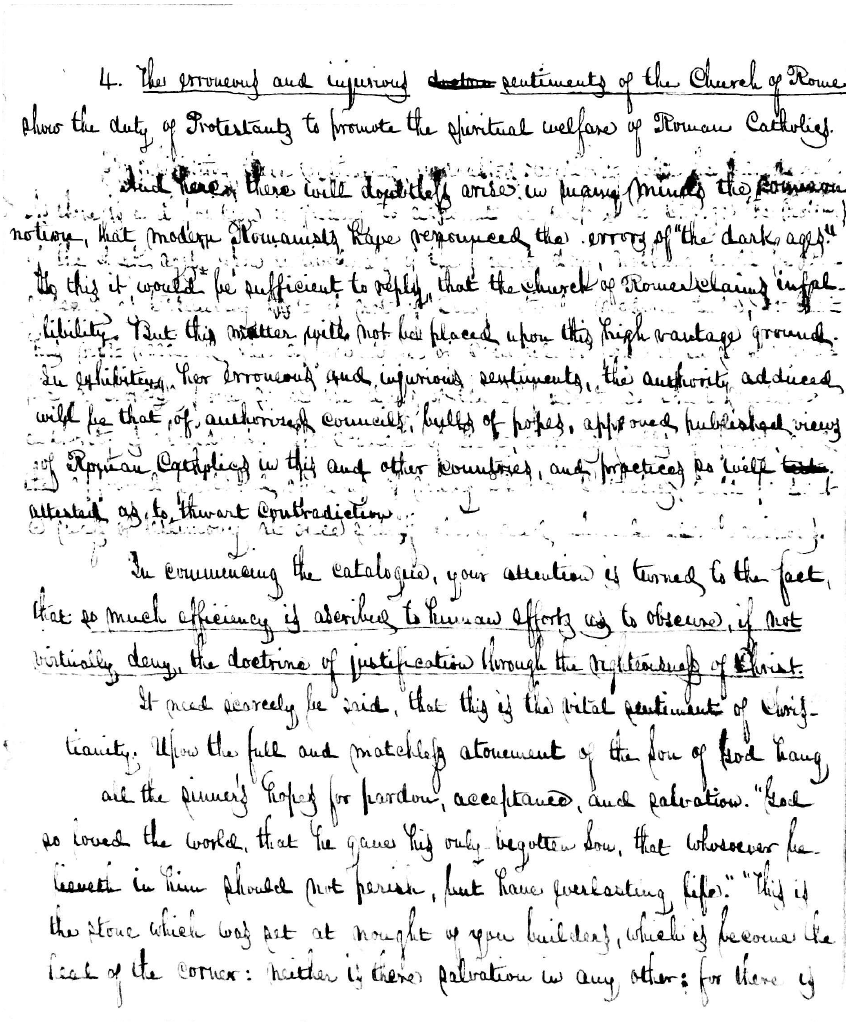
4. The erroneous and injurious sentiments of the Church of Rome show the duty of Protestants to promote the spiritual welfare of Roman Catholics.
And here, there will doubtless arise in many minds the common notion, that modern Romanists have renounced the errors of the dark ages. To this it would be sufficient to reply that the Church of Rome claims infallibility. But this matter will not be placed upon this high vantage ground in exhibitions. Her erroneous and injurious sentiments, the authority adduced will be that of authorized councils, bulls of popes, approved published views of Roman Catholics in this and other countries, and practices as well attested as to thwart contradiction.
In commencing the catalogue, your attention is turned to the fact, that so much efficiency is ascribed to human efforts as to obscure, if not virtually deny, the doctrine of justification through the righteousness of Christ.
It need scarcely be said, that this is the vital sentiment of Christianity. Upon the full and matchless atonement of the Son of God hang all the sinner’s hopes for pardon, acceptance, and salvation. “God so loved the world, that he gave his only-begotten Son, that whosoever believeth in him should not perish, but have everlasting life.” This is the stone which was set at nought of you builders, which is become the head of the corner: neither is there salvation in any other: for there is
Page 6:
none other name under heaven given among men, whereby we must be saved.
Page 9:
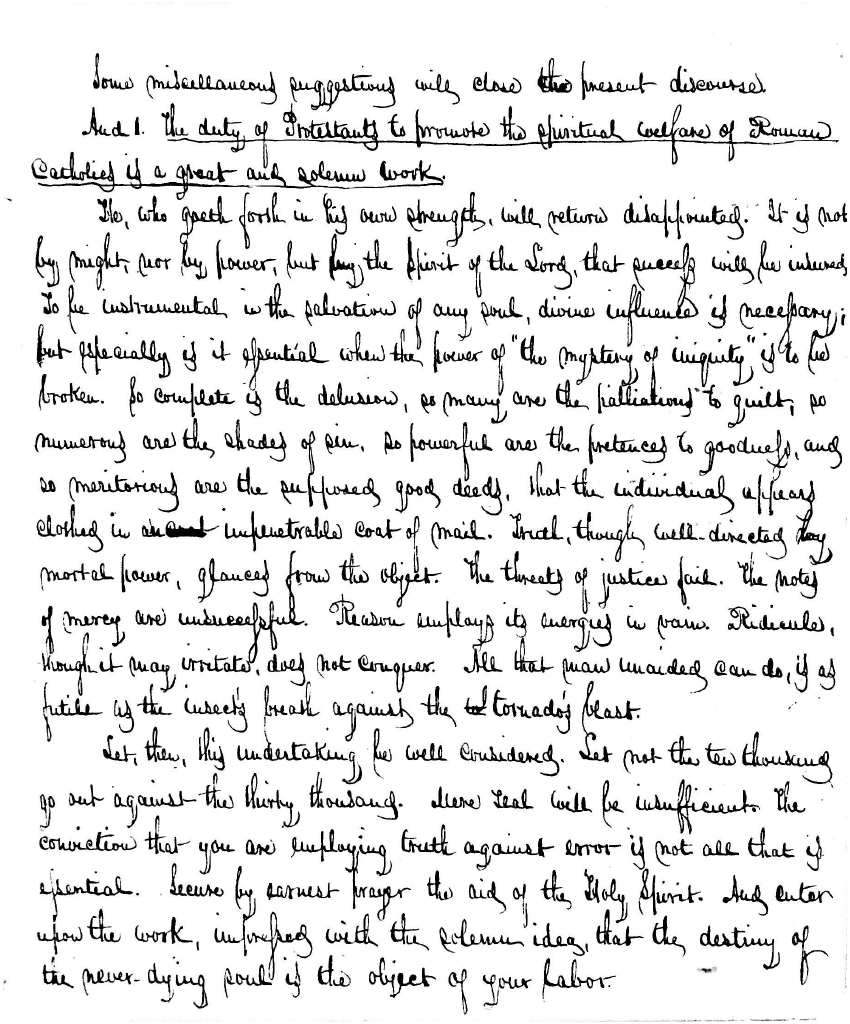
Some miscellaneous suggestions will close the present discourse.
And 1. The duty of Protestants to promote the spiritual welfare of Roman Catholics is a great and solemn work.
He, who goeth forth in his own strength, will return disappointed. It is not by might, nor by power, but by the Spirit of the Lord, that success will be insured [sic]. To be instrumental in the salvation of any soul, divine influence is necessary; but especially is it essential where the power of “the mystery of iniquity” is to be broken. So complete is the delusion; so many are the palliations to guilt, so numerous are the shades of sin. So powerful are the pretences to goodness, and so meritorious are the supposed good deeds, that the individual appears clothed in an impenetrable coat of mail. Truth, though well directed by mortal power, glanced from the object, the threats of justice fail. The notes of mercy are unsuccessful. Reason employs its energies in vain. Ridicule, though it may irritate, does not conquer. All that man unaided can do, is as futile as the insect’s breath against the tornado’s beast.
Let, then, this undertaking be well considered. Let not the ten thousand go out against the thirty thousand. Mere zeal will be insufficient. The conviction that you are employing truth against error is not all that is essential. Secure by earnest prayer the aid of the Holy Spirit. And enter upon the work, impressed with the solemn idea, that the destiny of the never-dying soul is the object of your labor.
Page 10:
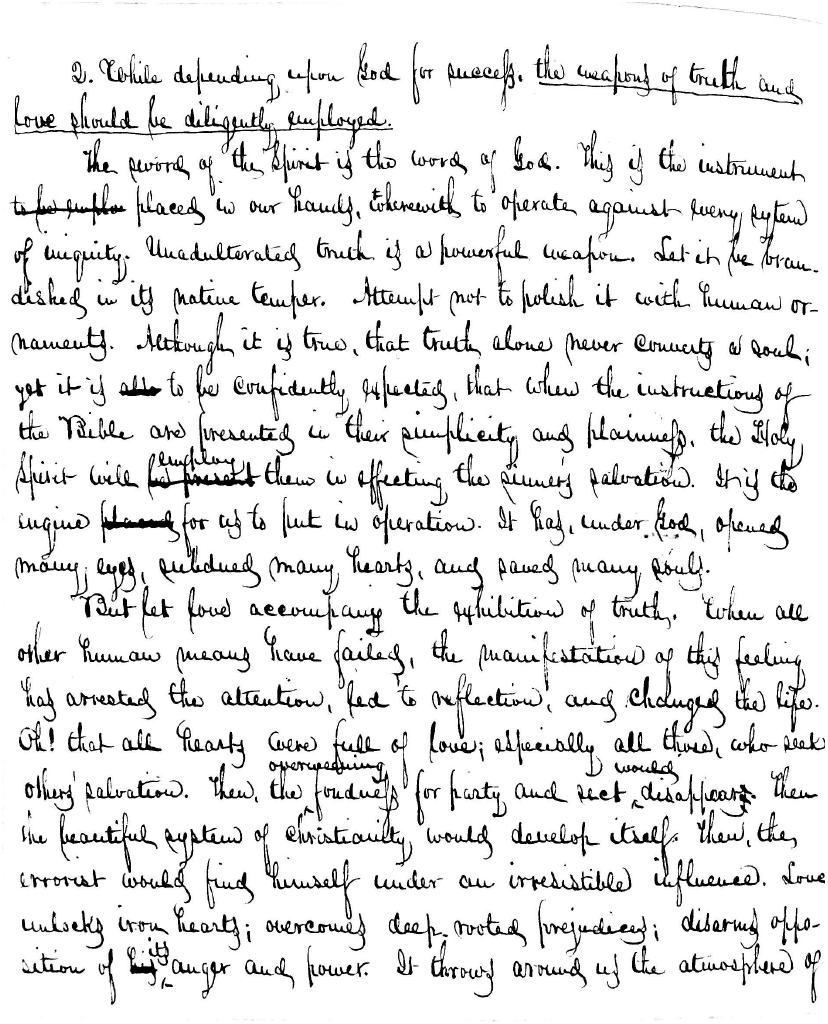
2. While depending upon God for success, the weapons of truth and love should be dilligently employed.
The sword of the Spirit is the word of God. This is the instrument placed in our hands, wherewith to operate against every system of iniquity. Unadulterated truth is a powerful weapon. Let it be brandished in its native temper. Attempt not to polish it with human ornaments. Although it is true, that truth alone never connects a soul; yet it is to be confidently expected, that when the instructions of the Bible are presented in their simplicity and plainness, the Holy Spirit will employ them in effecting the sinner’s salvation. It is the engine for us to put in operation. It has, under God, opened many eyes, subdued many hearts, and saved many souls.
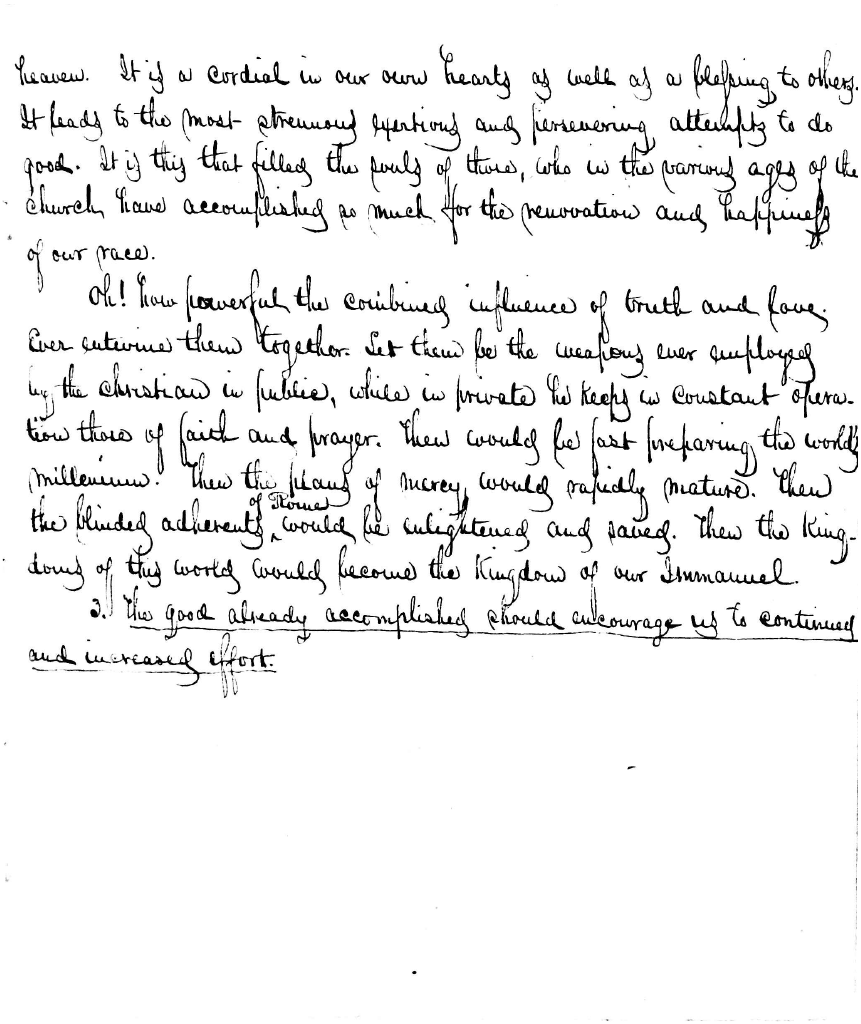
But let love accompany the exhibition of truth. When all other human means have failed, the manifestation of this feeling has arrested the attention, led to reflection, and changed the life. Oh! that all hearts were full of love; especially all those, who seek others’ salvation. Then, the overweening fondness for party and sect would disappear. Then the beautiful system of christianity would develop itself. Then, the errorist would find himself under an irresistible influence. Love unlocks iron hearts; overcomes deep-rooted prejudices; disarms opposition of its anger and power. It throws around us the atmosphere of
Page 11:
heaven. It is a cordial in our own hearts as well as a blessing to others. It leads to the most strenuous exertions and persevering attempts to do good. It is this that filled the souls of those, who in the various ages of the church have accomplished so much for the renovation and happiness of our race.
Oh! how powerful the combined influence of truth and love. Ever entwine them together. Let them be the weapons ever employed by the christian in public, while in private he keeps in constant operation those of faith and prayer. Then would be fast preparing the world’s millennium. Then the plans of mercy would rapidly mature. Then the blinded adherents of Rome would be enlightened and saved. Then the kingdoms of this world would become the kingdom of our Immanuel.
3. The good already accomplished should encourage us to continuous and increased effort.
Page 13:
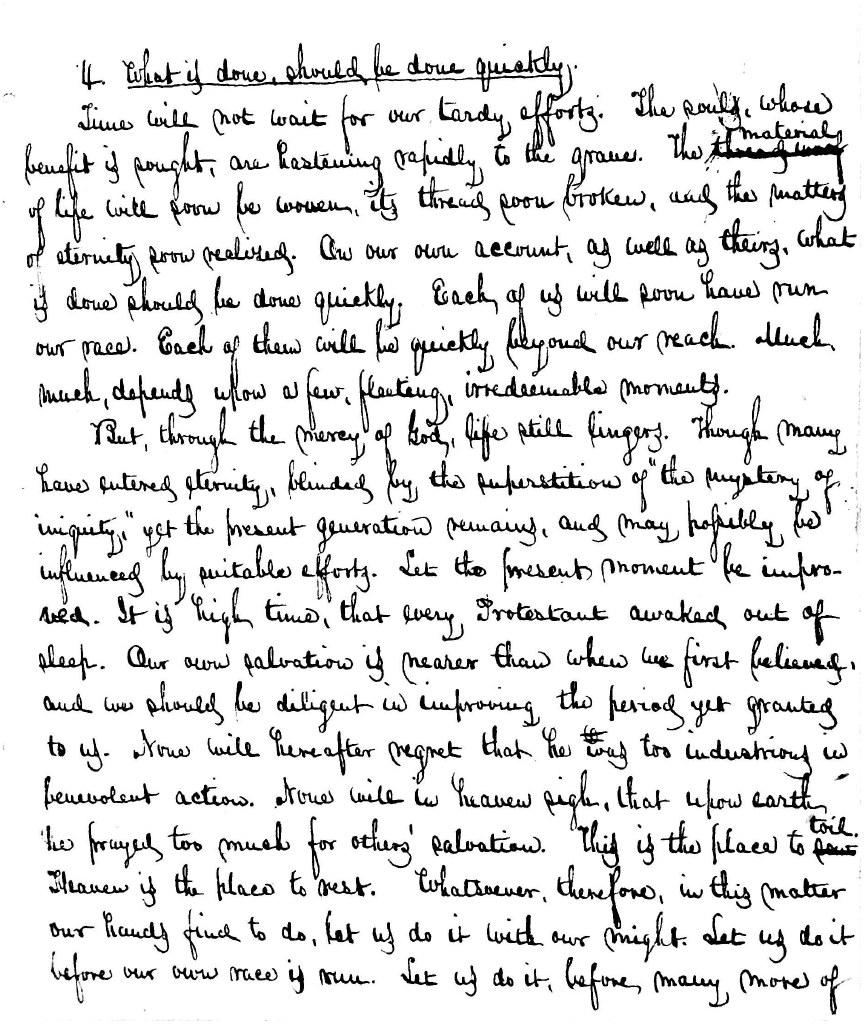
4. What is done, should be done quickly.
Time will not wait for our tardy efforts. The souls, whose benefit is sought, are hastening rapidly to the grave; the material of life will soon be woven, its thread soon broken, and the matters of eternity soon realized. On our own account, as well as theirs, what is done should be done quickly. Each of us will soon have run our race. Each of them will be quickly beyond our reach. Much, much, depends upon a few, fleeting, irredeemable moments.
But, through the mercy of God, life still lingers. Though many have entered eternity, blinded by the superstition of the “mystery of iniquity,” yet the present generation remains; and may possibly be influenced by suitable efforts. Let the present moment be improved. It is high time, that every Protestant awakened out of sleep. Our own salvation is nearer than when we first believed, and we should be diligent in improving the period yet granted to us. None will hereafter regret that he was too industrious in benevolent action. None will in heaven sigh, that upon earth he prayed too much for others’ salvation. This is the place to toil. Heaven is the place to rest. Whatever, therefore, in this matter our hands find to do, let us do it with our might. Let us do it before our own race is run. Let us do it before many more of
Page 14:
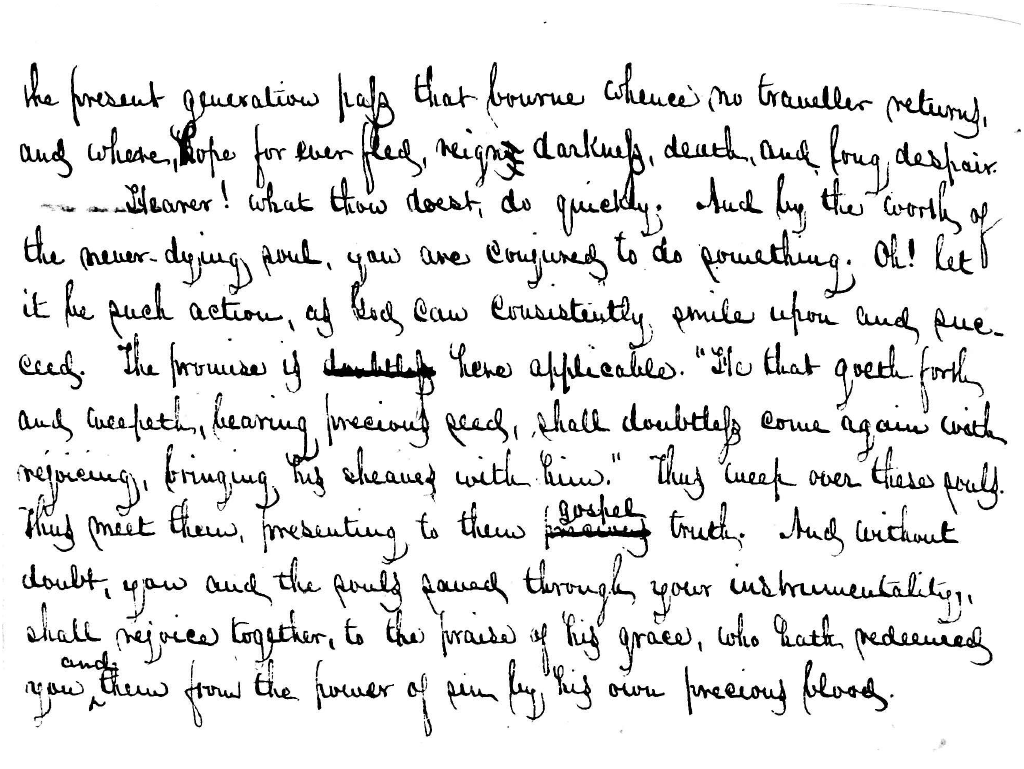
the present generation pass that bourne whence no traveller returns, and where, hope for ever fled, reign darkness, death, and long despair.
Hearer! what thou doest, do quickly. And by the worth of the never-dying soul, you arre conjured to do something. Oh! let it be such action, as God can consistently smile upon and succeed. The promise is here applicable. “He that goeth forth and weepeth, bearing precious seed, shall doubtless come again with rejoicing, bringing his sheaves with him.” Thus weep over these souls. Thus meet them, presenting to them gospel truth. And without doubt, you and the souls saved through your instrumentality, shall rejoice together, to the praise of his grace, who hath redeemed you and them from the power of sin by his own precious blood.
Page 17:
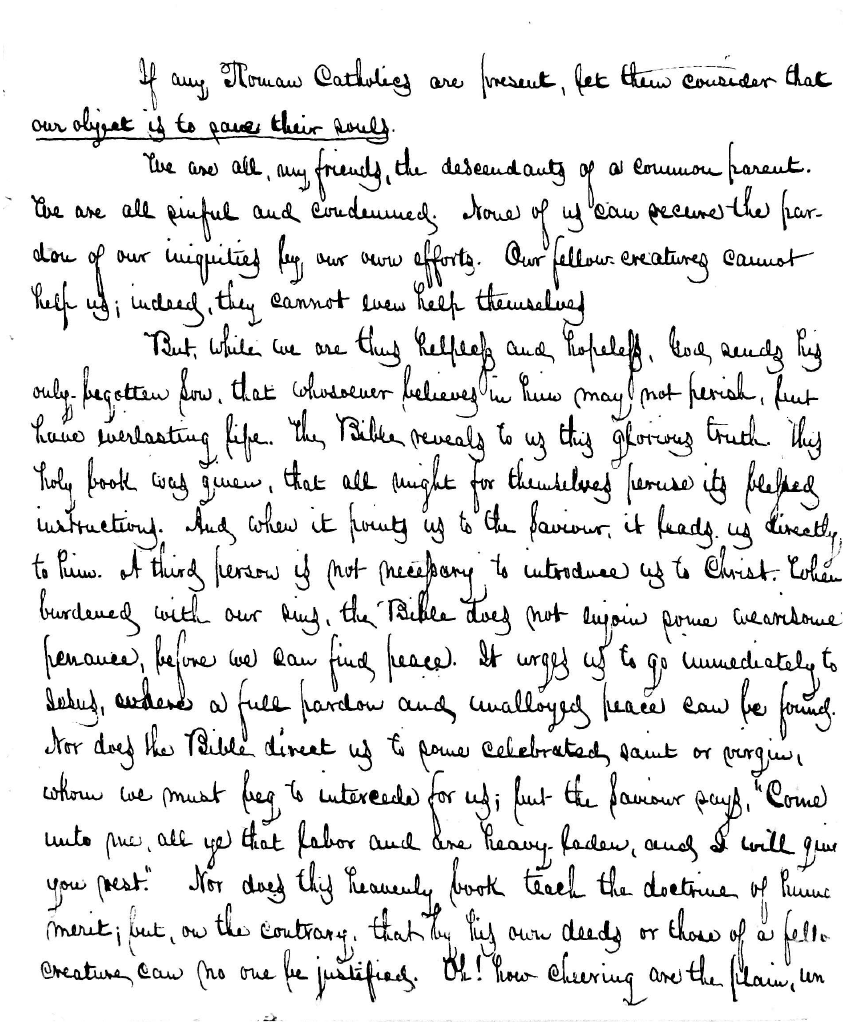
If any Roman Catholics are present, let them consider that our object is to save their souls.
We are all, my friends, the descendants of a common parent. We are all sinful and condemned. None of us can secure the pardon of our iniquities by our own efforts. Our fellow-creatures cannot help us; indeed, they cannot even help themselves.
But, while we are thus helpless and hopeless, God sends his only-begotten Son, that whosoever believes in him may not perish, but have everlasting life. The Bible reveals to us this glorious truth. This holy book was given, that all might for themselves peruse its blessed instructions. And when it points us to the Saviour, it leads us directly to him. A third person is not necessary to introduce us to Christ. When burdened with our sins, the Bible does not enjoin some wearisome penance, before we can find peace. It urges us to go immediately to Sebus, where a full pardon and unalloyed peace can be found. Nor does the Bible direct us to some celebrated saint or virgin, whom we must beg to intercede for us; but the Saviour says, “Come unto me, all ye that labor and are heavy-laden, and I will give you rest.” Nor does this heavenly book teach the doctrine of h… merit; but, on the contrary, that by his own deeds or those of a fellow-creature can no one be justified. Oh! how cheering are the plain, un-
Page 18:
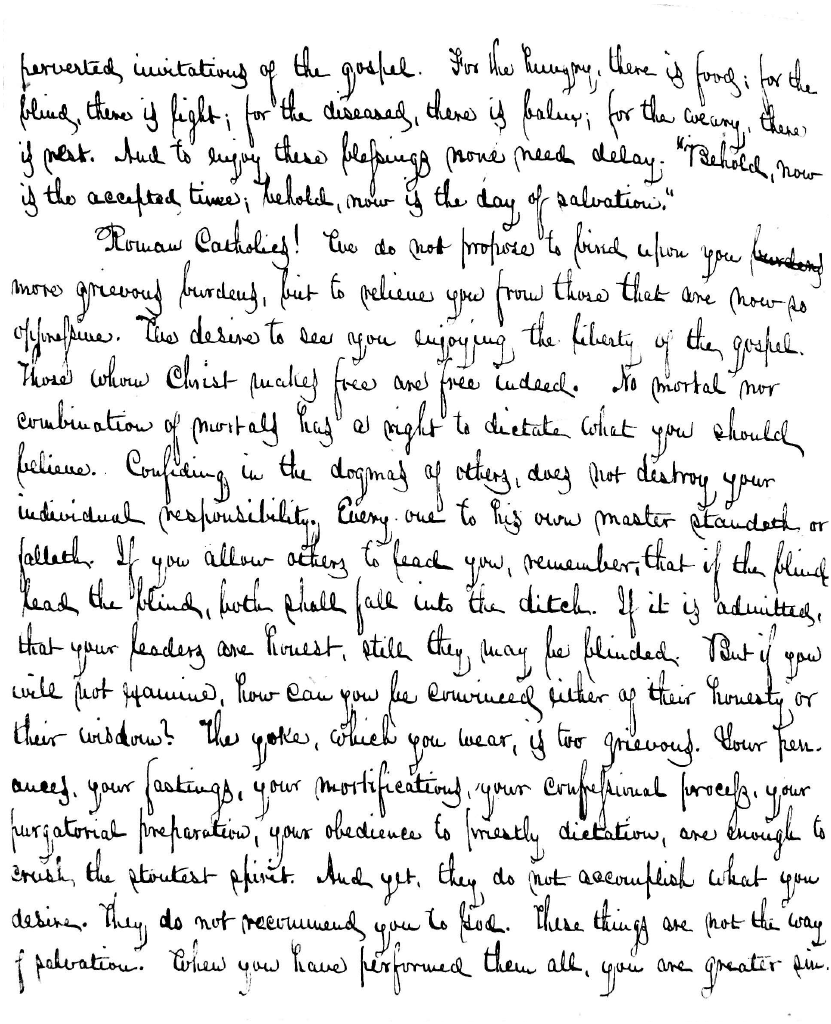
-perverted invitations of the gospel. For the hungry, there is food; for the blind, there is light; for the diseased, there is balm; for the weary, there is rest. And to enjoy these blessings none need delay. “Behold, now is the accepted time; behold, now is the day of salvation.”
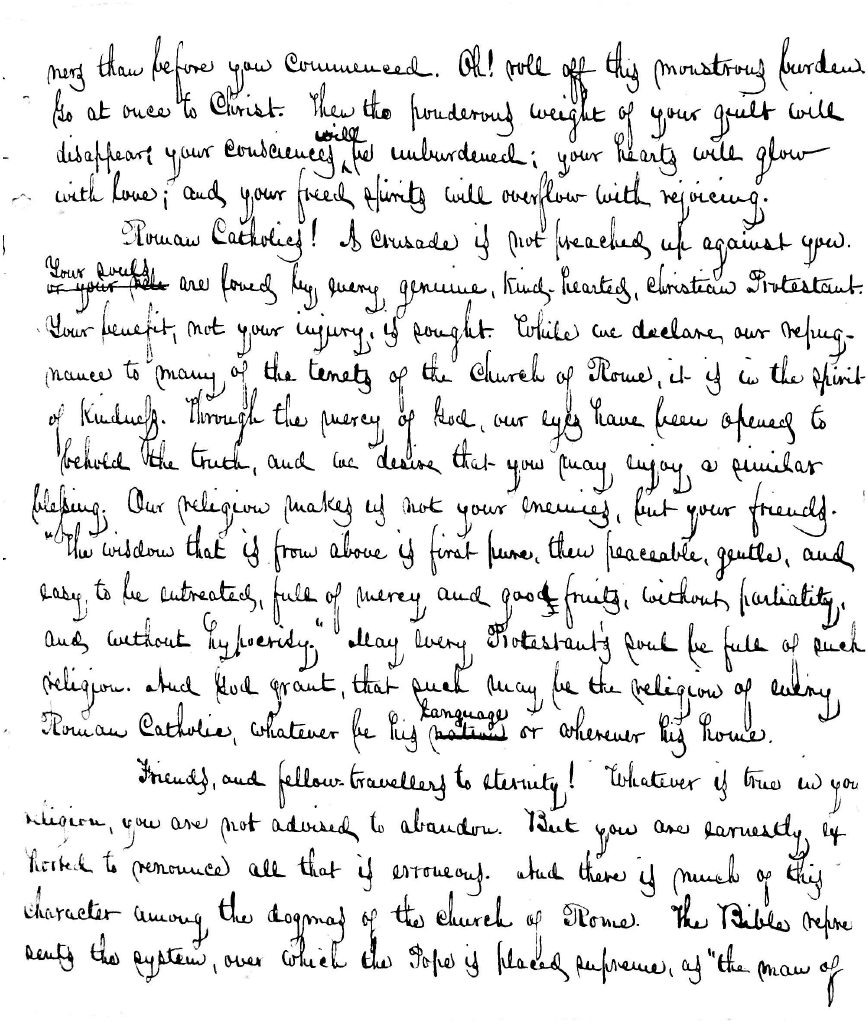
Roman Catholics! we do not propose to bind upon you more grievous burdens, but to relieve you from those that are now so oppressive. We desire to see you enjoying the liberty of the gospel. Those whom Christ makes free are free indeed. No mortal nor combination of mortals has a right to dictate what you should believe. Confiding in the dogmas of others, does not destroy your individual responsibility. Every one to his own master standeth or falleth. If you allow others to lead you, remember, that if the blind lead the blind, both shall fall into the ditch. If it is admitted, that your leaders are honest, still they may be blinded. But if you will not examine, how can you be convinced either of their honesty or their wisdom? The yoke, which you wear, is too grievous Your penances, your fastings, your mortifications, your confessional process, your purgatorial preparation, your obedience to priestly dietitian, are enough to crush the stoutest spirit. And yet, they do not accomplish what you desire. They do not recommend you to God. These things are no the way of salvation. When you have performed them all, you are greater sin-
Page 19:
-ners than before you commenced. Oh! roll off this monstrous burden. Go at once to Christ. Then the ponderous weight of your guilt will disappear; your consciences will be unburdened; your hearts will glow with love; and your freed spirits will overflow with rejoicing.
Roman Catholics! A crusade is not preached up against you. Your souls are loved by every genuine kind-hearted, christian Protestant. Your benefit, not your injury, is sought. While we declare our repugnance to many of the tenets of the church of Rome, it is in the spirit of kindness. Through the mercy of God, our eyes have been opened to behold the truth, and we desire that you may enjoy a similar blessing; our religion makes us not your enemies, but your friends. “The wisdom that is from above is first pure, then peaceable, gentle, and easy to be entreated, full of mercy and good fruits, without partiality, and without hypocrisy.” May every Protestant’s soul be full of such religion. And God grant, that such may be the religion of every Roman Catholic, whatever be his language or wherever his house.
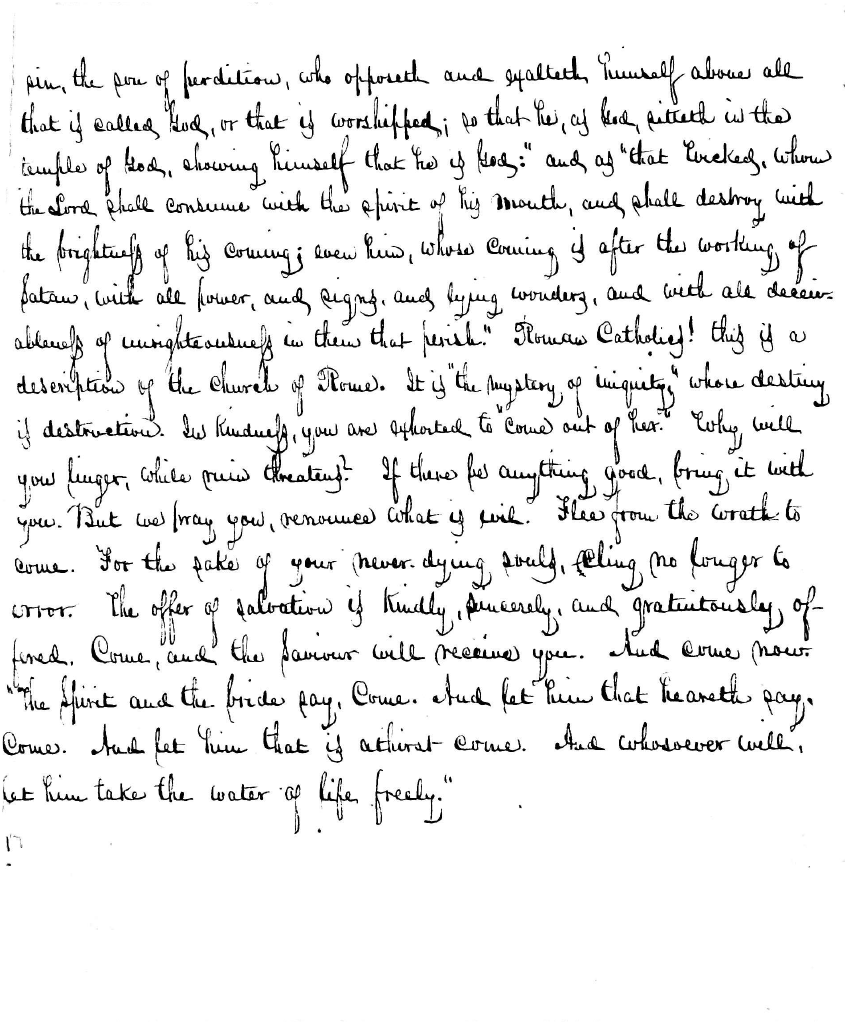
Friends, and fellow-travelers to eternity! Whatever is true in your religion, you are not advised to abandon. But you are earnestly exhorted to renounce all that is erroneous. And there is much of this character among the dogmas of the church of Rome. The Bible represents the system, over which the Pope is placed supreme, as “the man of
Page 20:
sin, the son of perdition, opposed and exalted himself above all that is called God, or that is worshipped; so that he, as God, sitteth in the temple of God, showing himself that he is God:” and as “that wicked, whom the Lord shall consume with the spirit of his mouth, and shall destroy with the brightness of his coming; even him, whose coming is after the working of Satan, with all power, and signs, and lying wonders, and with all deceivableness of unrighteousness in them that perish.” Roman Catholics! this is a description of the Church of Rome. It is “the mystery of iniquity,” whose destiny is destruction. In kindness, you are exhorted to “come out of her.” Why will you linger, while ruin threatens? If there be anything good, bring it with you. But we pray you, renounce what is evil. Flee from the wrath to come. For the sake of your never-dying souls, cling no longer to error. The offer of salvation is kindly, sincerely, and gratuitously offered. Come, and the Saviour will receive you. And come now. “The Spirit and the bride say, Come. And let him that heareth say, Come. And let him that is athirst come. And whosoever will, let him take the water of life freely.”