
Sermons
Acts 16:9
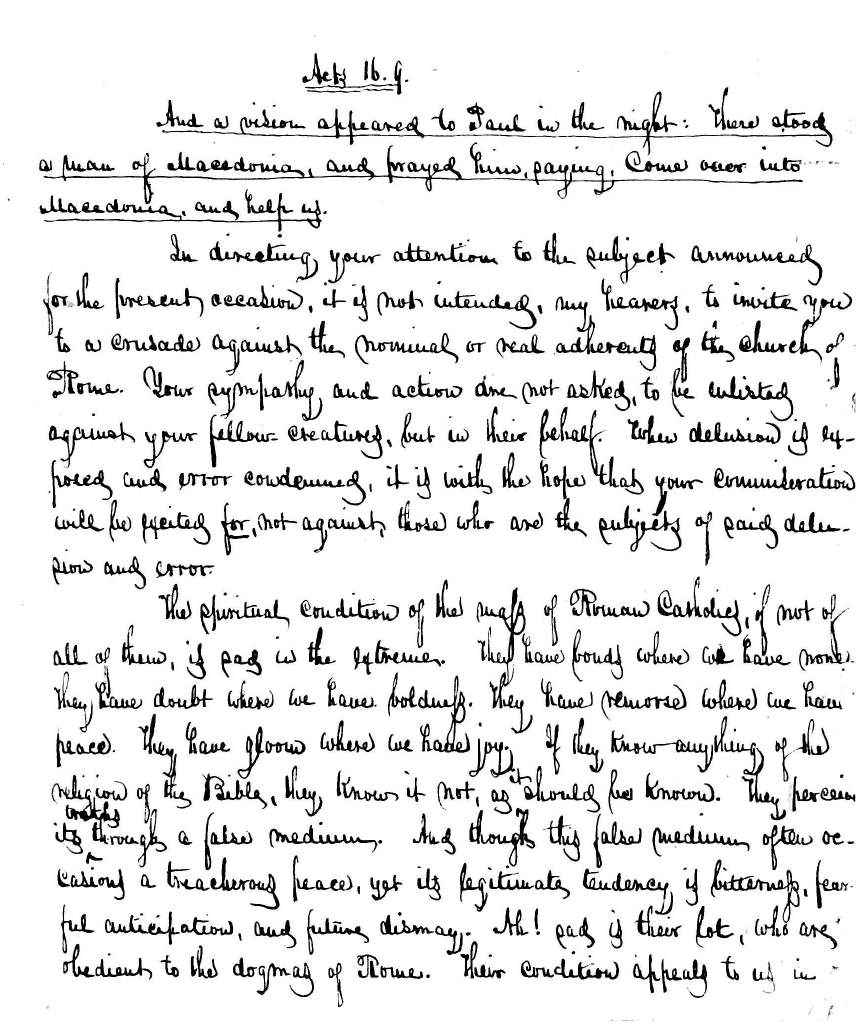
Acts 16:9
And a vision appeared to Paul in the night. There stood a man of Macedonia, and prayed him, saying, Come over into Macedonia, and help us.
In directing your attention to the subject announced for the present occasion, it is not intended, my hearers, to invite you to a crusade against the nominal or real adherents of the church of Rome. Your sympathy and actions are not asked, to be enlisted against your fellow creatures, but in their behalf. When delusion is exposed and error condemned, it is with the hope that your commiseration will be excited for, not against, those who are the subjects of said delusion and error.
The spiritual condition of the mass of Roman Catholics, if not of all of them, is sad in the extreme. They have bounds where we have none. They have doubt where we have boldness. They have remorse where we have peace. They have gloom where we have joy. If they know anything of the religion of the Bible, they know it not as it should be known. They perceive its truths through a false medium. And though this false medium often occasions a treacherous peace, yet its legitimate tendency is bitterness, fearful anticipation, and future dismay. Ah! sad is their lot, who are obedient to the dogmas of Rome. Their condition appeals to us in
No. XI: The Song of the Lamb
Rev. 15.3: The Song of the Lamb.
Strains of music struck upon the ear of the prophet, as there passed before him the visions depicting the future. Joyful spirits, having the harps of God, were praising with celestial melody, and uttering the language of triumph.
Neither in discord nor plaintively was sung the song, which burst upon the ear of the dweller of Patmos. Though his body was on the earth, his spirit was listening to heavenly strains. The songsters were a holy choir. They had once dwelt where the tones of mockery had often been uttered, where they had oft been taunted to sing the song of the Lord, where rejoicing was met with reproach and scorn; but now their conflicts over and the victory secured, they poured forth without fear or restraint the melodious tones, which were in harmony with their exulting hearts.
This happy throng stood upon “a sea of glass mingled with fire.” These figures were doubtless intended to convey the idea of what was grandly rich and extremely beautiful. Probably there…
No. XX: Spiritual Strength
Eph. 3.16: Spiritual Strength
Weakness is often realized by the believer. Thus is it when he feels called upon to resist temptation, to make higher attainments in the divine life, or keep constantly pressing toward the prize. In God alone is his help. Human effort of itself will not give him the victory over his spiritual foes, nor make him more holy, nor enable him to be always engaged in the ways of piety. To meet his condition, the Saviour has died, the Holy Spirit is given, and truth revealed. These furnish the needed aid. Yet, as the believer is a being of intellect, choice and feeling, he is expected to observe what God has enjoined, that he may grow stronger and stronger. What, then, is the course to be pursued, whereby spiritual strength may be acquired?
One part of it is to make renewed visits to the cross of Christ.
Here is the balm, which can give healing to the needy. Vain, are the attempts of the wounded and weak to obtain relief…
No. XIX: The Believer’s Pathway
Prov. 3.6: The Believer’s Pathway
Believers are ever under the watchful eye of their heavenly Father. Through Christ, they have chosen him as their portion. and they are assured, if making him supreme and submitting to his guidance, that he will direct their paths.
Perhaps, however, often their views of his guidance will be erroneous.
Opinions, founded upon appearances, are not always right. This is true, not only in this matter, but in many others. Man is by nature impatient. He often rushes to a conclusion before the facts are fully disclosed. And this tendency has an evil influence upon his practice as well as his opinions. It sometimes prevents him from doing what he is convinced is right and persisting in it, whether popular or unpopular, until the proper results are evident, even if he must pass off the stage of life before they are seen, and in eternity learn that they are produced.
Even Elijah, though still attached to the cause…
Collegiate Speech
Gentlemen: This day closed your collegiate life. For a series of years, you have been engaged in the fourfold object, of treasuring up material in the storehouse of memory; of enlarging, disciplining and refining the powers of the mind; of becoming acquainted with your own capabilities; and of learning how you may employ your native endowments and what you have acquired, with the best effect, upon the circle into which you may hereafter in the providence of God be thrown.
The past has fled at a rapid pace. But yesterday, seemingly, you commenced a regular course of study. When, however, at some future day, you look over the period intervening between this hour and that to which you will then have arrived, time will appear to have increased in the rapidity of its flight. And should you remain in this world, until age shall furrow your brow, you will be more and more impressed with the thought, that life is but a span; and that the figure, which represents our existence here as flying with the speed of the arrow, is an expression full of force and truth.
To detain you now with repeating the maxims, which those having charge of your education have often endeavored to impress upon the mind, would be inexpedient. Neither the time nor the occasion will justify the exhibition of such a minute detail of principles, as would be desirable so that no really important point be overlooked, and as would be necessary to approach even to the borders of doing justice to such a laborious and responsible effort.
Instead of such an attempt, let me fasten in your minds the thought and awaken the purpose, to aim at excellence in every worthy pursuit in which you are called upon to engage.
No obligation exists, binding us to enter upon any but worthy pursuits…
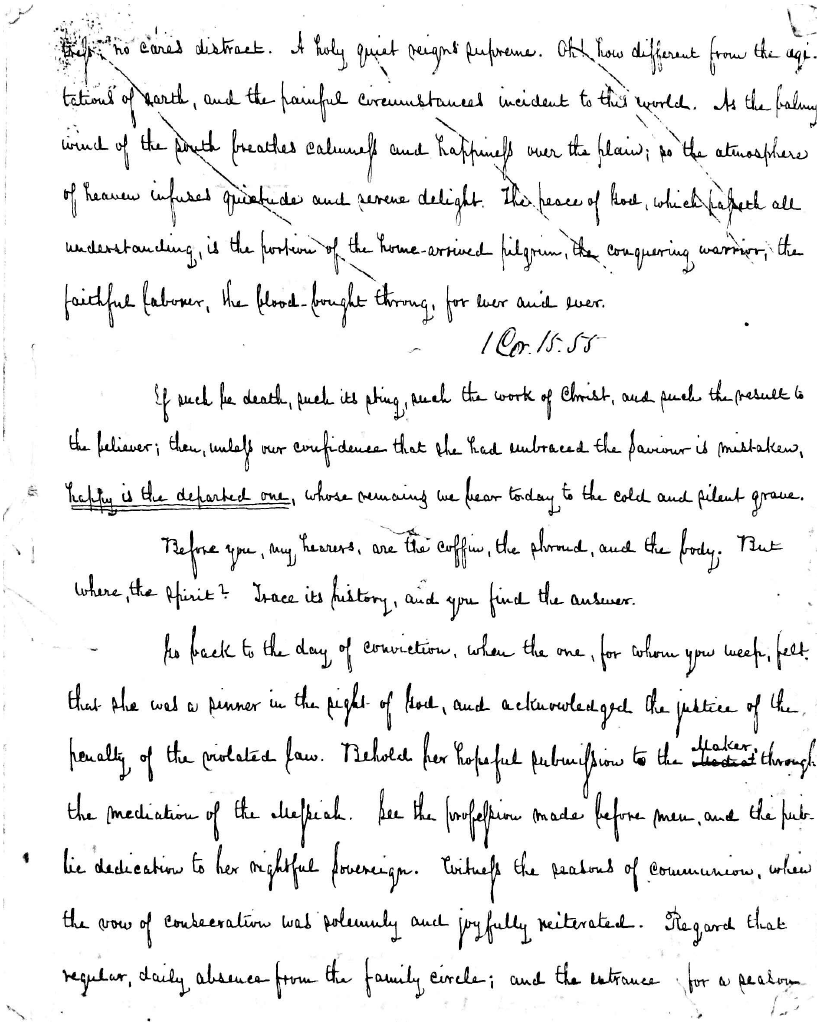
1 Cor 15:55
If such be death, such its sting, and such the work of Christ, and such the result to the believer; then, unless our confidence that she had embraced the Saviour is mistaken, happy is the departed one, whose remains we bear today to the cold and silent grave.
Before you, my hearers, are the coffin, the shroud, and the body. But where, the spirit? Trace its history, and you find the answer.
Go back to the day of conviction, when the one, for whom you weep, felt that she was a sinner in the sight of God, and acknowledged the justice of the penalty of the violated law. Behold her hopeful submission to the Maker, through the mediation of the Messiah. See the profession made before men, and the public dedication to her rightful Sovereign. Witness the seasons of communion, when the vow of consecration was solemnly and joyfully reiterated. Regard that regular, daily absence from the family circle; and the entrance for a season…
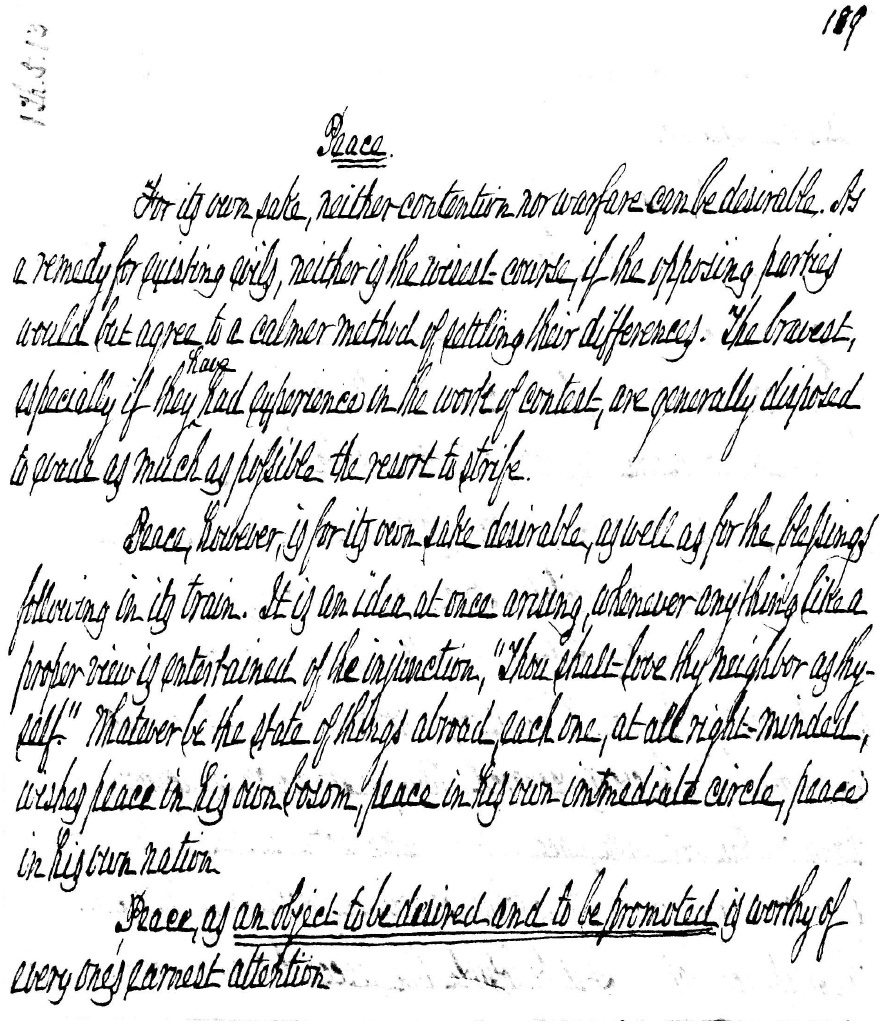
Peace
For its own sake, neither contention nor warfare can be desirable. As a remedy for existing evils, neither is the wisest course, if the opposing parties would but agree to a calmer method of settling their differences. The bravest, especially if they have had experience in the work of contest, are generally disposed to evade as much as possible the resort to strife.
Peace, however, is for its own sake desirable, as well as for the blessings following in its train. It is an idea at once arising, whenever anything like a proper view is entertained of the injunction, "Thou shalt love thy neighbor as thyself." Whatever be the state of things abroad, each one, at all right-minded, wishes peace in his own bosom, peace in his own immediate circle, peace in his own nation.
Peace, as an object to be desired and to be promoted is worthy of every one’s earnest attention…
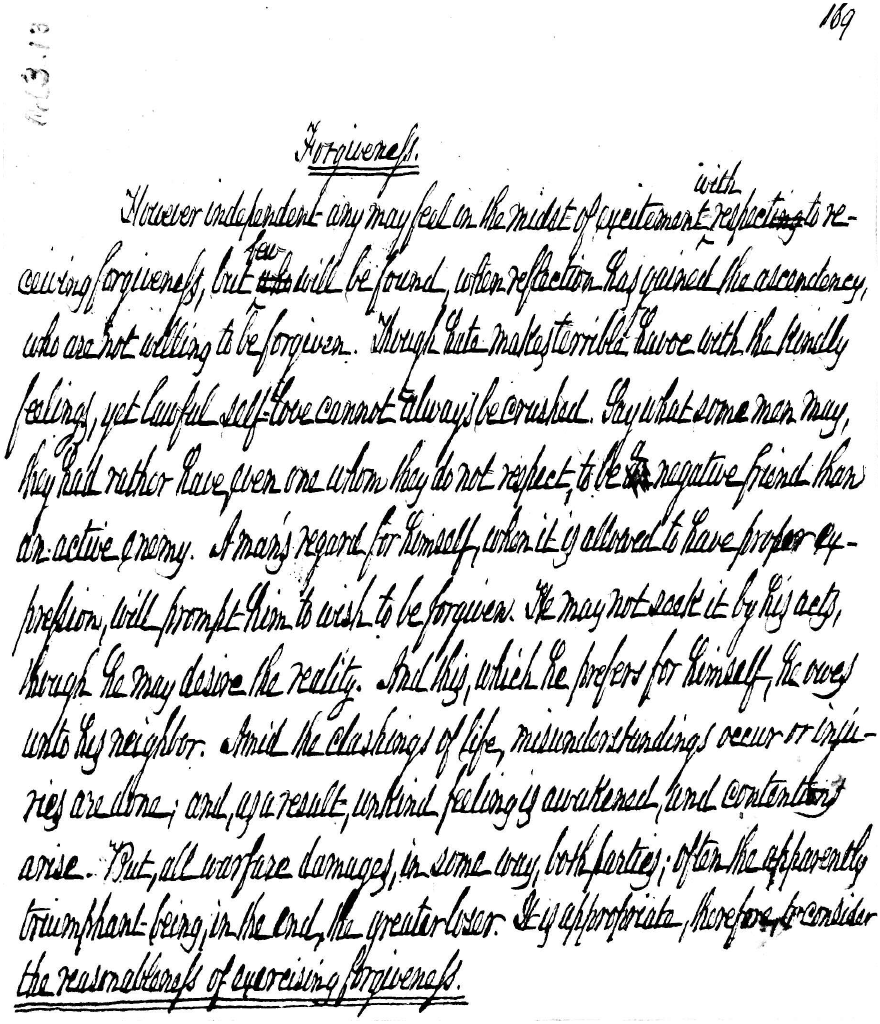
Forgiveness
However independent any may feel in the midst of excitement with respect to receiving forgiveness, but few will be found, when reflection has gained the ascendency, who are not willing to be forgiven. Though hate makes terrible havoc with the kindly feelings, yet lawful self-love cannot always be crushed. Say what some men may, they had rather have, even one whom they do not respect, to be a negative friend than an active enemy. A man's regard for himself, when it is allowed to have proper expression, will prompt him to wish to be forgiven. He may not seek it by his acts, though he may desire the reality. And this, which he prefers for himself, he owes unto his neighbor. Amid the clashings of life, misunderstandings occur or injuries are done; and, as a result, unkind feeling is awakened, and contentions arise. But, all warfare damages, in some way, both parties; often the apparently triumphant being, in the end, the greater loser. It is appropriate, therefore, to consider the reasonableness of exercising forgiveness…
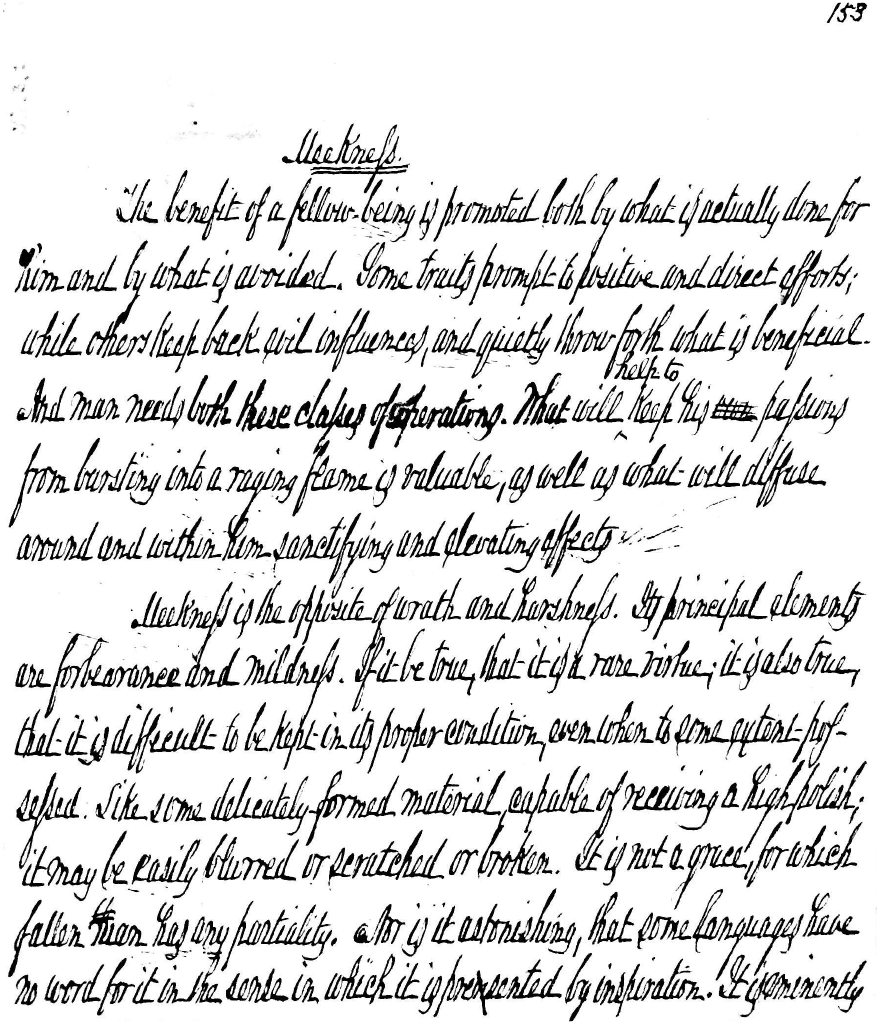
Meekness
The benefit of a fellow-being is promoted both by what is actually done for him and by what is avoided. Some traits prompt to positive and direct efforts; while others keep back evil influences, and quietly throw forth what is beneficial. And man needs both these classes of operations. What will keep his passions from bursting into a raging flame is valuable, as well as what will diffuse around and within him sanctifying and elevating effects.
Meekness is the opposite of wrath and harshness. Its principal elements are forbearance and mildness. If it be true, that it is a rare virtue; it is also true, that it is difficult to be kept in its proper condition, even when to some extent possessed. Like some delicately formed material capable of receiving a high polish; it may be easily blurred or scratched or broken. It is not a grace, for which fallen man has any partiality. Nor is it astonishing, that some languages have no word for it in the sense in which it is represented by inspiration. It is eminently…
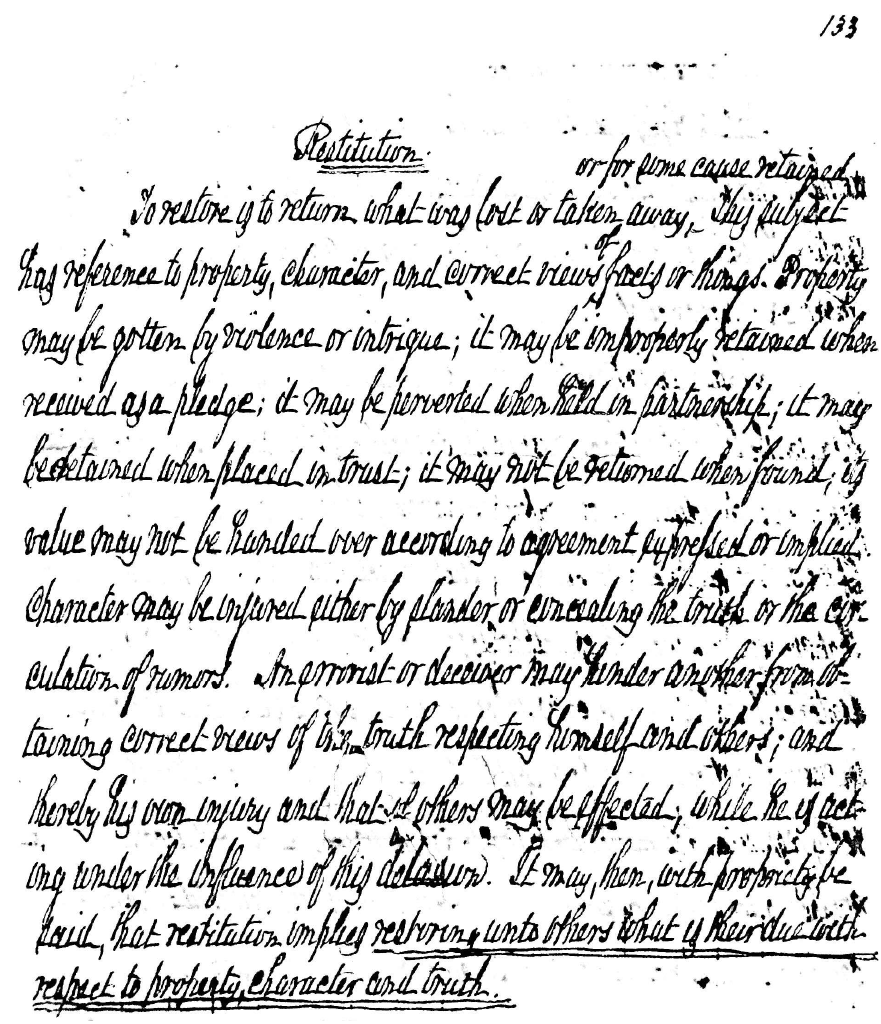
Restitution
To restore is to return what was lost or taken away, or for some cause retained. This justly has reference to property, character, and correct views of facts or things. Property may be gotten by violence or intrigue; it may be improperly retained when received as a pledge; it may be perverted when held in partnership; it may be detained when placed in trust; it may not be returned when found; its value may not be handed over according to agreement expressed or implied. Character may be injured either by slander or concealing the truth or the circulation of rumors. An errorist or deceiver may hinder another from obtaining correct views of the truth respecting himself and others; and thereby his own injury and that of others may be affected, while he is acting under the influence of this delusion. It may, then, with propriety be said, that restitution implies restoring unto others what is their due with respect to property, character and truth…
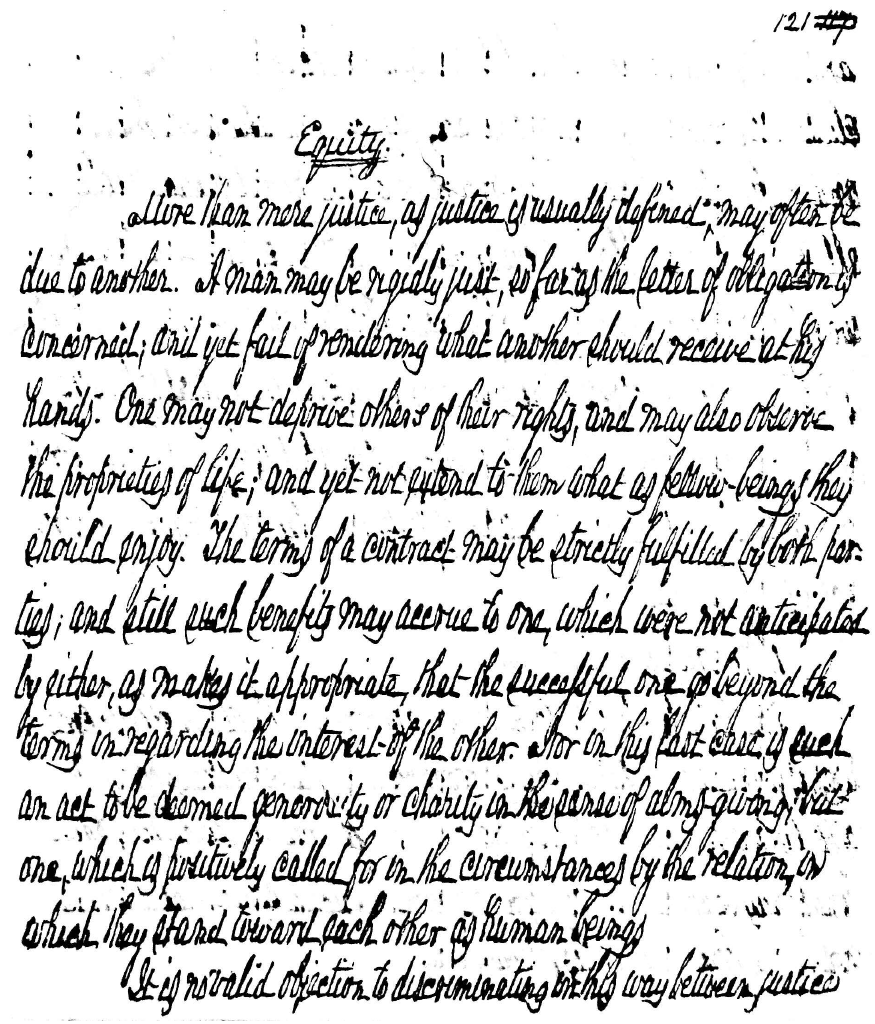
Equity
More than mere justice, as justice is usually defined, may often be due to another. A man may be rigidly just, so far as the letter of obligation is concerned; and yet fail of rendering what another should receive at his hands. One may not deprive others of their rights, and may also observe the proprieties of life; and yet not extend to them what as fellow-being they should enjoy. The terms of a contract may be strictly fulfilled by both parties; and still such benefits may accrue to one, which were not anticipated by either, as makes it appropriate, that the successful one go beyond the terms in regarding the interest of the other. Nor in this last case is such an act to be deemed generosity or charity in the sense of alms-giving, but one, which is positively called for in the circumstances by the relation, in which they stand toward each other as human beings.
It is no valid objection to discriminating in this way only between justice…
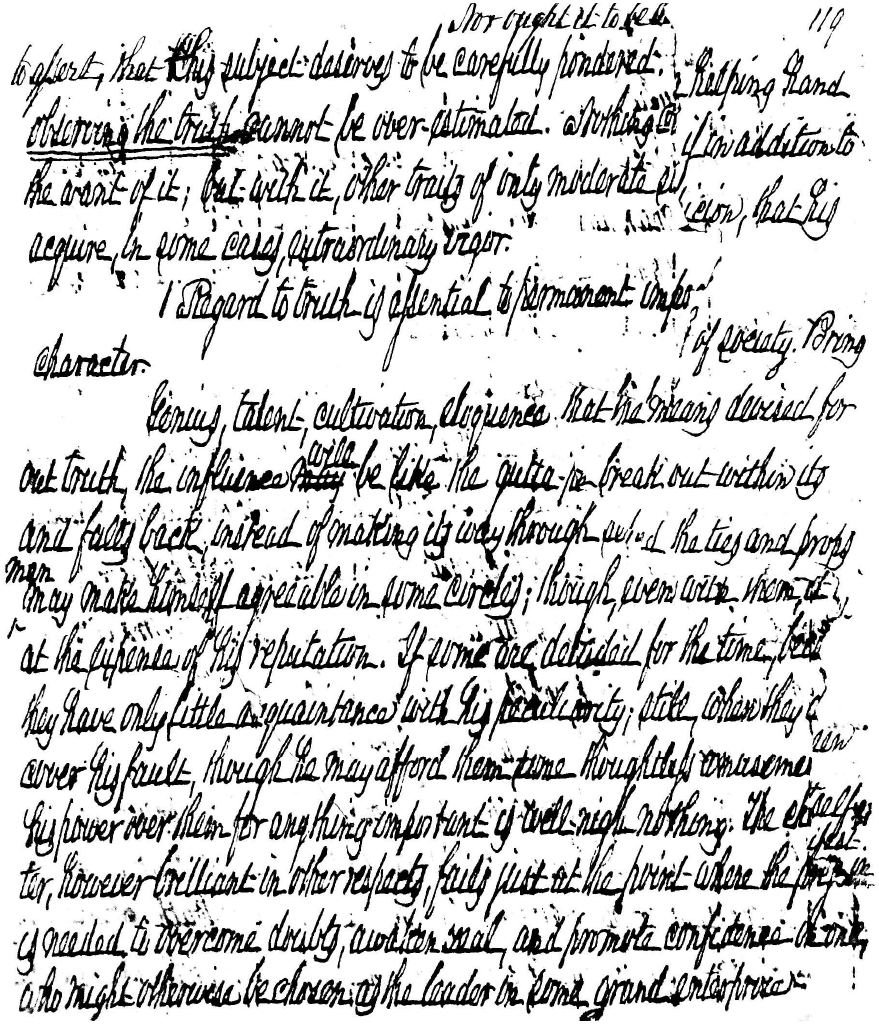
Regard to Truth
to assert, that this subject deserves to be carefully pondered. … Nor ought it to be … observing the truth cannot be over-estimated. Nothing … the want of it; but with it, other traits of only moderate … acquire, in some cases extraordinary rigor.
1. Regard to truth is essential to permanent impo- ... character.
Genius, talent, cultivation, eloquence may be po- … out truth, the influence will be like the quite … and falls back, instead of making its way through … Man may make himself agreeable in some circles; though even with them, it … at the expense of his reputation. If some are deluded for the time, be- … they have only little acquaintance with his peculiarity, still when they … cover his fault, though he may afford them some thoughtless amuseme- … his power over them for anything important is well-nigh nothing. The … -ter, however brilliant in other respects, fails just at the point where the … is needed to overcome doubts, awaken zeal, and promote confidence in one, who might otherwise be chosen as the leader in some grand enterprise…
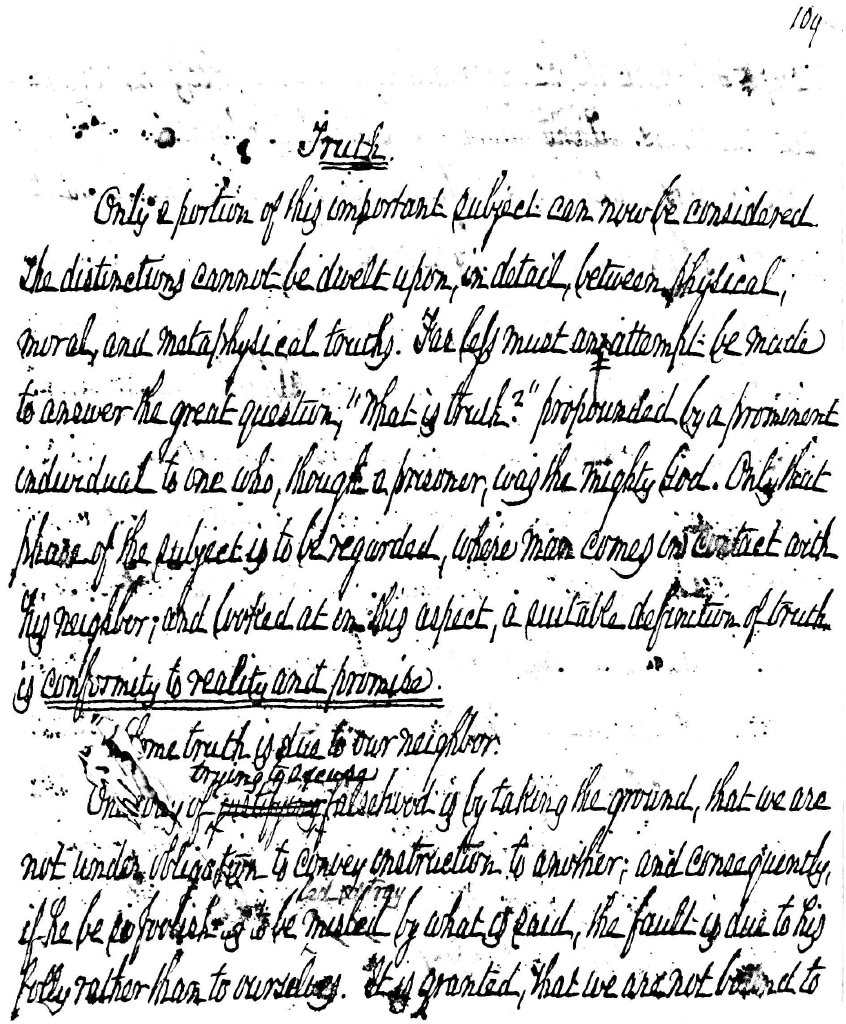
Truth
Only a portion of this important subject can now be considered. The distinctions cannot be dwelt upon, in detail, between physical, moral, and metaphysical truths. Far less must an attempt be made to answer the great question, “What is truth?” propounded by a prominent individual to one who, though a prisoner, was the mighty Lord. Only that phase of the subject is to be regarded, where man comes in contact with his neighbor; and looked at in this aspect, a suitable definition of truth is conformity to reality and promise.
… Some truth is due to our neighbor.
One … of trying to excuse falsehood is by taking the ground, that we are not under obligation to convey instruction to another; and consequently, if he be so foolish as to be misled by what is said, the fault is due to his folly rather than to ourselves. It is granted, that we are not bound to…
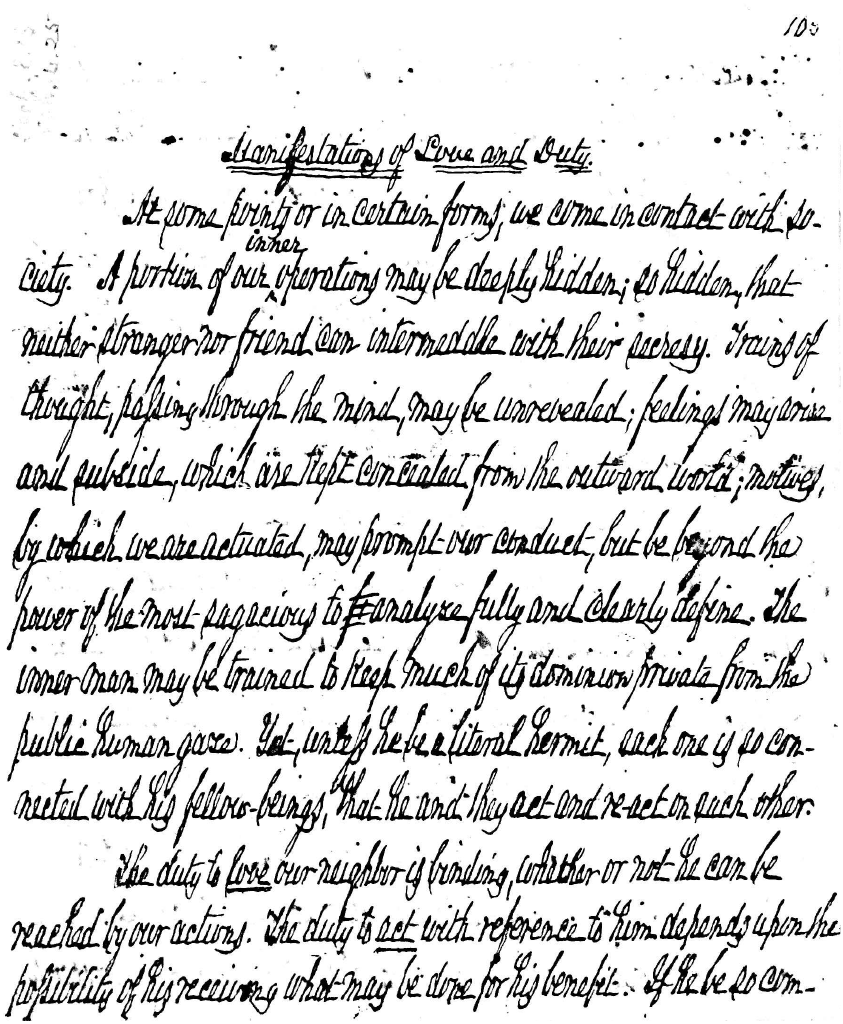
Manifestations of Love and Duty
At some points or in certain forms, we come in contact with society. A portion of our inner operations may be deeply hidden; so hidden, that neither stranger nor friends can intermeddle with their secrecy. Trains of thought, passing through the mind, may be unrevealed; feelings may arise and subside, which are tight concealed from the outward world; motives, by which we are actuated, may prompt our conduct, but be beyond the power of the most sagacious to analyze fully and clearly define. The inner man may be trained to keep much of its dominion private from the public human gaze. Yet, unless he be a literal hermit, each one is so connected with his fellow beings, that he and they act and re-act on each other.
The duty to love our neighbor is binding, whether or not he can be reached by our actions. The duty to act with reference to him and depends upon the possibility of his receiving what may be done for his benefit. If he be so com-…
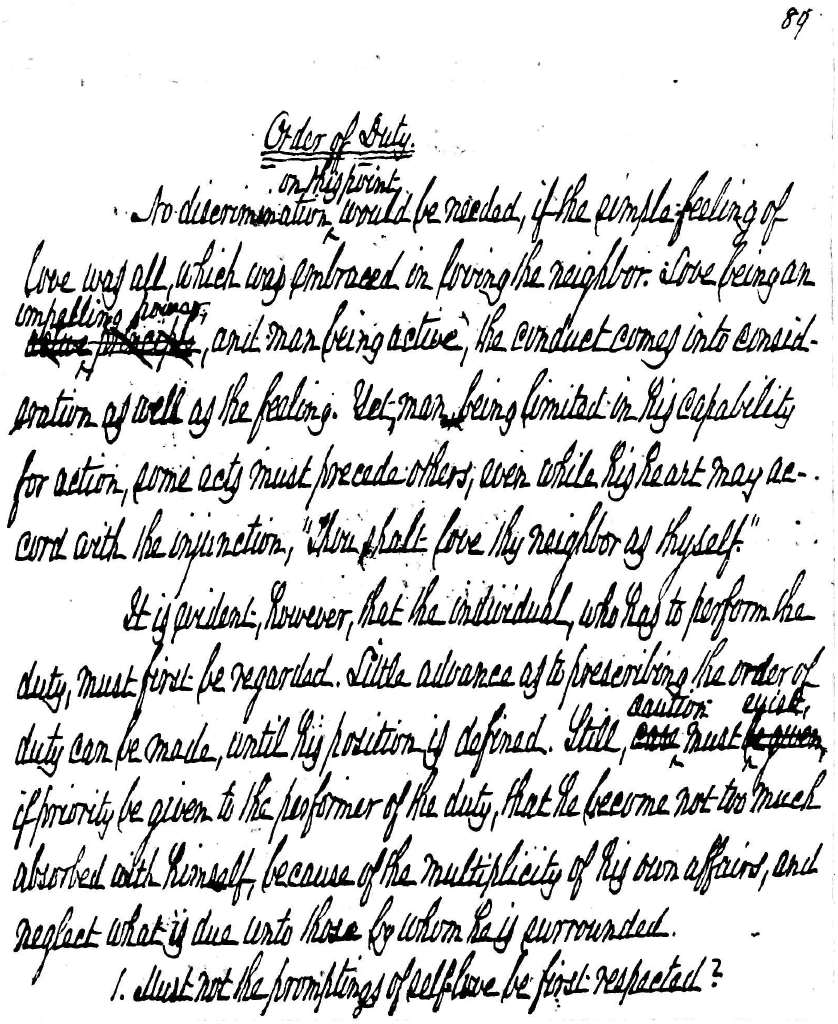
Order of Duty
No discrimination on this point would be needed, if the simple feeling of love was all which was embraced in loving the neighbor. Love being an impelling power, and man being active, the conduct comes into consideration as well as the feeling. Yet, man being limited in his capability for action, some acts must precede others, even while his heart may accord with the injunction, “Thou shalt love thy neighbor as thyself.”
It is evident, however, that he, an individual, who has to perform the duty, must first be regarded. Little advance as to prescribing the order of duty can be made, until his position is defined. Still, caution must exist, if priority be given to the performer of the duty, that he become not so much absorbed with himself, because of the multiplicity of his own affairs, and neglect what is due unto those by whom he is surrounded.
1. Must not the promptings of self-love be first respected?…
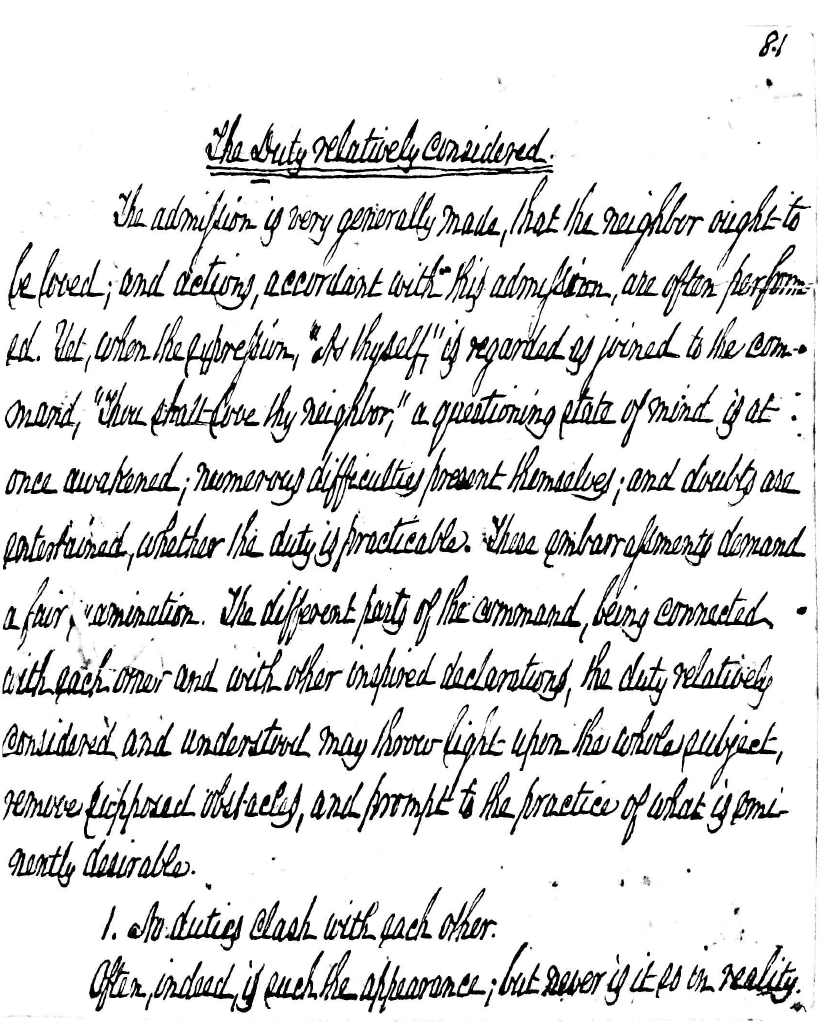
The Duty Relatively Considered
The admission is very generally made, that the neighbor ought to be loved; and actions, accordant with this admission, are often performed. Yet, when the expression “as himself” is regarded as joined to the command, “Thou shalt love thy neighbor,” a questioning state of mind is at once awakened; numerous difficulties present themselves; and doubts are entertained, whether the duty is practicable. These embarrassments demand a fair examination. The different parts of the command, being connected with each other and with other inspired declarations, the duty relatively considered and understood may throw light upon the whole subject 1 remove supposed obstacles, and prompt to the practice of what is eminently desirable.
1. As duties clash with each other.
Often, indeed, is such the appearance; but never is it as in reality…
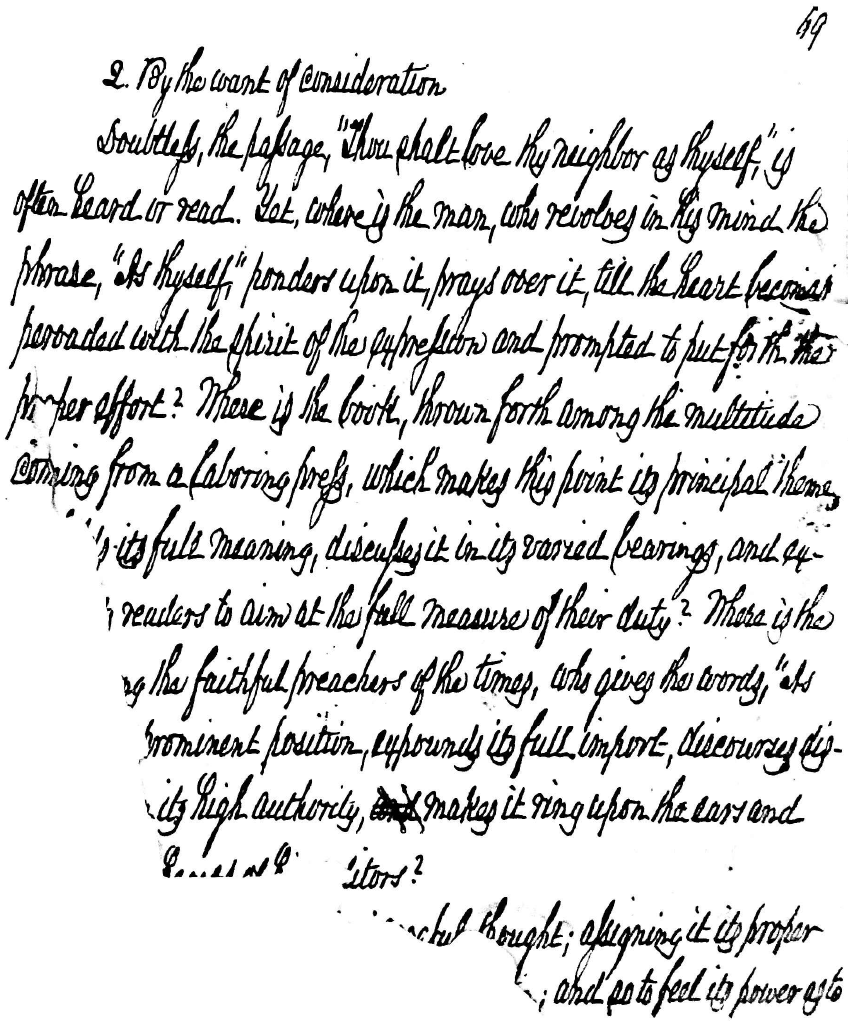
By the Want of Consideration
Doubtless, the passage, “Thou shalt love thy neighbor as thyself,” is often heard or read. Yet, where is the man, who resolves in his mind the phrase, “As thyself,” ponders upon it, prays over it, till the heart becomes pervaded with the spirit of the expression and prompted to put forth the proper effort? Where is the book, thrown forth among the multitude coming from a laboring press, which makes this point its principle theme, … its full meaning, displays it in its varied bearings, and ex- ... readers to aim at the full measure of their duty? Where is the … the faithful preachers of the times, who gives the words, “As … prominent position, expounds its full import, discovers dis- ... its high authority, makes it ring upon the ears and … -tors? ... thought; assigning it its proper … and so to feel its power as to…