Restitution
Page 1:
Restitution
To restore is to return what was lost or taken away, or for some cause retained. This justly has reference to property, character, and correct views of facts or things. Property may be gotten by violence or intrigue; it may be improperly retained when received as a pledge; it may be perverted when held in partnership; it may be detained when placed in trust; it may not be returned when found; its value may not be handed over according to agreement expressed or implied. Character may be injured either by slander or concealing the truth or the circulation of rumors. An errorist or deceiver may hinder another from obtaining correct views of the truth respecting himself and others; and thereby his own injury and that of others may be affected, while he is acting under the influence of this delusion. It may, then, with propriety be said, that restitution implies restoring unto others what is their due with respect to property, character and truth.
Page 2:
1. On the ground of justice
Certain rights are recognized by the law of nature. Regard for them lies at the foundation of society. And as necessary is their observance, that the rudest nations have felt their propriety, and incorporated among their ideas of government an observance of these essential elements.
Linked in intimately, therefore, is this subject with justice itself. What, then, in the light of justice, must be the character of that act, which takes from an individual, in an improper manner, what is his rightful possession? If we do not hesitate in pronouncing such an act criminal, what shall be said of that course of conduct, which withholds from another what is his due? If the same sentence, in the main, be passed in these cases, what is the next step to be taken? The answer, in view of justice, cannot be a doubtful one. To be just in the matter, it is assuredly requisite, that what was improperly taken or kept be restored, together with a compensation for the loss suffered during the time it was withheld; or, such an equivalent be extended as will be satisfactory to the injured party.
Page 3:
If it be said, that in some instances it might be impossible thus to do, either because of the nature of the thing taken or withheld, or because of the present inability of the individual doing the injury; still, though this be true, it does not alter what is right in the matter. Pure justice is one thing; our ability fully to meet its claims, when we have trampled upon its requisitions, is another. A man, who by his extravagance, thoughtlessness or idleness is unable to meet his creditor’s demand, which he solemnly pledged should be met on a certain day, is not thereby relieved from the claim. So, in the matter now considered. The language of justice is plain. It unequivocally bids the injurious one to restore; if the identical thing cannot be returned, it calls for an equivalent; if neither can be presented, while the claim of justice is not thereby abrogated, still it is proper, that some suitable acknowledgement of the fact be made.
2. In view of the rule of doing unto others as we would have them do unto us.
These words make an appeal, which is well-nigh irresistible; so far, at least, as an admission of the correctness of the rule is concerned. It addresses
Page 4:
itself to man in such a way, that he can with great difficulty entertain the feeling of self-respect, unless he acknowledges its propriety and excellence. Whatever may be his practice, he will be likely to admit the worthiness of the principle.
What is needed to feel its force is to place ourselves, in imagination, in another’s situation. Thereby we learn what we would wish to have done, were that our real condition. We bring in our own verdict. We set up our own standard of duty. If our decision is made intelligently as well as feelingly, we have discovered the kind and measure of conduct, which should guide us in the treatment of others.
Apply the rule now acquired to the subject of restitution. If we were the injured party, what would we wish of those by whom we felt ourselves injured? If restoring what was ours or an equivalent for the loss were possible, our own minds would naturally make such a demand, whether we expressed our convictions publicly or kept them concealed within our own bosoms. And if we believed, that both were impossible, in view of the known or apparent circumstances of the one who had injured us, his acknowledgment, that inability was the sole reason why
Page 5:
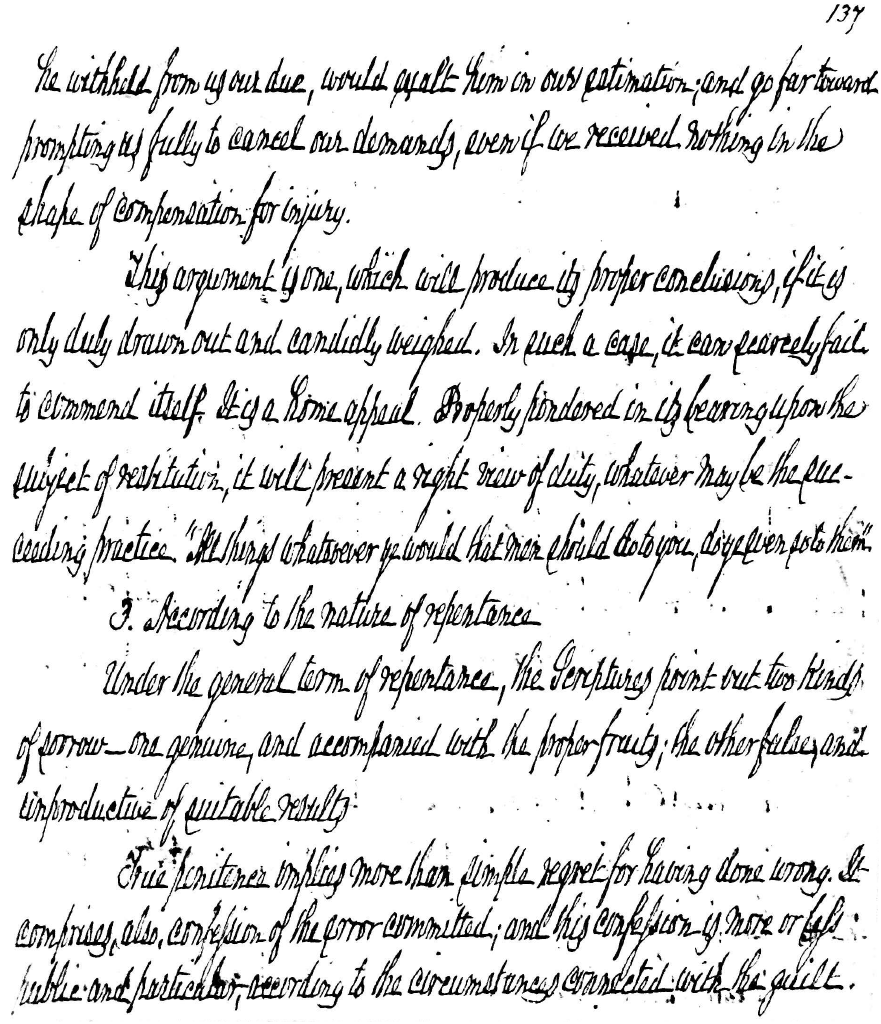
he withheld from us our due, would exalt him in our estimation, and go far toward prompting us fully to cancel our demands, even if we received nothing in the shape of compensation for injury.
This argument is one, which will produce its proper conclusion, if it is only duly drawn out and candidly weighed. In such a case, it can scarcely fail to commend itself. It is a home appeal. Properly pondered in its bearing upon the subject of restitution, it will present a right view of duty, whatever may be the succeeding practice. “All things whatsoever ye would that men should do to you, do ye even so to them.”
3. According to the nature of repentance.
Under the general term of repentance, the Scriptures point out two kinds of sorrow - one genuine, and accompanied with its proper fruits; the other false, and unproductive of suitable results.
True penitence implies more than simple regret for having done wrong. It comprises, also, confession of the error committed; and this confession is more or less public and particular, according to the circumstances connected with the guilt.
Page 6:
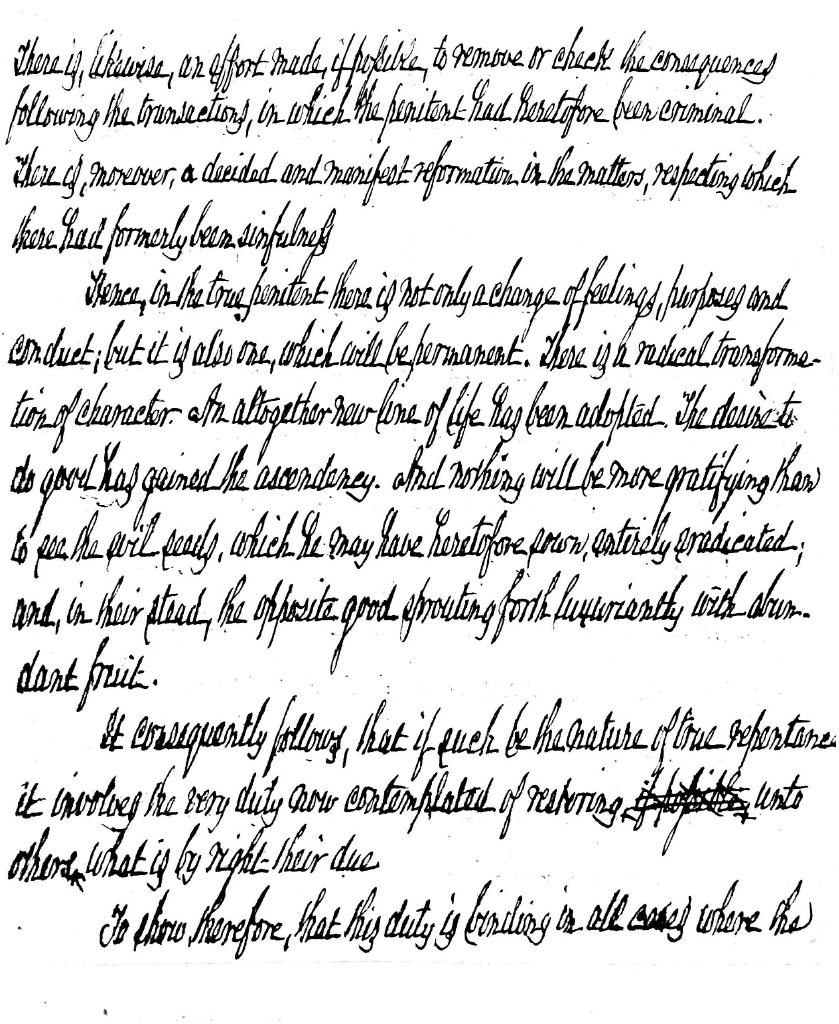
There is, likewise, an effort made, if possible, to remove or check the consequences following the transaction, in which the penitent had heretofore been criminal. There is, moreover, a decided and manifest reformation in the matters, respecting which there had formerly been sinfulness.
Hence, in the true penitent there is not only a change of feelings, purposes and conduct, but it is also one, which will be permanent. There is a radical transformation of character. An altogether new line of life has been adopted. The desire to do good has gained the ascendency. And nothing will be more gratifying than to see the evil seeds, which he may have heretofore sown, entirely eradicated; and, in their stead, the opposite good sprouting forth abundantly with abundant fruit.
It consequently follows, that if such be the nature of true repentance, it involves the very duty now contemplated of restoring unto others what is by right their due.
To show therefore, that this duty is binding in all cases where the
Page 7:
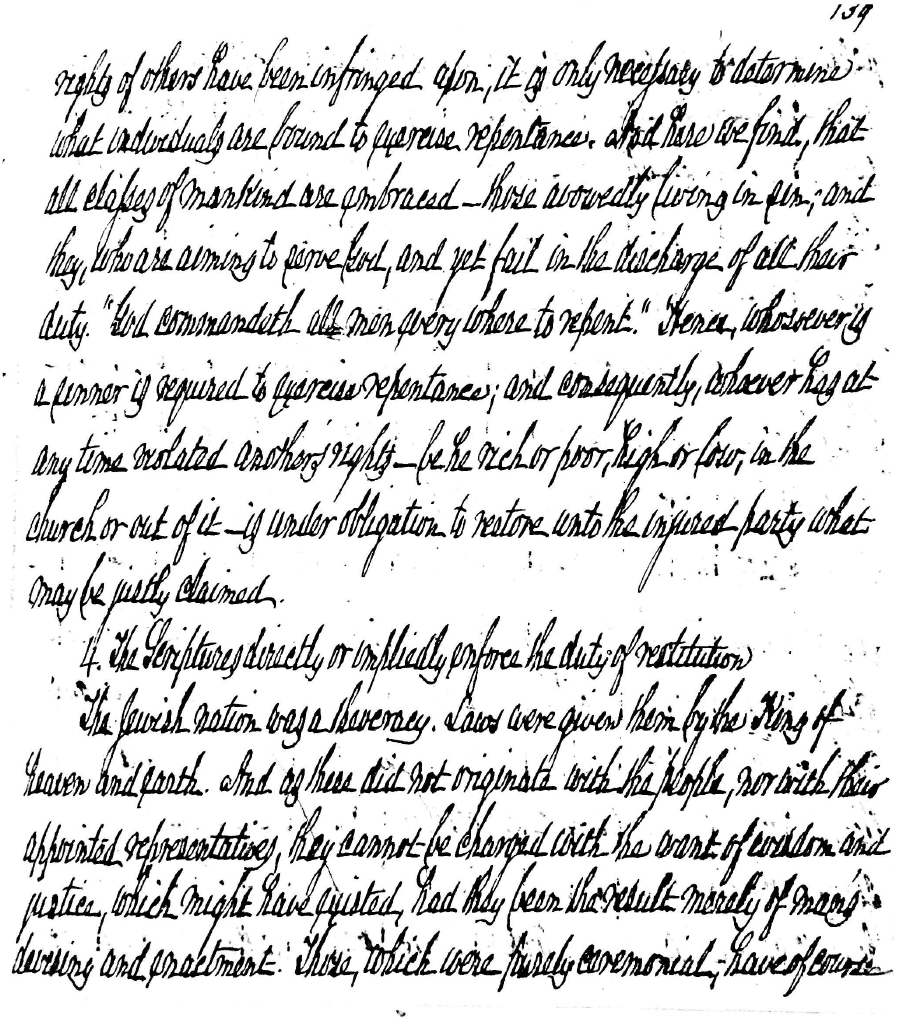
rights of others have been infringed upon, it is only necessary to determine what individuals are bound to exercise repentance. And here we find, that all classes of mankind are embraced - those avowedly living in sin; and they, who are aiming to serve God, and yet fail in the discharge of all their duty. “God commandeth all men every where to repent.” Hence, whosoever is a sinner is required to exercise repentance; and consequently, whoever has at any time violated another’s rights - be he rich or poor, high or low, in the church or out of it - is under obligation to restore unto the injured party what may be justly claimed.
4. The Scriptures directly or impliedly enforce the duty of restitution.
The Jewish nation was a theocracy. Laws were given them by the King of heaven and earth. And as these did not originate with the people, nor with their appointed representatives, they cannot be charged with the want of wisdom and justice, which might have existed, had they been the result merely of man’s devising and enactment. Those, which were truly ceremonial, have of course
Page 8:
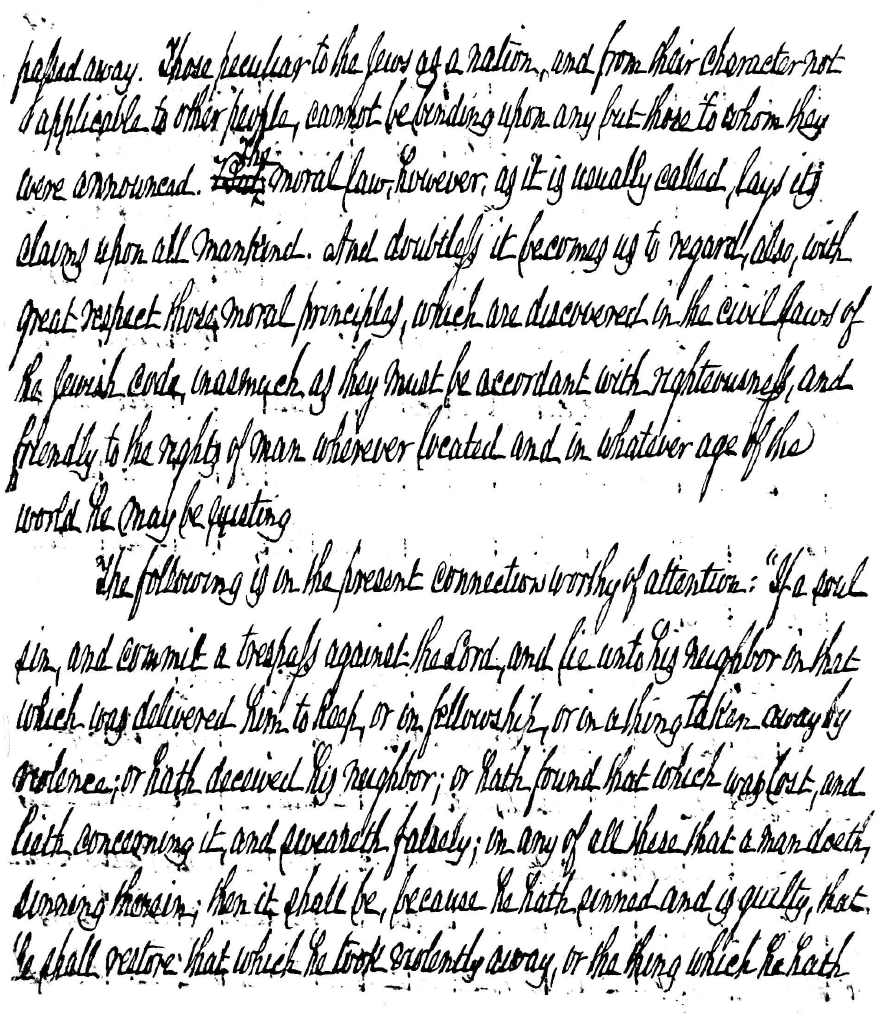
passed away. Those peculiar to the Jews as a nation, and from their character not applicable to other people, cannot be binding upon any but those to whom they were announced. The moral law, however, as it is usually called, lays its claims upon all mankind. And doubtless it becomes us to regard, also, with great respect those moral principles, which are discovered in the civil laws of the Jewish code, inasmuch as they must be accordant with righteousness and friendly to the rights of man wherever located, and in whatever age of this world he may be existing.
The following is in the present connection worthy of attention: “If a soul sin, and commit a trespass against the Lord, and lie unto his neighbor in that which was delivered him to keep, or in fellowship, or in a thing taken away by violence, or hath deceived his neighbor; or hath found that which was lost, and lieth concerning it, and sweareth falsely; in any of all these that a man doeth, sinning therein; then it shall be, because he hath sinned and is guilty, that he shall restore that which he took violently away, or the thing which he hath
Page 9:
deceitfully gotten, or that which was delivered him to keep, or the lost thing which he found; or all that about which he hath sworn falsely; he shall even restore it in the principal, and shall add the fifth part more thereto, and give it unto him to whom it pertaineth.”
By this ordinance, the duty of restitution among the Jews was clearly exhibited. Such regulations were important in their influence upon society. They were based upon justice. And though to us the appointment may seem arbitrary, designating the “fifth part” to be added to the principal; yet some such specification was necessary, inasmuch as the Jew was precluded from receiving usury or interest from his Jewish brethren.
Nor was the statute a dead letter. Its authority was acknowledged, for Samuel is represented as saying, “Behold, here I am: witness against me before the Lord and before his anointed: whose ox or whose ass I have taken? or whom have I defrauded? whom have I oppressed? or of whose hand have I received any bribe to blind mine eyes therewith? and I will restore it you.” When …
Page 10:
captives were recovering from the Babylonish bondage, Jeremiah required, that they should comply with the principle of restitution; for it appears, that some had taken advantage of others’ necessities. And even in the degenerate days when Zaccheus lived, he, at least, felt the propriety of the duty, and at once carried out the idea of restoring in a four-fold measure.
Admitting, that these men were Jews, and that they acted according to a civil statute; still, it may be asked, why was there such a statute? Was … wrong? Was it not for the good of society? If not wrong, and if for the benefit of the community, let it be placed for the present upon no higher ground than the welfare of mankind. Then, if the tie binding man to his fellow-man places us under any moral obligation, just in proportion to the good effects of observing the duty of restitution is man under obligation to make it a rule of conduct. Let the duty be neglected, and the value … its performance is so much subtracted from the sum of human wel-...-e. On the ground, therefore, of the good which may be effected by its
Page 11:
observance, even if there were no other reasons, it may be urged, that where injury has been done restitution is binding.
5. Peace of mind shows the propriety of this duty.
It will doubtless be admitted, that if an approving conscience can be consistently with truth obtained, each one ought to secure such an acquisition to keep the mind unnecessarily in a turbulent state, and subject at any moment to be the prey of remorse, is to violate what we owe ourselves as moral and accountable beings. Every one possessed of an immortal spirit is bound to make himself both holy and happy.
Yet, suppose an instance exists, where the duty now advocated ought to be performed. For aught that appears to the contrary, at any instant truth may dash conviction upon the mind, that an injury has been committed which has not been amended. Conscience, aroused by the light … darting in upon it, begins to inflict its scorpion-lash. The soul is made … quail in horror, and is racked with agony. The duty still neglected, though
Page 12:
The monitor may at times be stupified and occasional repose enjoyed, yet the same means, which at first awakened conscience, may make repeated and frequent visits. And each visit may possibly increase the action of the avenging power. At length, with the duty still neglected, the spirit enters eternity! Now, the season for amendment is gone! Now, the enlightened conscience must be forever sleepless! And what was comparatively as the effects of an evening’s zephyr is charged for the commotion, tossings and horrors of the fetterless whirlwind and maddened storm! The tempest drives on and on and on. Too late to make restitution, the soul must endure the consequences of the crime and the neglect forever.
And who will not say, that in this case the neglect of duty is at an immense cost? A cost far too great for a moral being to experience. Still, whoever is in the circumstances supposed is liable to such an issue. A flood of light might at any moment be poured upon the mind, and conscience be effectually aroused. The peace of mind of the guilty is con-
Page 13:
-stantly in hazard. The spell of false security can easily be broken. Man is so constituted, that if criminal he can become a prey to himself. One wrong transaction unamended can detail its consequences as long as the deathless spirit endures.
These things being so, it is wrong thus to expose the immortal soul. The study of its peace is a duty. The proper end of man is to enjoy God forever, and this enjoyment secured, the soul will be in perfect harmony with itself as well as its glorious Creator.
Consequently, that must be duty which will secure such results. And if the neglect of restitution prevents the attainment and the retaining of such peace of mind, it is most manifestly a duty, where injury has been done, to restore unto others that to which they are rightfully entitled.
Then, if this subject be thus regarded, is it strange, that from time to time some are heard engaging in the work of restitution?
If others’ rights have been trampled upon, and the one thus acting
Page 14:
will reflect upon the course which he has been pursuing, will he not have reasons sufficient to prompt him to the discharge of this duty? It is true, that it will be a mortifying business; yet, it is not the performance of duty, which is the shameful part of the transaction. The shame has its foundation in the crime. Like all other sins, the reprehensible part is the thing itself. That of which the guilty one should be the least ashamed is when convinced of his error he strives to the extent of his power to make amendment.
But it may be inquired, by what rule shall the work of restitution be guided?
As the rule laid down for the Jews was one adapted to their condition, as a nation having little mercantile life, it will not be applicable in all cases. That feature in their laws, which forbade them to charge each other interest, made it necessary, that some fixed amount be determined, by which they were to be directed when the business of restoring to others their rights had to be performed.
The spirit of their laws, however, a well as the points already considered, throw some light upon this question. If the owner has suffered loss by
Page 15:
What has been detained from his possession; although it is probable, that the precise amount of such loss cannot always be ascertained, still it would seem to be right to be guided by the ordinary calculations in the community where he abides; the value of his loss thus ascertained, should be added to the principal, and the whole amount placed to his benefit or that of his representatives. Thus of matters of property. As to character, inasmuch as no pecuniary amount can meet its damage, it is evident, that such means should be adopted as will best tend to place the individual in a proper light in that circle where he is known, and where his character be truly understood. And where one has been misled by false statements, he ought to be made acquainted with the truth.
Yet, be it remembered, though no answer can be given as satisfactory as the demonstration of a mathematical problem, or a calculation by figures; still the duty is plain, that the best attempt toward restitution be made, where injury has been done, and where something like restoring another’s rights can be accomplished.
Page 16:
Or, it may be asked, what shall be done, supposing that he who has injured another is unable to make amends?
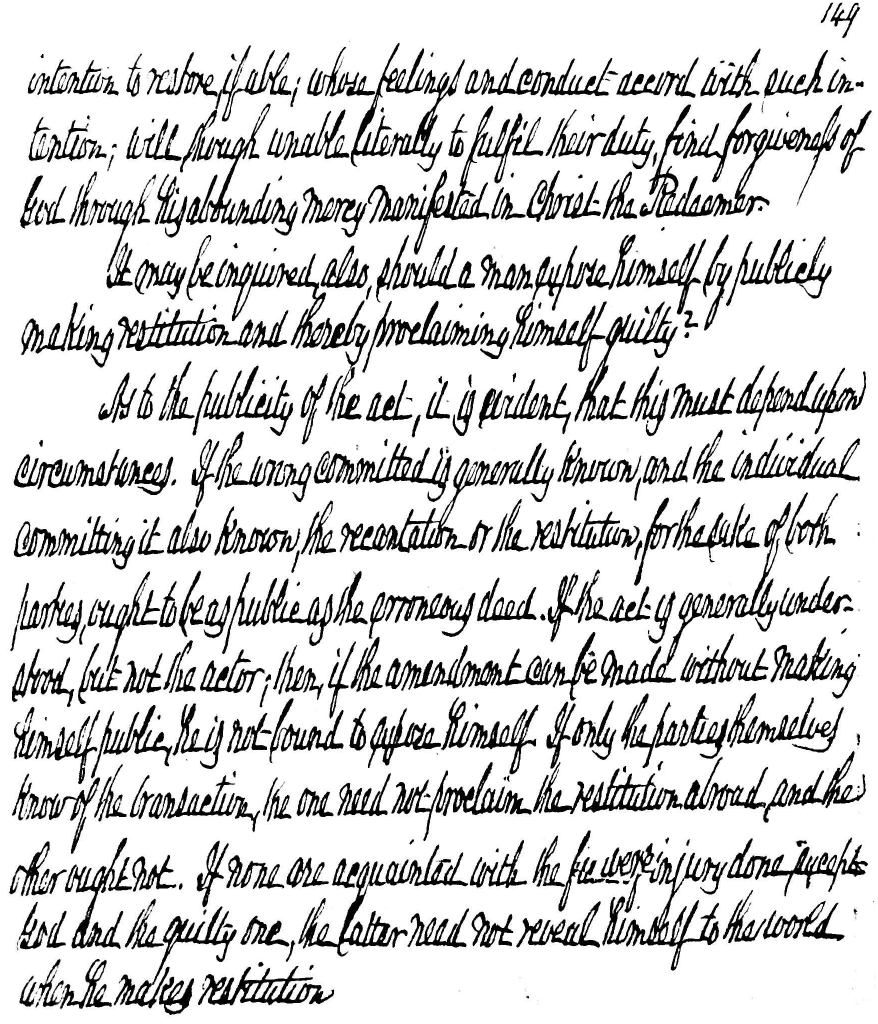
In this case, evidently the duty cannot be literally fulfilled. But does the intention to do right exist? Is there the feeling, that if ever the ability is possessed, the act shall be performed? Does the conduct accord with such feeling and intention? Then it appears, that the man is approaching as nearly as possible to the fulfillment of duty.
Leaving out of consideration, then, how God would regard such an individual, how ought his fellow-man, whom he has injured, look upon him? There is that in human nature, which, in the majority of such instances, would prompt the injured to acknowledge themselves satisfied. True, your Shylock man, who will at all events have their “pound of flesh,” would still demand the literal due. Such, however, never felt the tender gushings of human benevolence, or else have effectually checked them by giving predominance to the worst and most degraded passions of the depraved heart.
And, in the light of the the Scriptures we may believe, that those, who have the
Page 17:
intention to restore if able, whose feelings and conduct accord with such intention; will, though unable literally to fulfill their duty, find forgiveness of God through His abounding mercy manifested in Christ the Redeemer.
It may be inquired, also, should a man expose himself by publicly making restitution and thereby proclaiming himself guilty?
As to the publicity of the act, it is evident, that this must depend upon circumstances. If the wrong committed is generally known, and the individual committing it also known, the recantation or the restitution, for the sake of both parties, ought to be as public as the erroneous deed. If the act is generally understood, but not the actor; then, if the amendment can be made without making himself public, he is not bound to expose himself. If only the party themselves know of the transaction, the one need not proclaim the restitution abroad and the other ought not. If none are acquainted with the fact of injury done except God and the guilty one, the latter need not reveal himself to the world when he makes restitution.
Page 18:
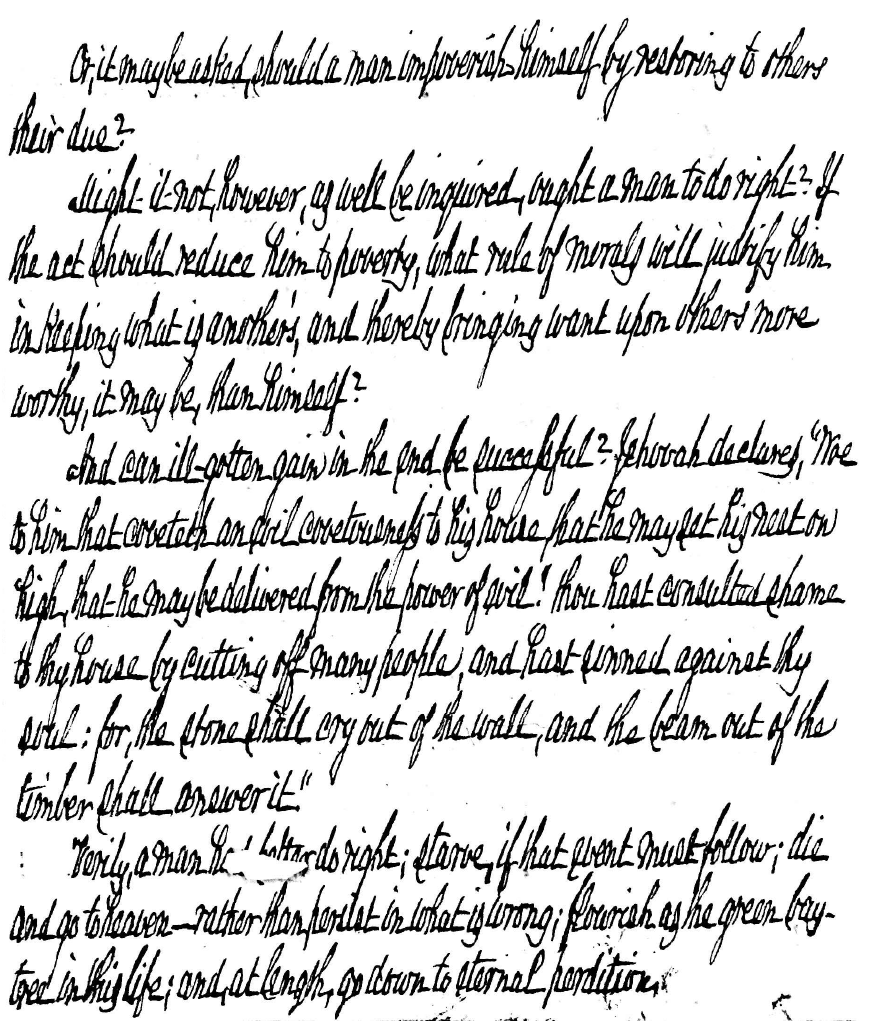
Or, it maybe asked, should a man impoverish himself by restoring others their due?
Might it not, however, as well be inquired, ought a man to do right? If the act should reduce him to poverty what rule of morals will justify him in keeping what is another’s, and thereby bringing upon others more worthy, it may be, than himself?
And can ill-gotten gain in the end be successful? Jehovah declares, “Woe to him that coveteth an evil covetousness to his house, that he may set his nest on high, that he may be delivered from the power of evil! Thou hast consulted shame to thy house by cutting off many people, and hast sinned against thy soul: for, the stone shall cry out of the wall, and the beam out of the timber shall answer it.”
Verily, a man had better do right; starve, if that event must follow; die and go to heaven - rather than persist in what is wrong; flourish as the green bay-tree in this life; and, at length, go down to eternal perdition.
Page 19:
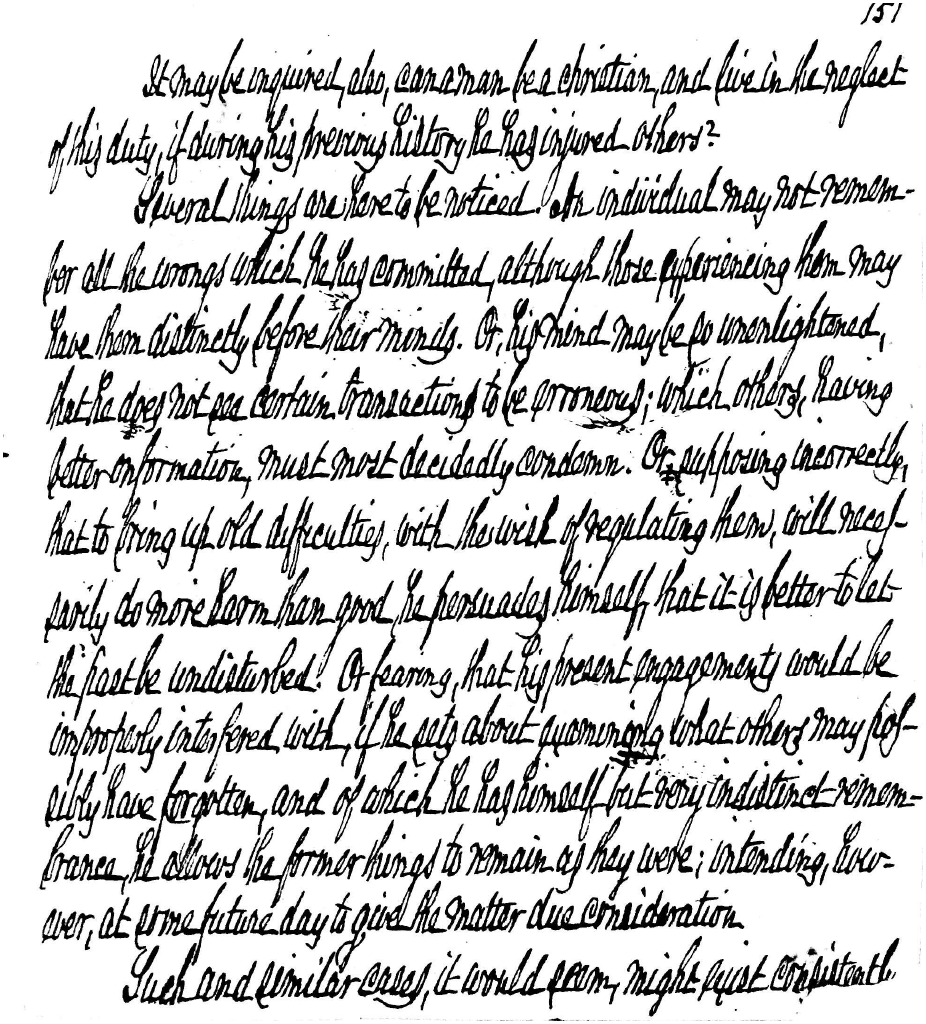
It may be inquired, also, can a man be a christian, and live in the neglect of this duty, if during his previous history he has injured others?
Several things are here to be noticed. An individual may not remember all the wrongs which he has committed, although of those experiencing them he may have them distinctly before their minds. Or, his mind may be so unenlightened, that he does not see certain transactions to be erroneous; which others, having better information, must most decidedly condemn. Or supposing incorrectly, that to bring up old difficulties, with the wish of regulating them, will necessarily do more harm than good, he persuades himself, that it is better to let the past be undisturbed. Or fearing, that his present engagements would be improperly interfered with, if he sets about examining what others may possibly have forgotten, and of which he has himself but very indistinct remembrance, he allows the former things to remain as they were; intending, however, at some future day to give the matter due consideration.
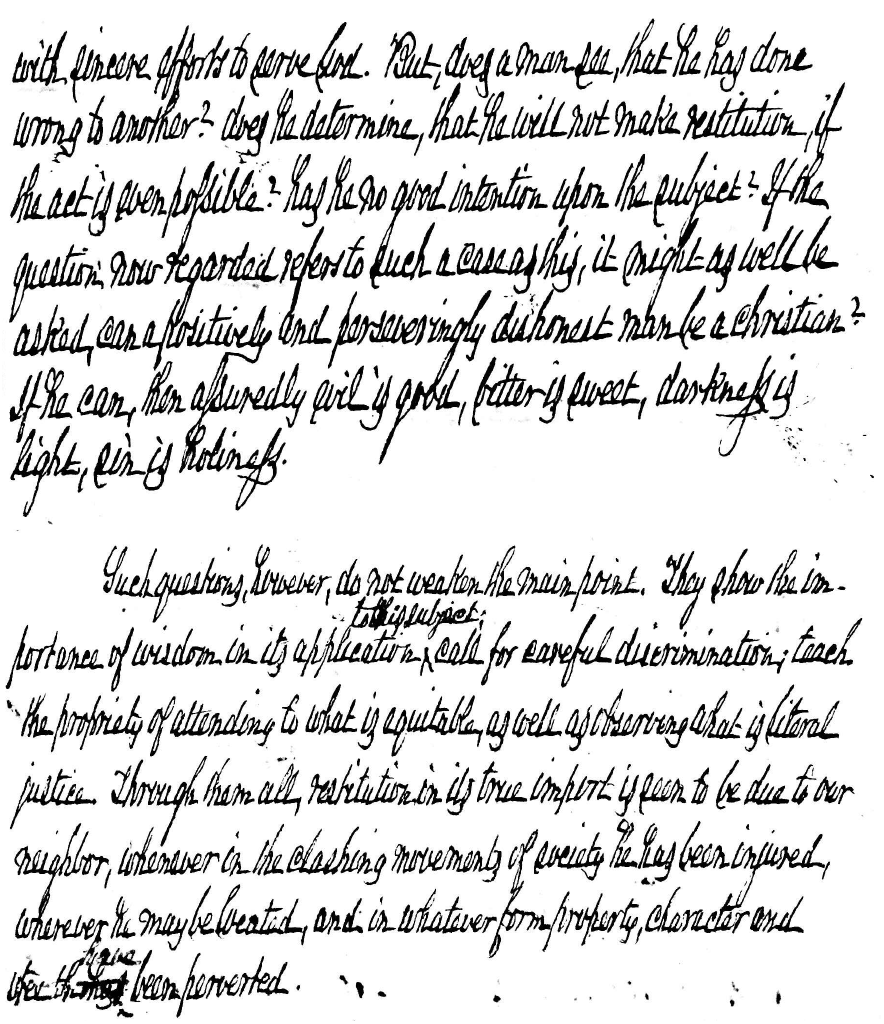
Such and similar cases, it would seem, might exist consistently
Page 20:
with sincere efforts to serve God. But, does a man see, that he has done wrong to another? does he determine, that he will not make restitution if the act is even possible? has he no good intention upon the subject? If the question now regarded refers to such a case as this, it might as well be asked, can a positively and perseveringly dishonest man be a christian? If he can, then assuredly evil is good, bitter is sweet, darkness is light, sin is holiness.
Such questions, however, do not weaken the main point. They show the importance of wisdom in its application to this subject; call for careful discrimination; teach the property of attending to what is equitable, as well as observing what is literal justice. Through them all, restitution in its true important is seen to be due to our neighbor, whenever in the clashing movements of society he has been injured, wherever he may be located, and in whatever form property, character and truth have been perverted.