Equity
Page 1:
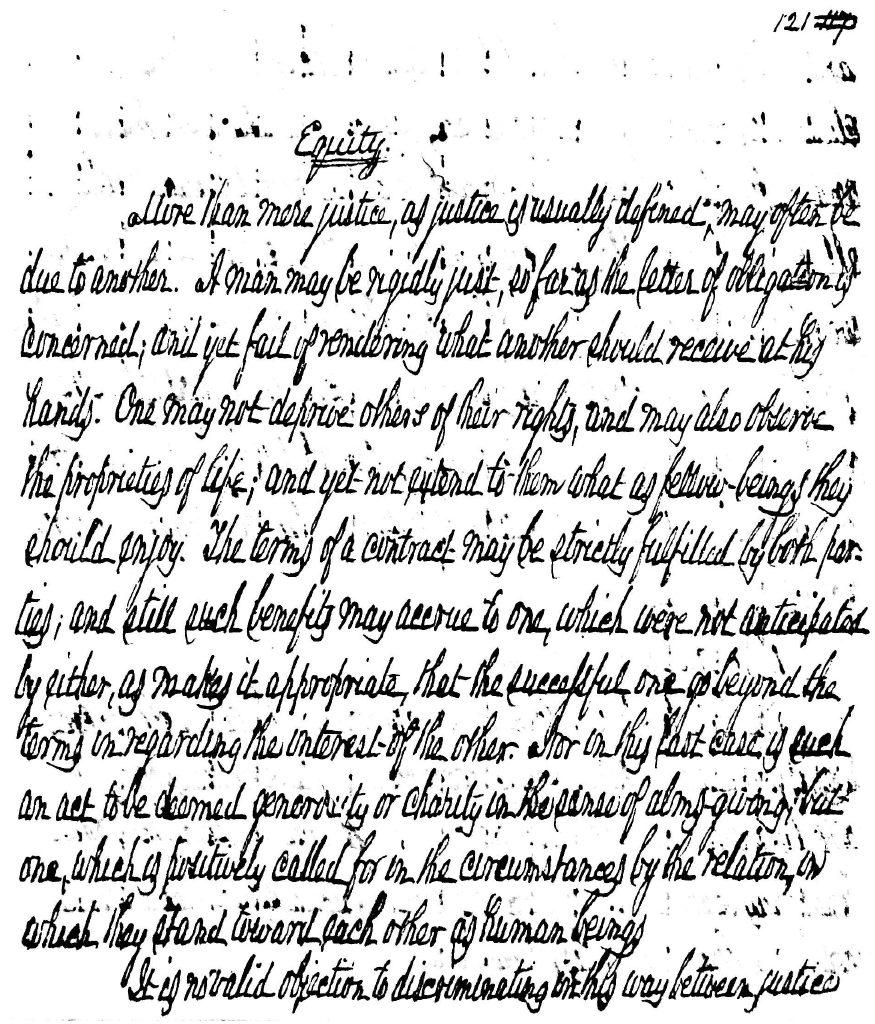
Equity
More than mere justice, as justice is usually defined, may often be due to another. A man may be rigidly just, so far as the letter of obligation is concerned; and yet fail of rendering what another should receive at his hands. One may not deprive others of their rights, and may also observe the proprieties of life; and yet not extend to them what as fellow-being they should enjoy. The terms of a contract may be strictly fulfilled by both parties; and still such benefits may accrue to one, which were not anticipated by either, as makes it appropriate, that the successful one go beyond the terms in regarding the interest of the other. Nor in this last case is such an act to be deemed generosity or charity in the sense of alms-giving, but one, which is positively called for in the circumstances by the relation, in which they stand toward each other as human beings.
It is no valid objection to discriminating in this way only between justice
Page 2:
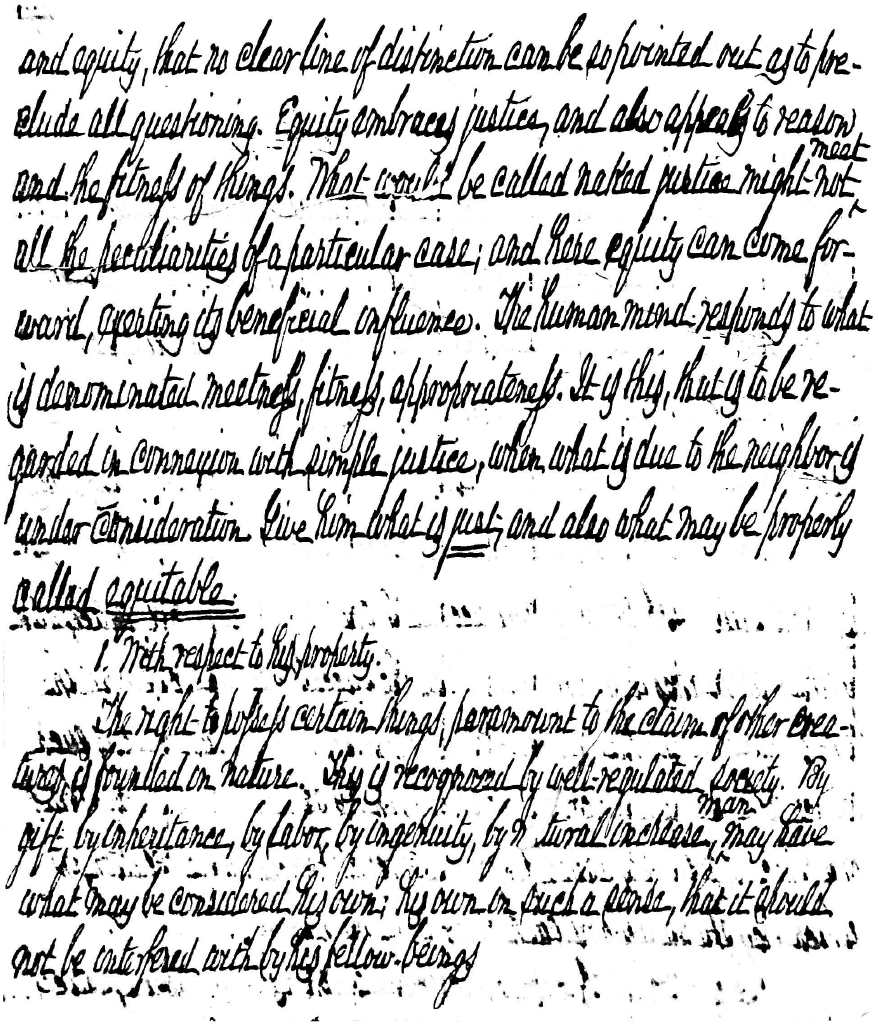
And equity, that no clear line of distinction can be so pointed out as to preclude all questioning. Equity embraces justice, and also appeals to reason and the fitness of things. What would be called naked justice might not meet all the peculiarities of a particular case; and here equity can come forward, exerting its beneficial influence. The human mind responds to what is denominated meetness, fitness, appropriateness. It is this, that is to be regarded in connection with simple justice, when what is due to the neighbor is under consideration. Give him what is just, and also what may be properly called equitable.
1. With respect to his property.
The right to possess certain things, paramount to the claim of other creatures, is founded in nature. This is recognized by well-regulated society. By gift, by inheritance, by labor, by ingenuity, by natural increase, man may have what may be considered his own; his own in such a sense, that it should not be interfered with by his fellow-beings.
Page 3:
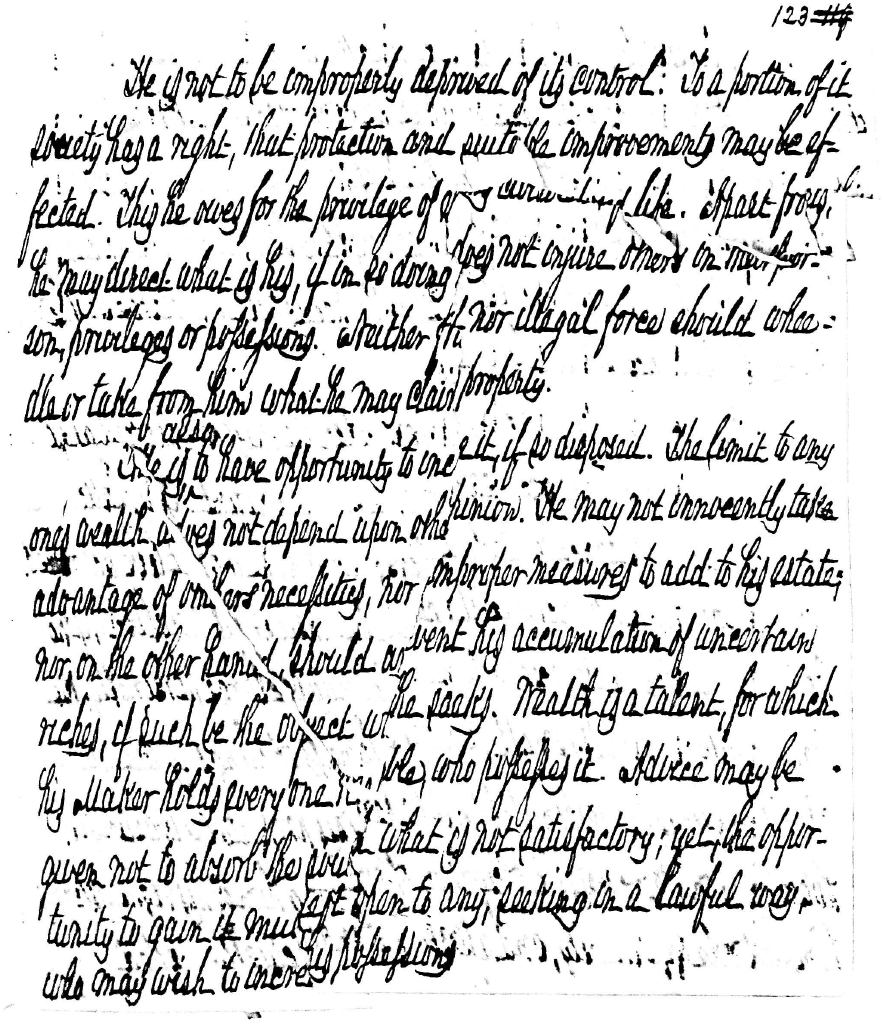
He is not to be improperly deprived of its control. To a portion of it society has a right, that protection and suitable improvements may be affected. This he owes for the privilege of en…ing civilized life. Apart from this, he may direct what is his, if in so doing he does not injure others in their person, privileges or professions. Neither fraud nor illegal force should wheedle or take from him what he may claim as property.
He is to have opportunity to increase it, if so disposed. The limit to any one’s wealth does not depend upon another’s opinion. He may not innocently take advantage of others’ necessities, nor use improper measures to add to his estate; nor on the other hand, should any prevent his accumulation of uncertain riches, if such be the object which he seeks. Wealth is a talent, for which his Maker holds every one responsible, who possesses it. Advice may be given not to absorb the soul with what is not satisfactory; yet, the opportunity to gain it must be left open to any, seeking in a lawful way, who may wish to increase his possessions.
Page 4:
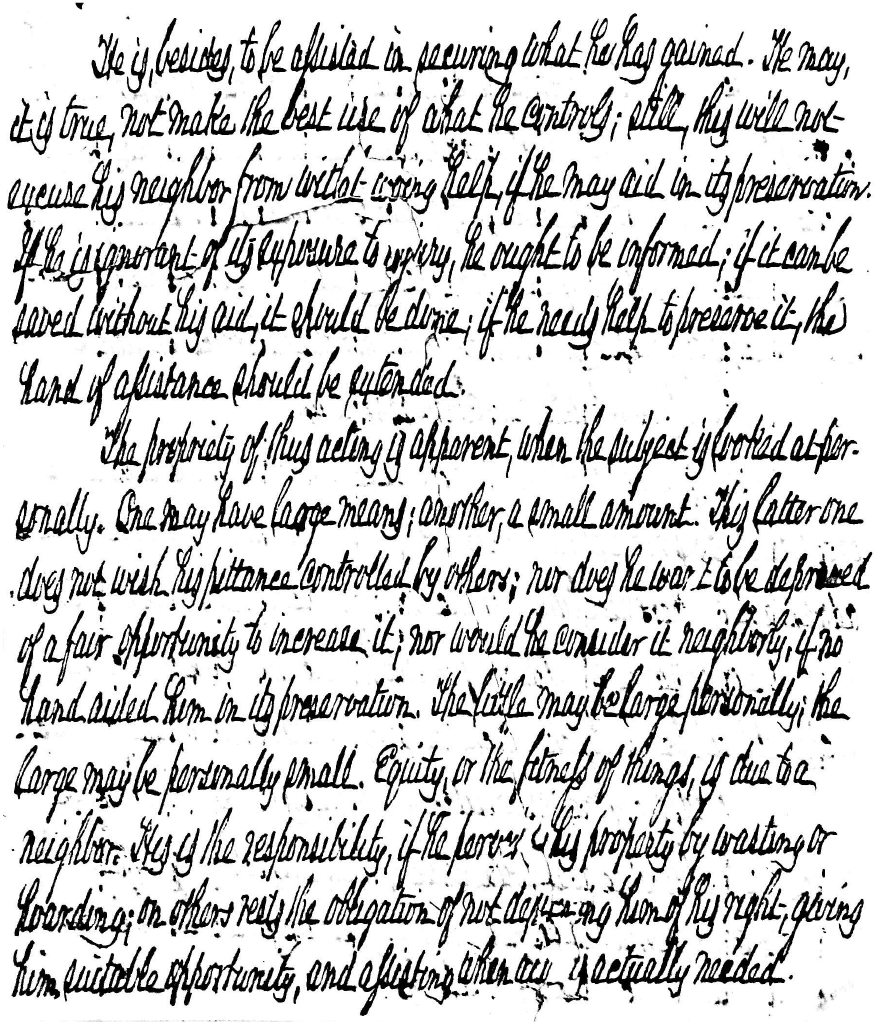
He is, besides, to be assisted in securing what he has gained. He may, it is true, not make the best use of what he controls; still, this will not excuse his neighbor from withholding help, if he may aid in its preservation. If he is ignorant of its exposure to injury, he ought to be informed; if it can be saved without his aid, it should be done; if he needs help to preserve it, the hand of assistance should be extended.
The propriety of thus acting is apparent, when the subject is looked at personally. One may have large means; another, a small amount. The latter one does not wish his pittance controlled by others; nor does he want to be deprived of a fair opportunity to increase it; nor would he consider it neighborly, if no hand aided him in its preservation. The little may be large personally; the large may be personally small. Equity, or the fitness of things, is due to a neighbor. His is the responsibility, if he perv…s his property by wasting or hoarding; on others rests the obligation of not depriving him of his right, giving him suitable opportunity, and assisting when aid is actually needed.
Page 5:
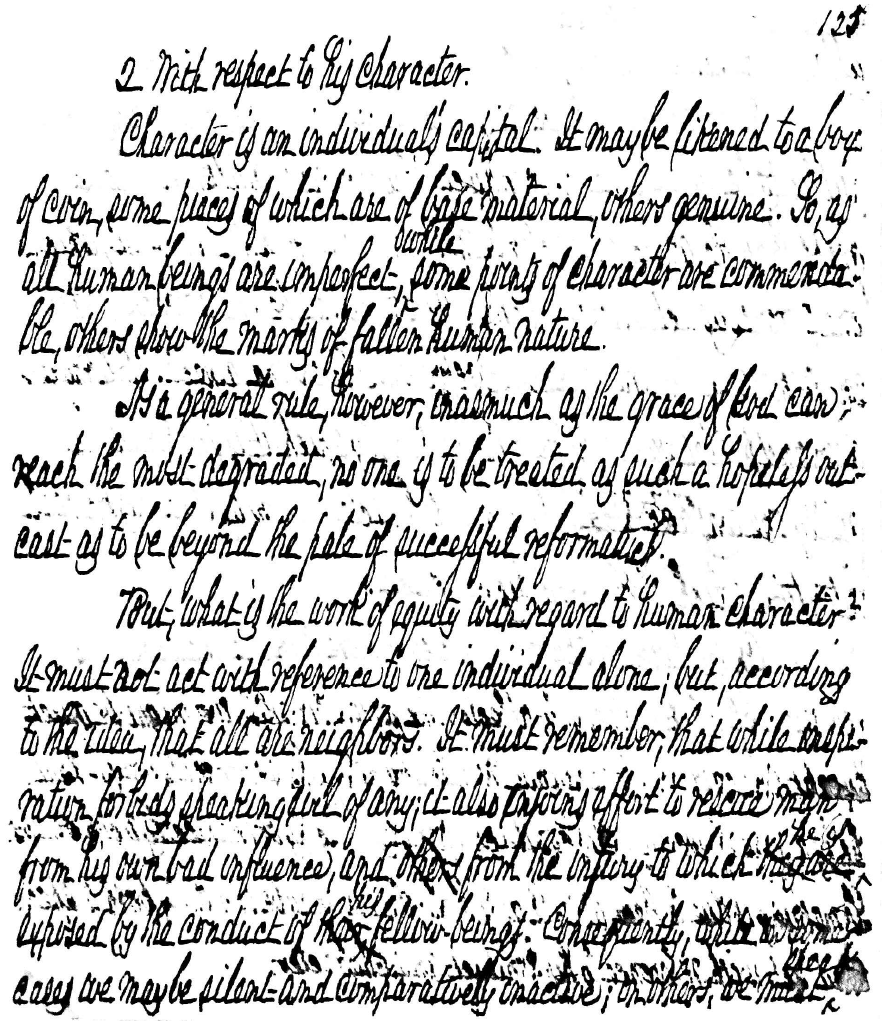
2. With respect to his character.
Character is an individual’s capital. It may be likened to a box of coin, some pieces of which are of base material, others genuine. So, as all human beings are imperfect, while some points of character are commendable, others show the marks of fallen human nature.
As a general rule, however, inasmuch as the grace of God can reach the most degraded, no one is to be treated as such a hopeless outcast as to be beyond the pale of successful reformation.
But, what is the work of equity with regard to human character? It must not act with reference to one individual alone; but according to the idea, that all are neighbors. It must remember, that while inspiration forbids speaking evil of any; it also enjoins effort to rescue man from his own bad influence, and from the injury to which he is exposed by the conduct of his fellow-beings. Consequently, while in some cases we maybe silent and comparatively inactive; in others, we muse speak
Page 6:
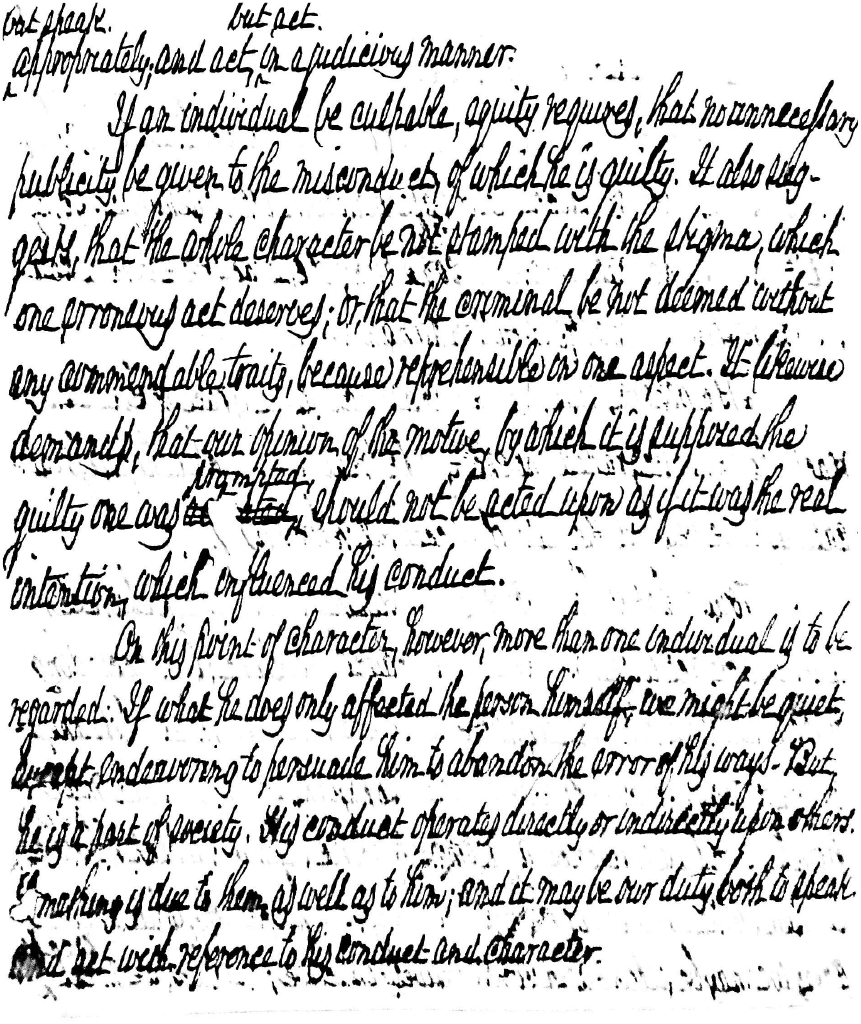
but speak appropriately; and act, but act in a judicious manner.
If an individual be culpable, equity requires, that no unnecessary publicity be given to the misconduct, of which he is guilty. It also suggests, that the whole character be not stamped with the stigma, which one erroneous act deserves; or, that the criminal be not deemed without any commendable traits, because reprehensible in one aspect. It likewise demands, that our opinion of the motive, by which it is supposed the guilty one was prompted, should not be acted upon as if it was the real intention, which influenced his conduct.
On this point of character, however, more than one individual is to be regarded. If what he does only affected the person himself, we might be quiet, except endeavoring to persuade him to abandon the error of his ways. But, he is a part of society. His conduct operates directly or indirectly upon others. Something is due to them as well as to him; and it may be our duty both to speak and act with reference to his conduct and character.
Page 7:
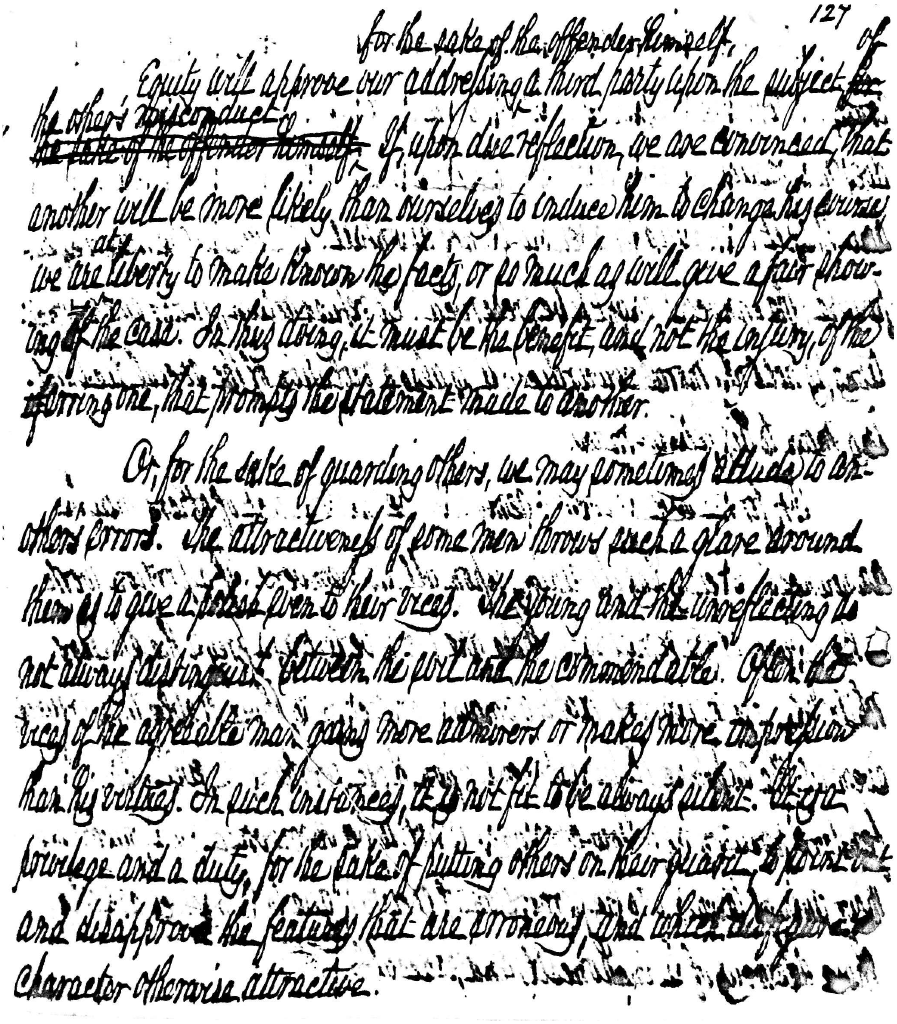
Equity will approve our addressing for the sake of the offender himself, a third party upon the subject of the other’s misconduct. If, upon due reflection, we are convinced, that another will be more likely than ourselves to induce him to change his course, we are at liberty to make known the facts, or so much as will give a fair showing of the case. In thus doing, it must be the benefit, and not the injury, of the erring one, that prompts the statement made to another.
Or, for the sake of guarding others, we may sometimes allude to another’s errors. The attractiveness of some men throws such a glare around them as to give a polish even to their vices. The young and the unreflecting do not always distinguish between the evil and the commendable. Often the vices of the agreeable man gains more admirers or makes more impression than his virtues. In such instances, it is not fit to be always silent. It is a privilege and a duty, for the sake of putting others on their guard, to point out and disapprove the features that are erroneous, and which disfigure character otherwise attractive.
Page 8:
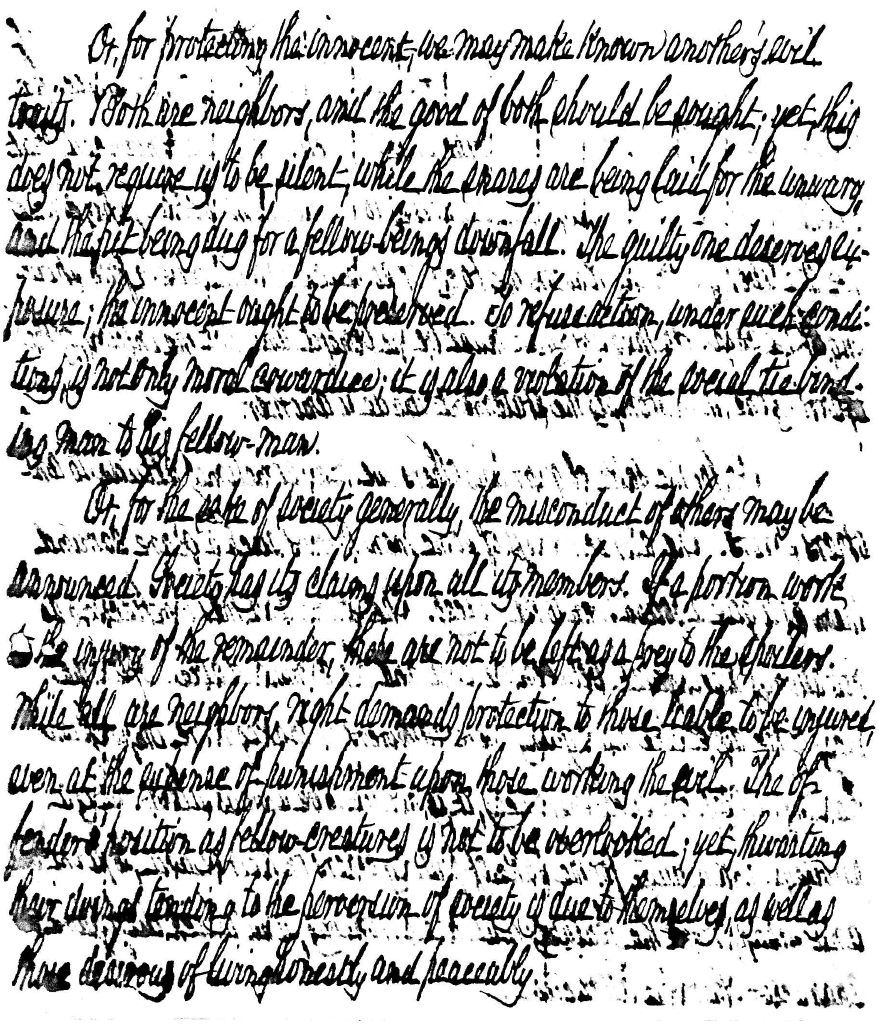
Or, for protecting the innocent, we may make known another’s evil traits. Both are neighbors, and the good of both should be sought; yet this does not require us to be silent, while the snares are being laid for the unwary, and the pit being dug for a fellow-being’s downfall. The guilty one deserves exposure; the innocent ought to be preserved. To refuse action, under such conditions, is not only moral cowardice; it is also a violation of the social tie binding man to his fellow-man.
Or, for the sake of society generally, the misconduct of others may be announced. Society has its claims upon all its members. If a portion work to the injury of the remainder, these are not to be left as prey to the spoilers. While all are neighbors, right demands protection to those liable to be injured, even at the expense of punishment upon those working the evil. The offenders’ position as fellow-creatures is not to be overlooked; yet, thwarting their doings tending to the perversion of society, of due to themselves, as well as those desirous of living honestly and peacefully.
Page 9:
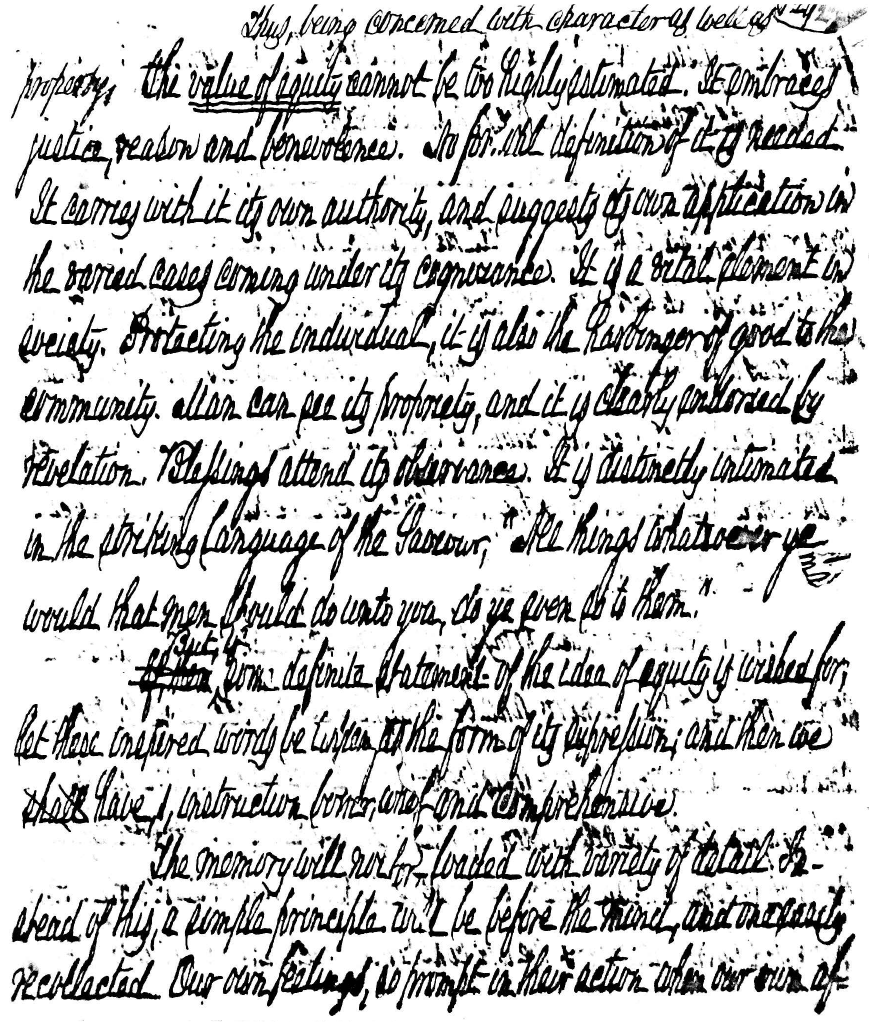
Thus, being concerned with character as well as property, the value of equity cannot be too highly estimated. It embraces justice, reason and benevolence. No formal definition of it is needed. It carries with it its own authority, and suggests its own application in the varied cases coming under its cognizance. It is a vital element of society. Protecting the individual, it is also the harbinger of good to the community. Man can see its propriety, and it is clearly endorsed by revelation. Blessings attend its observance. It is distinctly intimated in the striking language of the Saviour, "All things whatsoever ye would that men should do unto you, do ye even so to them."
But, if some definite statement of the idea of equity is wished for, let these inspired words be taken as the form of its expression; and then we have, 1, instruction, both brief and comprehensive.
The memory will not be loaded with variety of detail. Instead of this, a simple principle will be before the mind, and one easily recollected. Our own feelings, so prompt in their action when our own af-
Page 10:
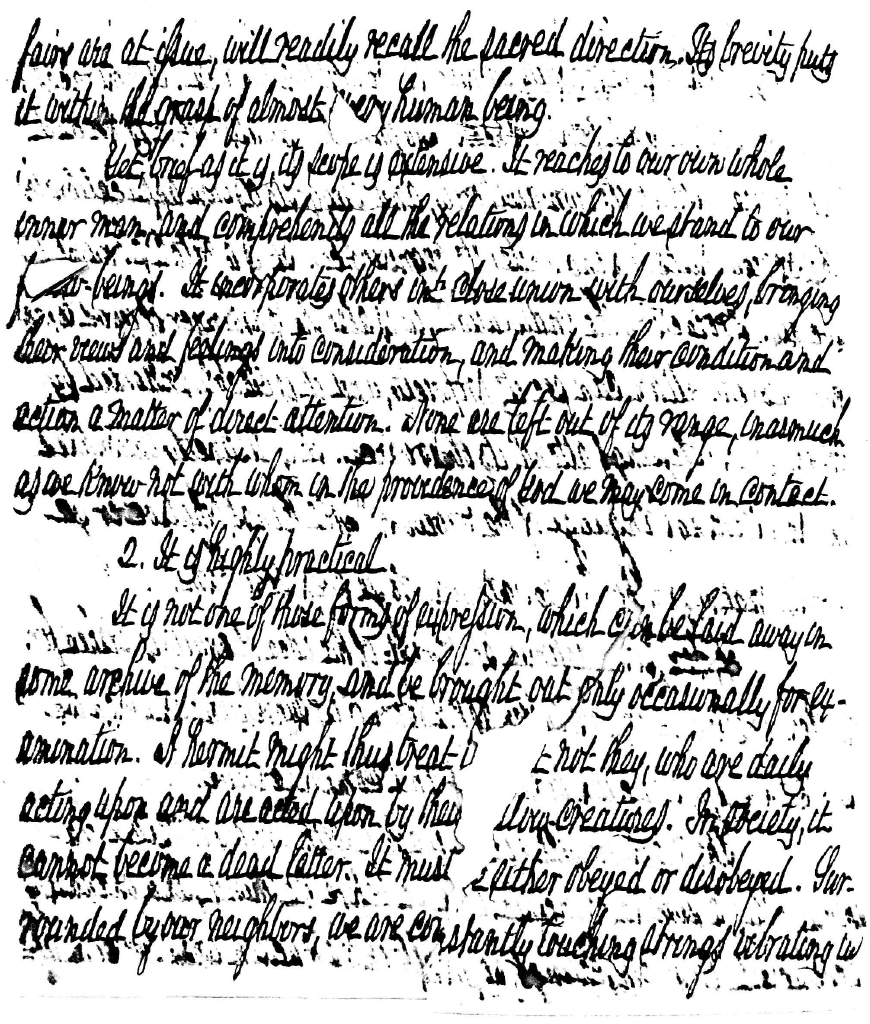
-fairs are at issue, will readily recall the sacred direction. Its brevity puts it within the grasp of almost every human being.
Yet, brief as it is, its scope is extensive. It reaches to our own whole inner man, and comprehends all the relations in which we stand to our fellow-beings. It incorporates others into close union with ourselves, bringing their views and feelings into consideration, and making their own condition and action a matter of direct attention. None are left out of its range, inasmuch as we know not with whom in the providence of God we may come in contact.
2. It is highly practical.
It is not one of those forms of expression, which can be laid away in some archive of the memory, and be brought out only occasionally for examination. A hermit might thus treat it; but not they, who are daily acting upon and are acted upon by their fellow-creatures. In society, it cannot become a dead letter. It must be either obeyed or disobeyed. Surrounded by our neighbors, we are constantly touching strings vibrating in
Page 11:
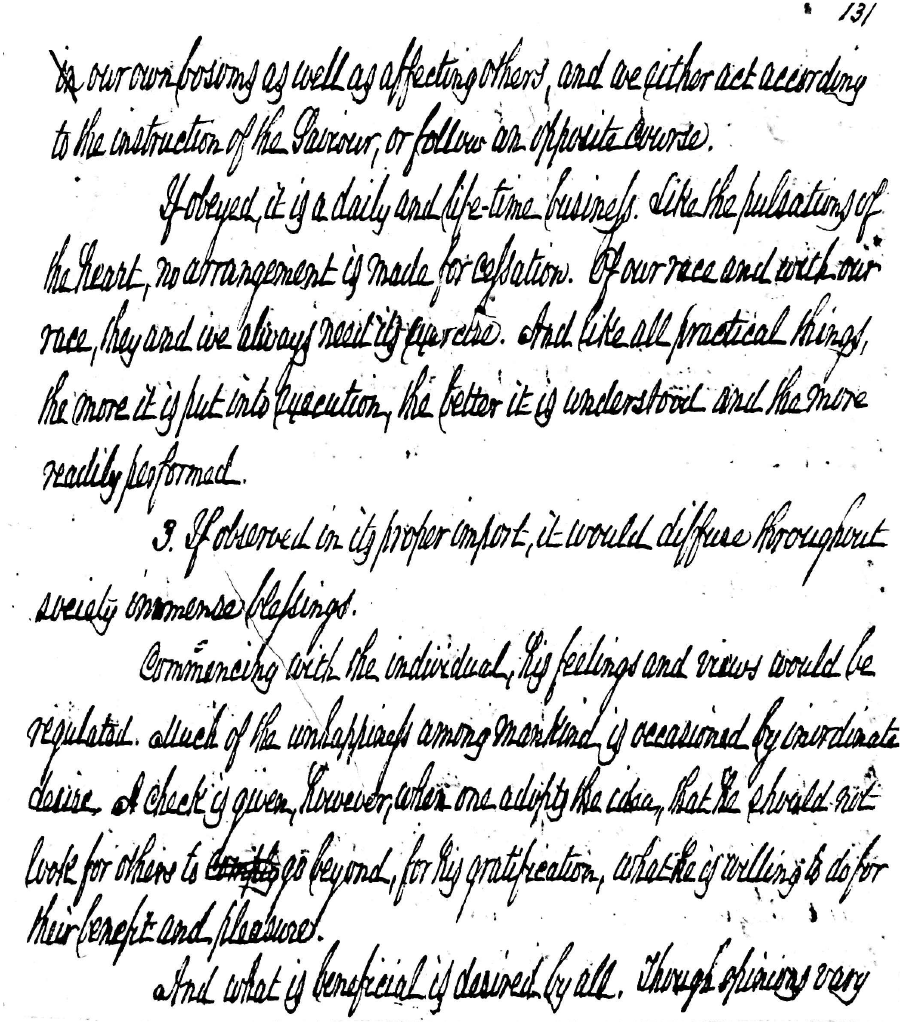
Our own bosoms as well as affecting others, and we either act according to the instruction of the Savior, or follow an opposite course.;
If obeyed, it is a daily and life-time business. Like the pulsations of the heart, no arrangement is made for cessation. Of our race and with our race, they and we always need its exercise. And like all practical things, the more it is put into execution, the better it is understood and the more readily performed.
3. If observed in its proper import, it would diffuse throughout society immense blessings.
Commencing with the individual, his feelings and views would be regulated. Much of the unhappiness among mankind is occasioned by inordinate desire. A check is given, however, when one adopts the idea, that he should not look for others to go beyond, for his gratification, what he is willing to do for their benefit and pleasure.
And what is beneficial is desired by all. Though opinions vary
Page 12:
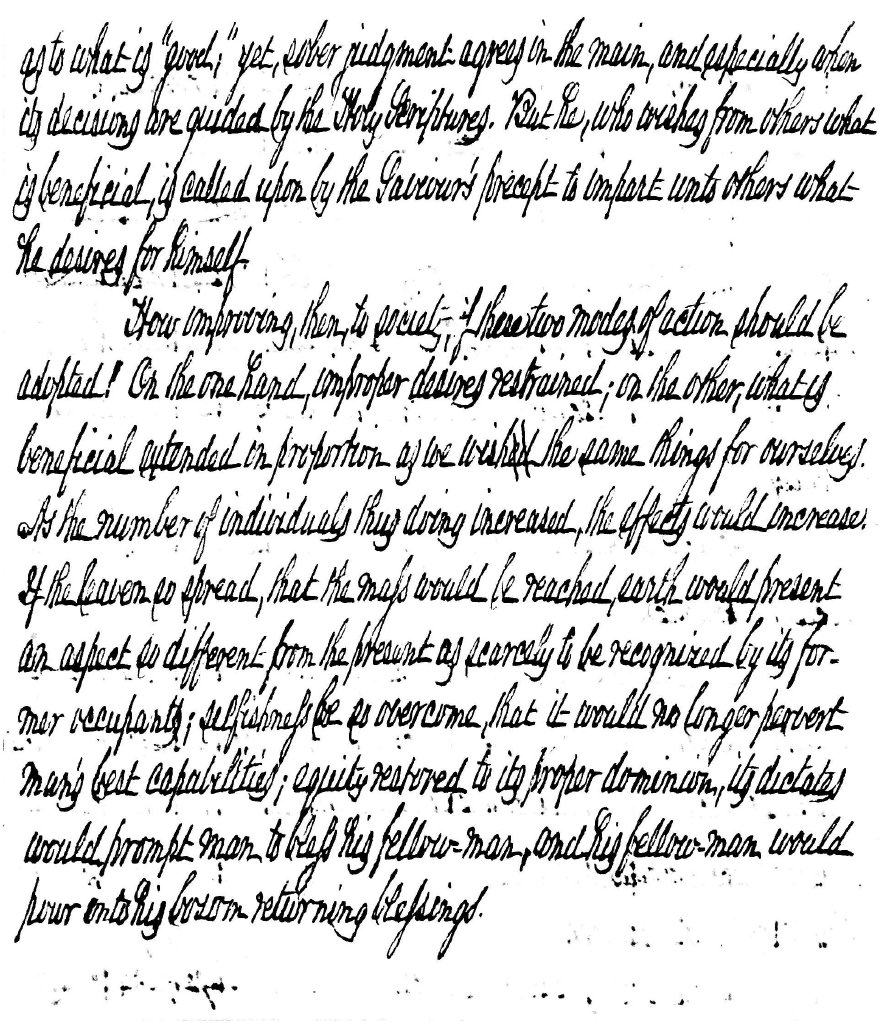
as to what is “good,” yet sober judgment agrees on the main, and especially when its decisions are guided by the Holy Scriptures. But he, who wishes from others what is beneficial, is called upon by the Saviour’s precept to impart unto others what he desires for himself.
How improving, then, to society, if these two modes of action should be adopted! On the one hand, improper desires restrained; on the other, what is beneficial extended in proportion, as we wish the same things for ourselves. As the number of individuals thus doing increased, the effects would increase. If the leaven so spread, that the mass would be reached, earth would present an aspect so different from the present as scarcely to be recognized by its former occupants; selfishness be so overcome, that it would no longer pervert man’s best capabilities; equity restored to its proper dominion, its dictates would prompt man to bless his fellow-man, and his fellow-man would pour into his bosom returning blessings.