Meekness
Page 1:
Meekness.
The benefit of a fellow-being is promoted both by what is actually done for him and by what is avoided. Some traits prompt to positive and direct efforts; while others keep back evil influences, and quietly throw forth what is beneficial. And man needs both these classes of operations. What will keep his passions from bursting into a raging flame is valuable, as well as what will diffuse around and within him sanctifying and elevating effects.
Meekness is the opposite of wrath and harshness. Its principal elements are forbearance and mildness. If it be true, that it is a rare virtue; it is also true, that it is difficult to be kept in its proper condition, even when to some extent possessed. Like some delicately formed material capable of receiving a high polish; it may be easily blurred or scratched or broken. It is not a grace, for which fallen man has any partiality. Nor is it astonishing, that some languages have no word for it in the sense in which it is represented by inspiration. It is eminently
Page 2:
an idea from above. Under the Mosaic economy, it was commended; in the gospel, it is repeatedly enjoined. It is a trait, without which no man can be perfect. In Christ Jesus, it shone as a gem, whose clear but mild luster gave to his character a geniality and attractiveness, which show the beauty of which humanity is capable; and which tend to draw all to his service, who will duly listen to his words, “Learn of me, for, I am meek and lowly in heart.”
Viewed as the opposite of wrath and harshness, and composed of forbearance and mildness, meekness is a trait suitable to be exercised with reference to our neighbor. As it is of value to ourselves, so its practice may be highly useful to others. Love to our fellow-beings and duty toward them clearly call for its existence, and for that existence to be of no doubtful character. Its sphere is the domain of both public and private life; and, instead of interfering with what may be thought to be higher and grander traits, it throws around them greater dignity. meekness, regarded as embracing forbearance and mildness, blesses ourselves and our fellow-beings.
Page 3:
1. As meekness is attained, a personal victory is secured.
High authority justifies the assertion, that the control of ourselves is one of the greatest kind of triumphs. If he is a brilliant man, who as the leader of embattled hosts goes on from conquest to conquest; he will effect a more splendid achievement, if he also brings into subjection the citadel of his own heart. Victories over mind surpass in greatness triumphs over matter. And many an one, whose conquests by military power have made him world-renowned, has not only failed to subdue himself, but has fallen a prey to his own ungoverned temper, and has thrown such a cloud of disgrace around his character as cannot be driven away by all his other successful and wonderful exploits. “He that is slow to anger is better than the mighty; and he that ruleth his spirit than he that taketh a city.”
So to speak, acquiring meekness is a victory, which conquers a peace. It places a more than imperial guard around the conqueror. It fortifies the avenues of approach to him, who has made the successful movement. It has built such strong lines of de-
Page 4:
-fence, that so long as they are kept unbroken, he is secure. It strengthens the inner man, as well as protects the points whereby he comes in contact with his fellow beings. Thus defended, the inner man may abide in peace. However raging may be the whirlwind of passion around him, none of its gusts need disturb the serenity within, which has been obtained by the triumph over himself, and which is kept secure by his defences around and within his own heart.
And now he, clothed with meekness, exerts a silent, yet impressive, power over others. The quietness of the encampment is a token, that it abides in strength, and few will venture to make an attack. The reigning calmness is a check, upon those, who, having given way to their impulses, can behold the contrast between the storm in their own spirits and the peaceful atmosphere surrounding him, who dwells above the tumults of ungoverned passion. And this silent power prepares the way for greater impressiveness, when beholding the commotions of life he goes forth, endeavoring to lull the angry waves, and soothe into quietude the raging winds, of human ambition and strife.
Page 5:
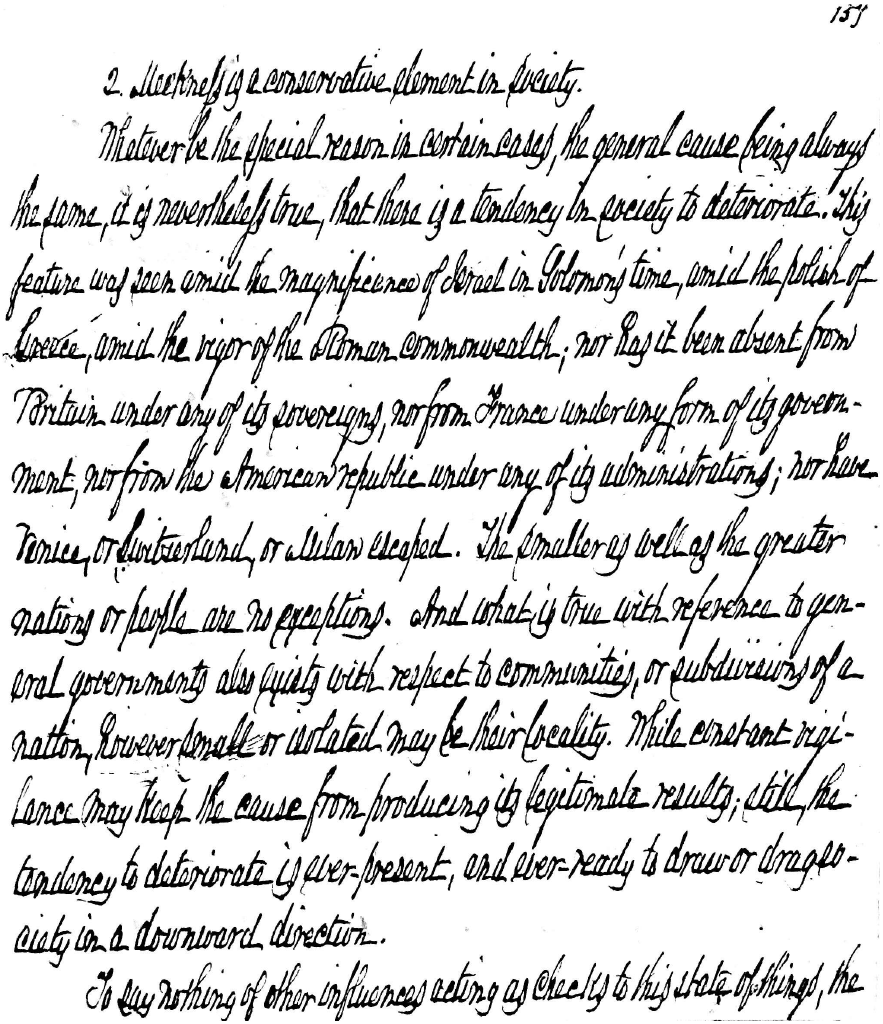
2. Meekness is a conservative element in society.
Whatever be the special reason in certain cases, the general cause being always the same, it is nevertheless true, that there is a tendency in society to deteriorate. This feature was seen amid the magnificence of Israel in Solomon’s time, amid the polish of Greece, amid the rigor of the Roman commonwealth; nor has it been absent from Britain under any of its sovereigns, nor from France under any form of its government, nor from the American republic under any of its administrations; nor have Vence, or Switzerland, or Milan, escaped. The smaller as well as the greater nations or people are no exceptions. And what is true with reference to general governments also exists with respect to communities, or subdivisions of a nation. However small or isolated may be their locality. While constant vigilance may keep the cause from producing its legitimate results; still, the tendency to deteriorate is ever-present, and ever-ready to draw or drag society in a downward direction.
To say nothing of other influences acting as checks to this state of things, the
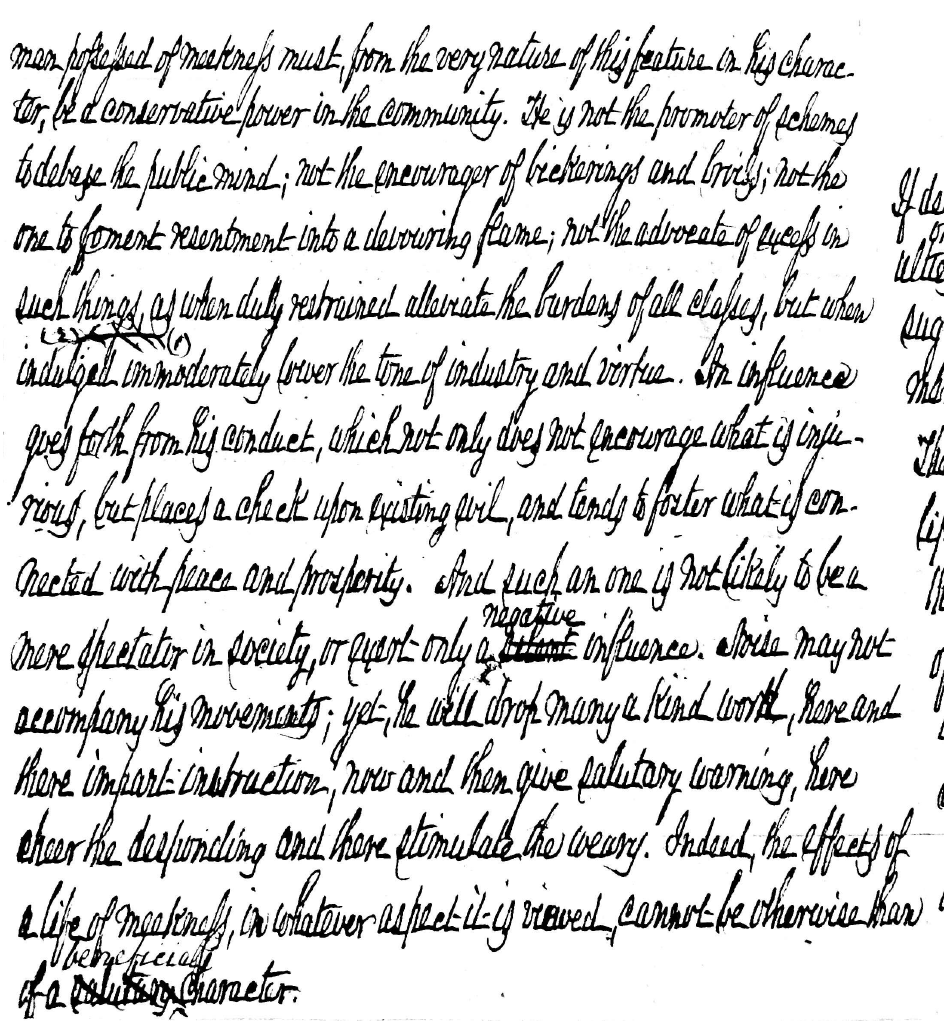
Page 6:
man possessed of meekness must, from the very nature of this feature in his character, be a conservative power in the community. He is not the promoter of schemes to debase the public mind; not the encourager of bickerings and br…s; not the one to ferment resentment into a devouring flame; not the advocate of excess in such things, as when duly restrained alleviate the burdens of all classes, but when indulged immoderately lower the tone of industry and virtue. An influence goes forth from his conduct, which not only does not encourage what is injurious, but places a check upon existing evil, and tends to foster what is connected with peace and prosperity. And such an one is not likely to be a mere spectator in society, or exert only negative influence. Noise may not accompany his movements; yet, he will drop many a kind work, here and there impart instruction, now and then give a salutary warning, here cheer the desponding and there stimulate the weary. Indeed, the effects of a life of meekness, in whatever aspect it is viewed, cannot be otherwise than of a beneficial character.
Page 7:
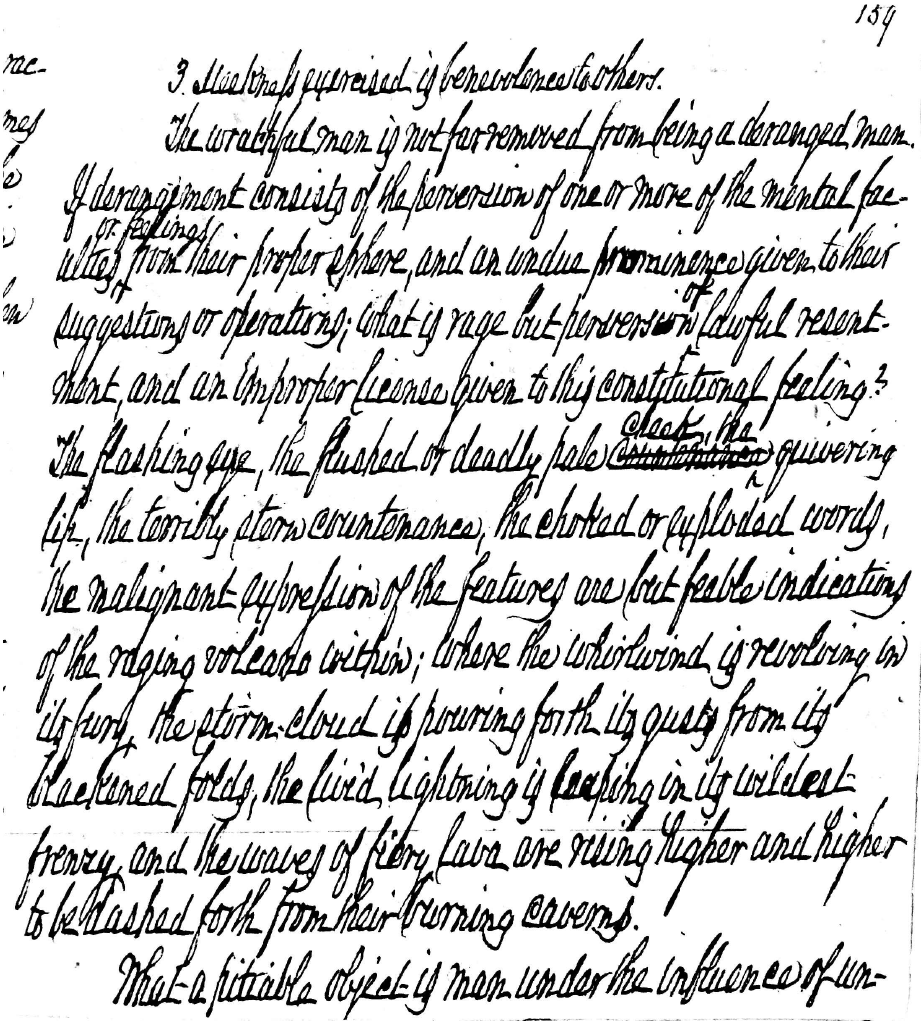
3. Meekness exercised is benevolence to others.
The wrathful man is not far removed from being a deranged man. If derangement consists of the perversion of one or more of the mental faculties or feelings from their proper sphere, and an undue prominence given to their suggestions or operations; what is rage but perversion of lawful resentment, and an improper license given to the constitutional feeling? The flashing axe, the flushed or deadly pale cheek, the quivering lip, the terribly stern countenance, the choked or exploded words, the malignant expression of the features are but feeble indications of the raging volcano within; where the whirlwind is revolving in its fury, the storm cloud is pouring forth its gusts from its blackened folds, the livid lightning is leaping in its wildest frenzy, and the waves of fiery lava are rising higher and higher to be dashed forth from their burning caverns.
What a pitiable object is man under the influence of un-
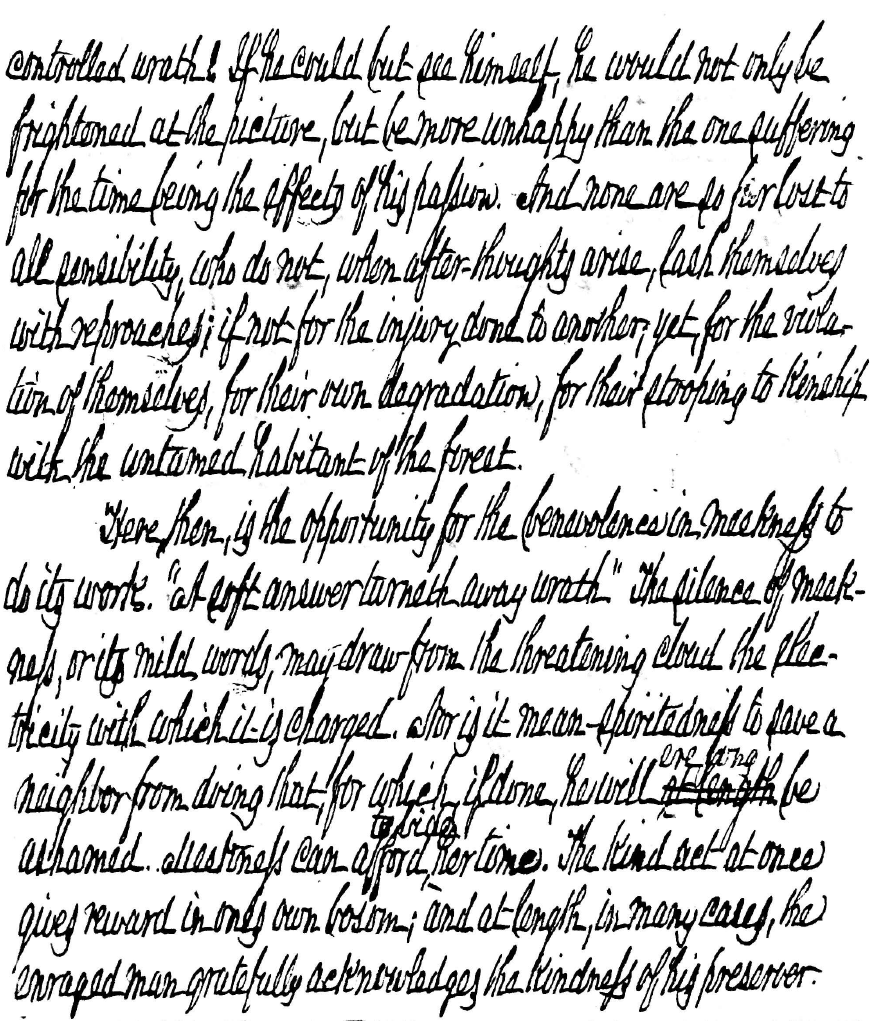
Page 8:
-controlled wrath! If he could but see himself, he would not only be frightened at the picture, but be more unhappy than the one suffering for the time being the effects of his passion. And none are so far lost to all sensibility, who do not, when after-thoughts arise, lash themselves with reproaches; if not for the injury done to another; yet, for the violation of themselves, for their own degradation, for their stooping to kinship with the untamed habitant of the forest.
Here, then, is the opportunity for the benevolence in meekness to do its work. “A soft answer turneth away wrath.” The silence of meekness, or its mild words, may draw from the threatening cloud the electricity with which it is charged. Nor is it mean-spiritedness to save a neighbor from doing that, for which, if done, he will ere long be ashamed. Meekness can afford to bide her time. The kind act at once gives reward in one’s own bosom; and at length, in many cases, the enraged man gratefully acknowledges the kindness of his preserver.
Page 9:
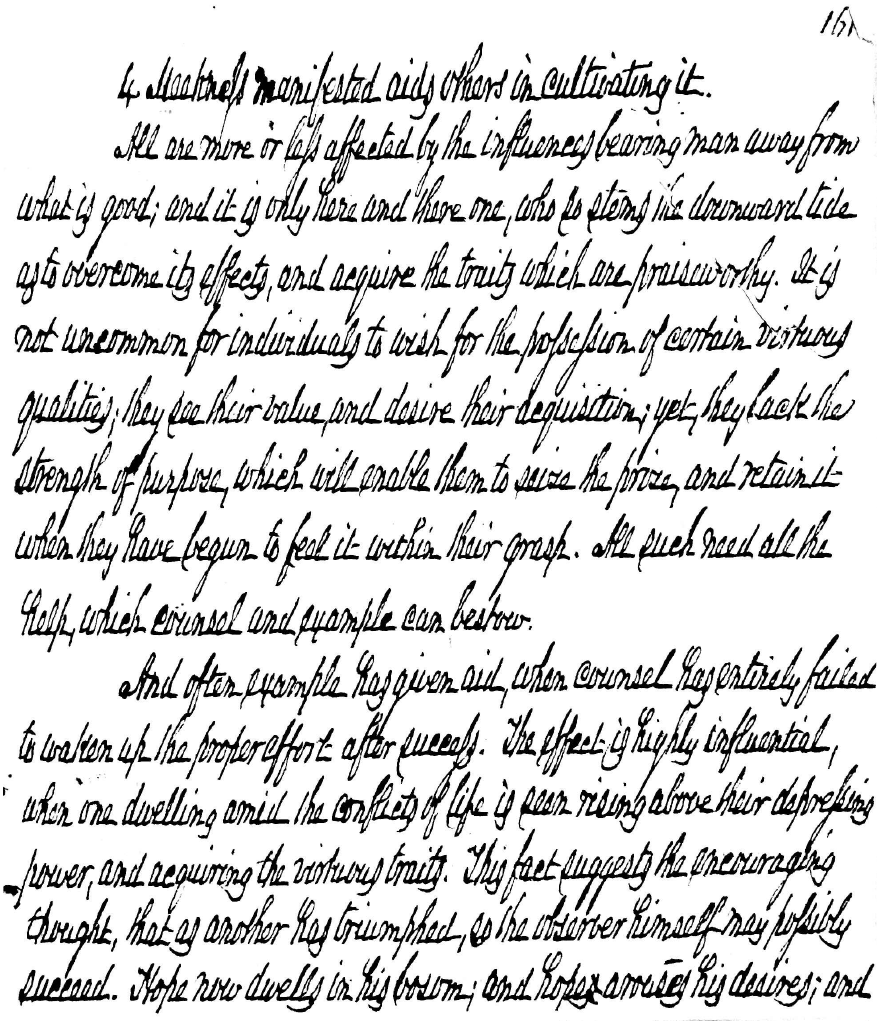
4. Meekness manifested aids others in cultivating it.
All are more or less affected by the influences bearing man away from what is good; and it is only here and there one, who so stems the downward tide as to overcome its effects, and acquire the traits which are praiseworthy. It is not uncommon for individuals to wish for the possession of certain virtuous qualities; they see their value, and desire their acquisition; yet, they lack the strength of purpose, which will enable them to seize the prize, and retain it when they have begun to feel it within their grasp. All such need all the help, which counsel and example can bestow.
And often example has given aid, when counsel has entirely failed to waken up the proper effort after success. The effect is highly influential, when one dwelling amid the conflicts of life is seen rising above their depressing power, and acquiring the virtuous traits. This fact suggests the encouraging thought, that as another has triumphed, so he, as the observer himself may possibly succeed. Hope now dwells in his bosom; and hope arouses his desires; and
Page 10:
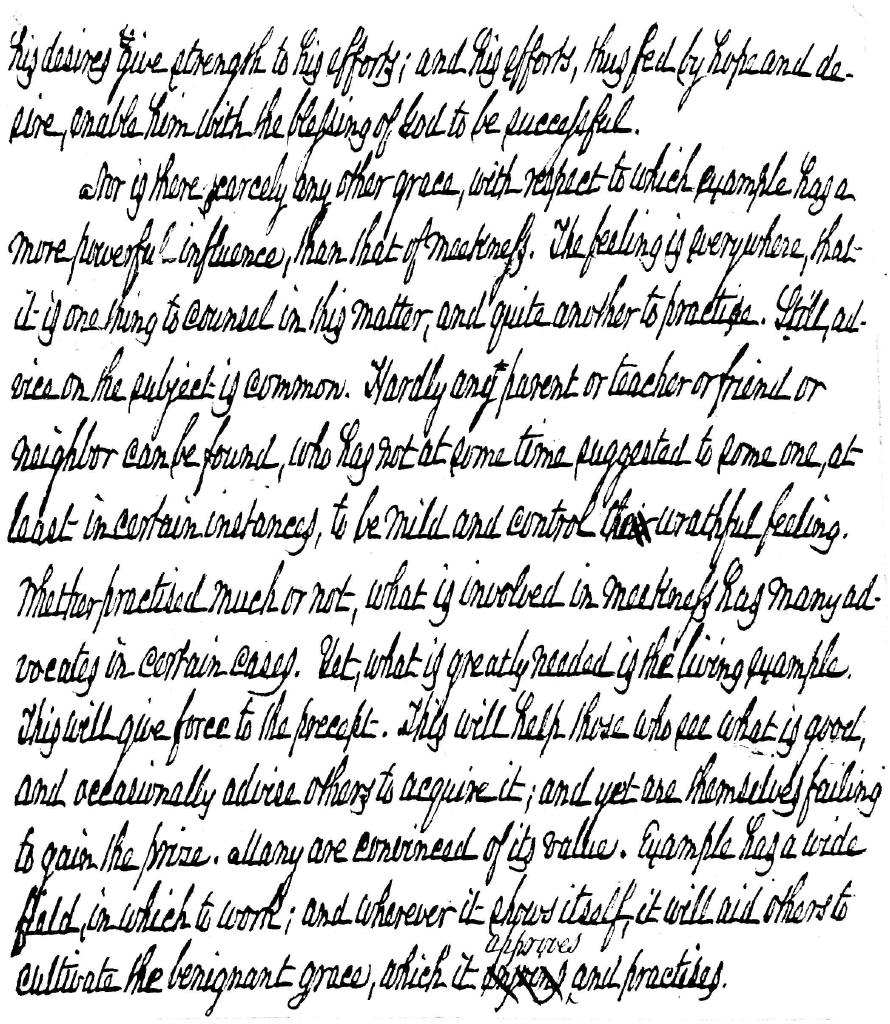
His desires give strength to his efforts; and his efforts, thus fed by hope and desire, enable him with the blessing of God to be successful.
Nor is there scarcely any other grace, with respect to which example has a more powerful influence, than that of meekness. The feeling is everywhere, that it is one thing to counsel in this matter, and quite another to practice. Still, advice on the subject is common. Hardly any parent or teacher or friend or neighbor can be found, who has not at some time suggested to some one, at least in certain instances, to be mild and control their wrathful feeling. Whether practiced much or not, what is involved in meekness has many advocates in certain cases. Yet, what is greatly needed is the living example. This will give force to the precept. This will help those who see what is good, and occasionally advise others to acquire it; and yet are themselves failing to gain the prize. Many are convinced of its value. Example has a wide field, in which to work; and wherever it shows itself, it will aid others to cultivate the benignant grace, which it approves and practices.
Page 11:
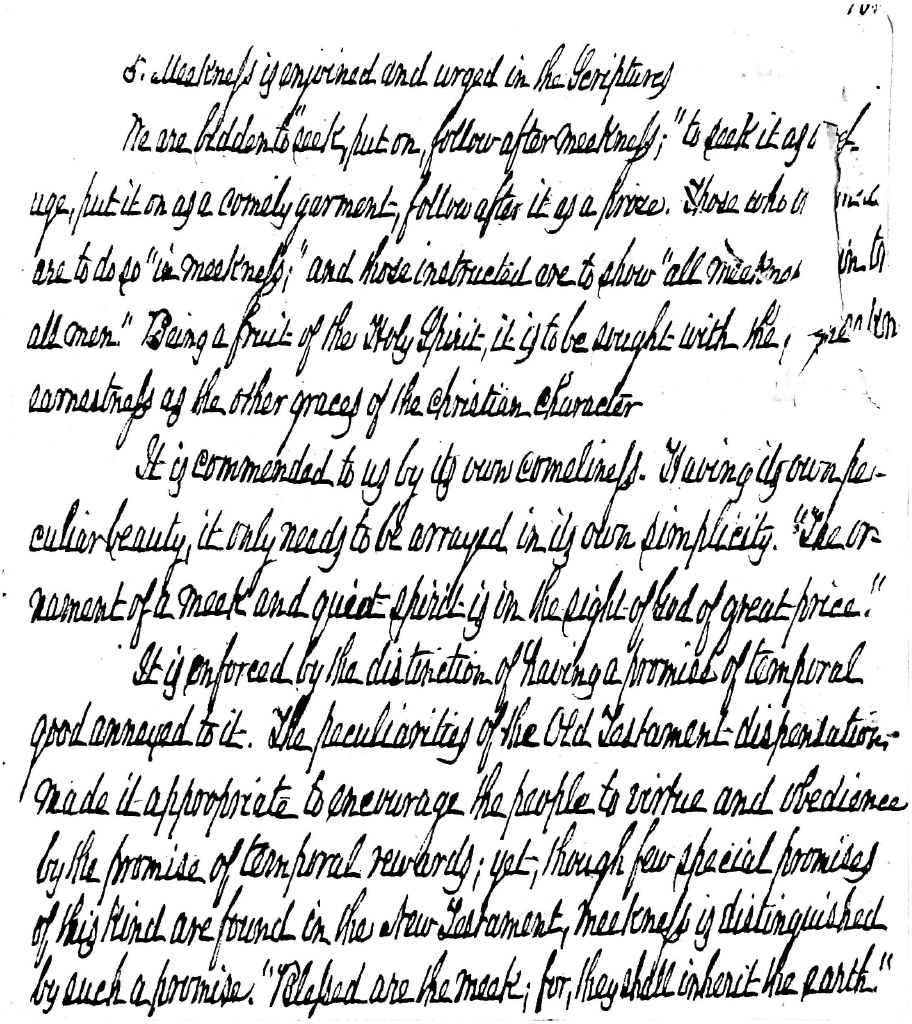
5. Meekness is enjoined and urged in the scriptures.
We are bidden to “seek, put on, follow after meekness;” to seek it as …uge, put it on as a comely garment, follow after it as a prize. Those who … are to do so “in meekness;” and those instructed are to show “all meekness … all men.” Being a fruit of the Holy Spirit, it is to be sought with the … earnestness as the other graces of the christian character.
It is commended to us by its own comeliness. Having its own peculiar beauty, it only needs to be arrayed in its own simplicity. “The ornament of a meek and quiet spirit is in the sight of God a great price.”
It is enforced by the distinction of having a promise of temporal good annexed to it. The peculiarities of the Old Testament dispensation made it appropriate to encourage the people to virtue and obedience by the promise of temporal rewards; yet, though few special promises of this kind are found in the New Testament, meekness is distinguished by such a promise. “Blessed are the meek, for they shall inherit the earth.”
Page 12:
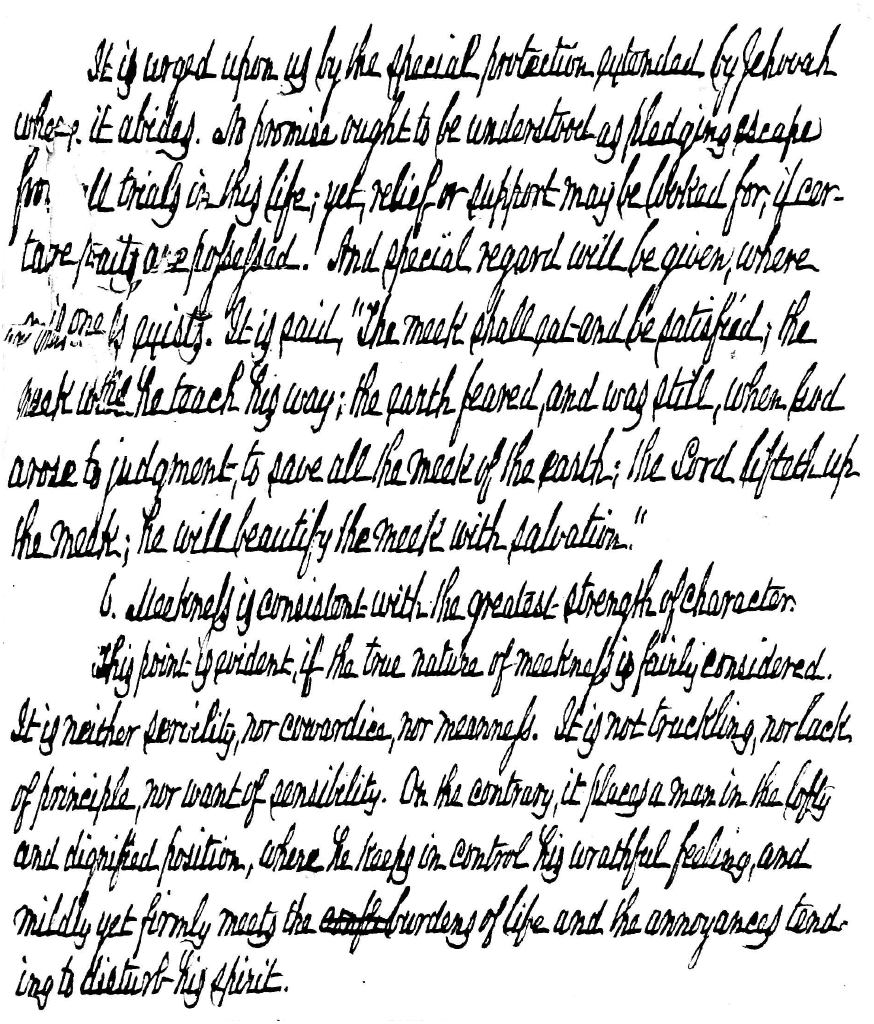
It is urged upon us by the special protection extended by Jehovah wh… it abides. No promise ought to be understood as pledging escape fro…ll trials in this life; yet, relief or support may be looked for, if certa…aits are possessed. And special regard will be given, where m… exists. It is said, “The meek shall eat and be satisfied; the meek … he teach his way; the earth feared, and was still, when God arose to judgment, to save all the meek of the earth; the Lord lifteth up the meek; he will beautify the meek with salvation.”
5. Meekness is consistent with the greatest strength of character.
This point is evident, if the true nature of meekness is fairly considered. It is neither servility, nor cowardice, nor meanness. It is not truckling, nor lack of principle, nor want of sensibility. On the contrary, it keeps a man in the lofty and dignified position, where he keeps in control his wrathful feeling, and mildly yet firmly meets the burdens of life and the annoyances tending to disturb his spirit.
Page 13:
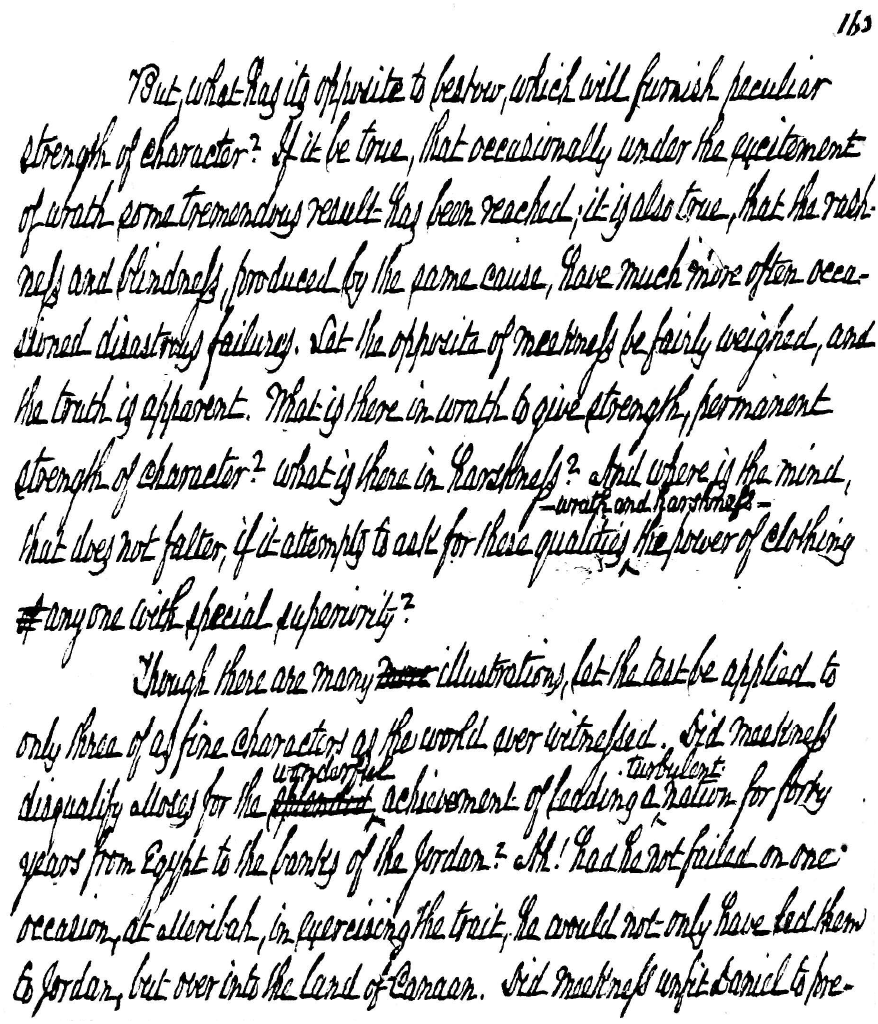
But what has its opposite to bestow, which will furnish peculiar strength of character? If it be true, that occasionally under the excitement of some tremendous result has been reached; it is also true, that the rashness and blindness, produced by the same cause, have much more often occasioned disastrous failures. Let the opposite of meekness be fairly weighed, and the truth is apparent. What is there in wrath to give strength, permanent strength of character? What is there in harshness? And where is the mind, that does not falter, if it attempts to ask for these qualities - wrath and harshness - the power of clothing anyone with special superiority?
Though there are many illustrations, let the test be applied to only three of as fine characters as the world ever witnessed. Did meekness disqualify Moses for the wonderful achievement of leading a turbulent nation for forty years from Egypt to the banks of the Jordan? Ah! Had he not failed on one occasion, at Meribah, in exercising the trait, he could not only have led them to Jordan, but over into the Land of Canaan. Did meekness unfit Daniel to pre-
Page 14:
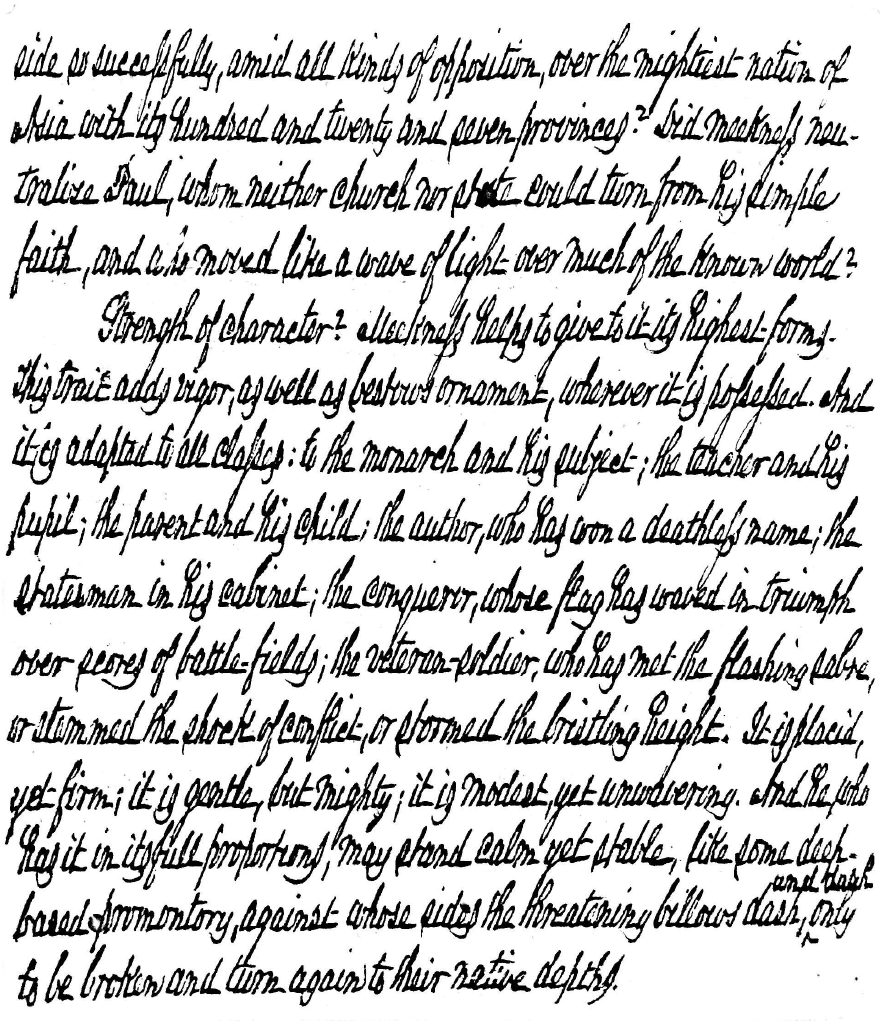
-side as successfully, amid all kinds of opposition, over the mightiest nation of Asia with its hundred and twenty and seven provinces? Did meekness neutralize Paul, whom neither church nor state could turn from his simple faith, and who moved like a wave of light over much of the known world?
Strength of character? Meekness helps to give to its highest forms. This trait adds vigor, as well as bestows ornament, wherever it is possessed. And it is adapted to all classes: to the monarch and his subject; the teacher and his pupil; the parent and his child; the author, who has won a deathless name; the statesman in his cabinet; the conqueror, whose flag as waved in triumph over scores of battle-fields; the veteran-soldier, who has met the flashing sabre, or stemmed the shock of conflict, or stormed the bristling height. It is placid, yet firm; it is gentle, but mighty; it is modest, yet unwavering. And he, who has it in full proportions, may stand calm yet stable, like some deep-based promontory, against whose sides the threatening billows dash, and dash only to be broken and turn again to their native depths.
Page 15:
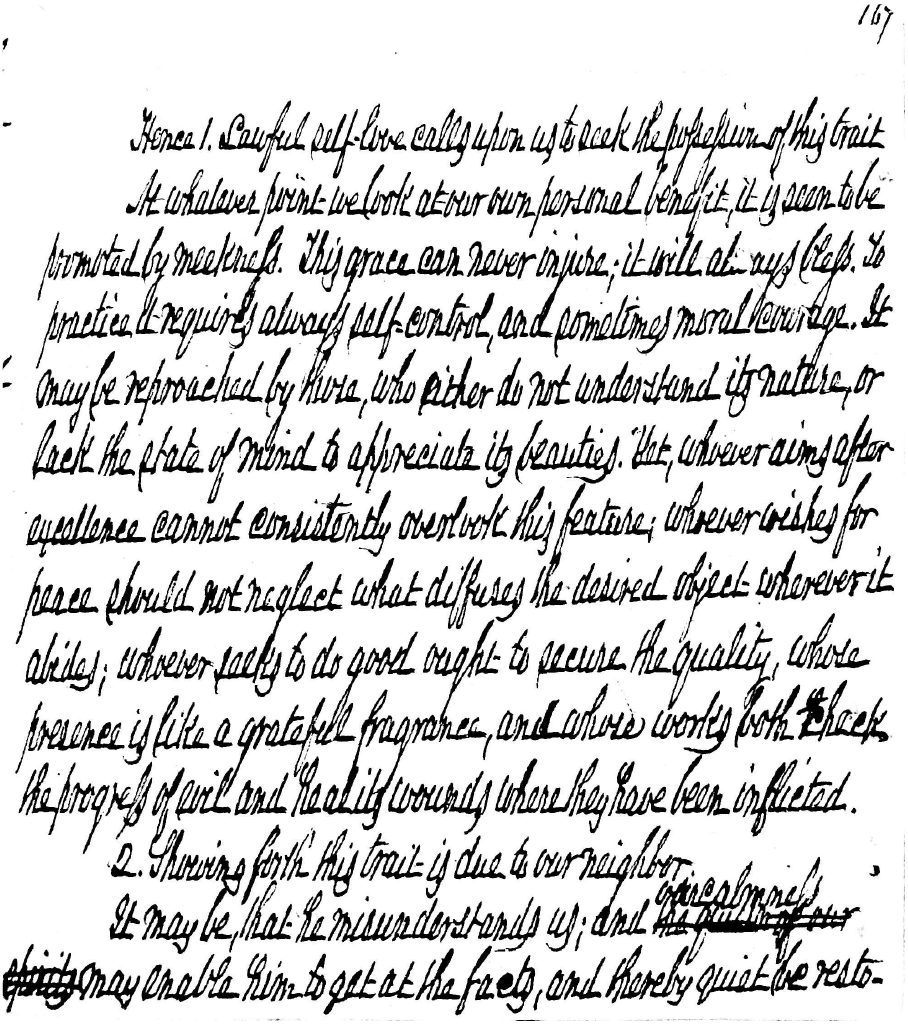
Hence 1. Lawful self-love calls upon us to seek possession of this trait.
At whatever point we look at our own personal benefit, it is seen to be promoted by meekness. This grace can never injure; it will always bless. To practice it requires always self-control, and sometimes moral courage. It may be reproached by those, who either do not understand its nature, or lack the state of mind to appreciate its beauties. Yet, whoever aims after excellence cannot consistently overlook this feature; whoever wishes for peace should not neglect what diffuses the desired object wherever it abides; whoever seeks to do good ought to secure the quality, whose presence is like a grateful fragrance, and whose works both check the progress of evil and heal its wounds where they have been inflicted.
2. Showing forth this trait is due to our neighbor.
It may be, that he misunderstands us; and calmness may enable him to get at the facts, and thereby quiet be resto-
Page 16:
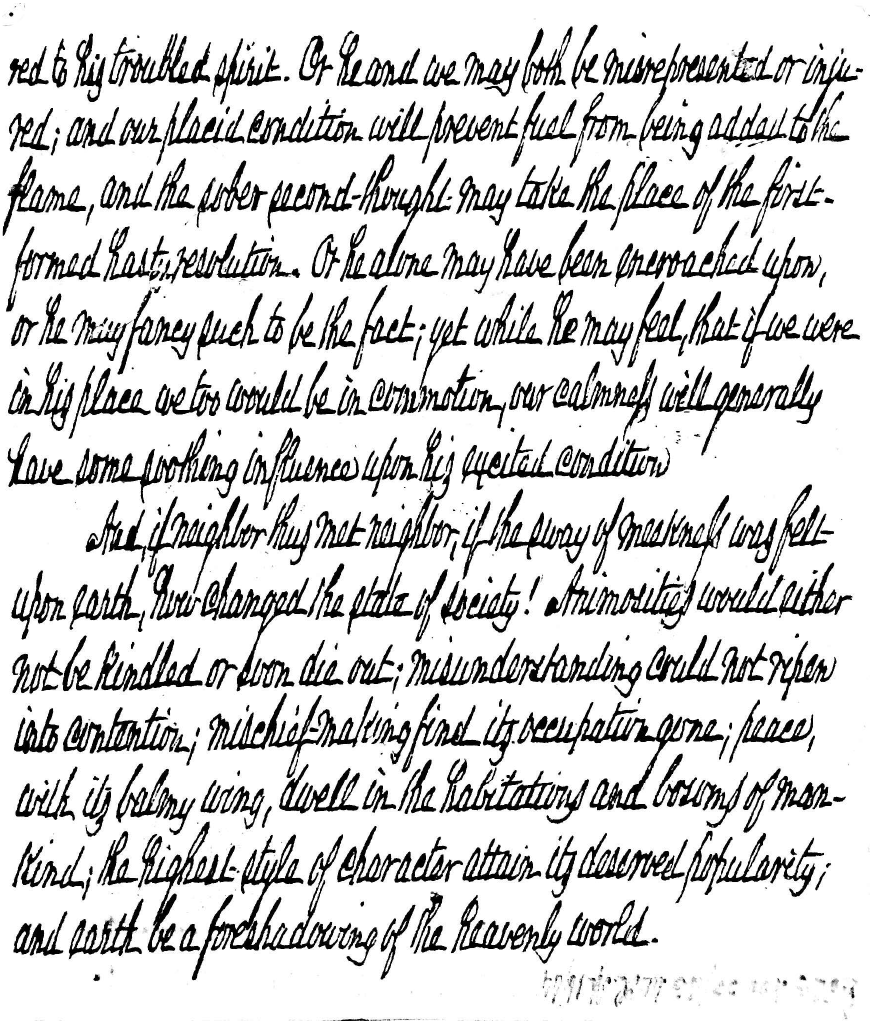
-red to his troubled spirit. Or he and we may both be misrepresented or injured; and our placid condition will prevent fuel from being added to the flame, and the sober second-thought may take the place of the first-formed hasty resolution. Or he alone may have been encroached upon, or he may fancy such to be the fact; yet while he may feel, that if we were in his place we too would be in commotion, our calmness will generally have some soothing influence upon his excited condition.
And if neighbor thus met neighbor, if the sway of meekness was felt upon earth, how changed the state of society! Animosity would either not be kindled or soon die out; misunderstanding could not ripen into contention; mischief-making find its occupation gone; peace, with its balmy wing, dwell in the habitations and bosoms of mankind; the highest style of character attain its deserved popularity; and earth be a foreshadowing of the heavenly world.