Forgiveness
Page 1:
Forgiveness
However independent any may feel in the midst of excitement with respect to receiving forgiveness, but few will be found, when reflection has gained the ascendency, who are not willing to be forgiven. Though hate makes terrible havoc with the kindly feelings, yet lawful self-love cannot always be crushed. Say what some men may, they had rather have, even one whom they do not respect, to be a negative friend than an active enemy. A man's regard for himself, when it is allowed to have proper expression, will prompt him to wish to be forgiven. He may not seek it by his acts, though he may desire the reality. And this, which he prefers for himself, he owes unto his neighbor. Amid the clashings of life, misunderstandings occur or injuries are done; and, as a result, unkind feeling is awakened, and contentions arise. But, all warfare damages, in some way, both parties; often the apparently triumphant being, in the end, the greater loser. It is appropriate, therefore, to consider the reasonableness of exercising forgiveness.
Page 2:
1. So far as forgiveness affects character, it causes to resemble God.
Had this trait no existence in the character of Jehovah, Adam would not have posterity extending to the present day; or, men allowed to exist here for a time, no ark would have floated upon the bellows of the deluge.; or, earth’s population remaining to this passing hour, not another hour would witness their spirits this side the world of despair.
Still, this benevolent feeling does not destroy nor weaken the attribute of justice. One quality is not indulged and exercised, so as to interfere with others. The Lord acts righteously, while he acts kindly. While bestowing pardon, he grants the boon in such a way, that as Governor, he cannot be arraigned in the mind of any on the ground of having disregarded the principles of a holy administration; nor as judge, with having perverted law, and neglected the rights or privileges of any of his creatures/
The magistrate, sitting upon the bench of an earthly court, may have very tender emotions toward the criminal convicted in a fair trial; yet, that kind feeling, seen in his heaving bosom, tearful eye and trembling voice, gives him no right to violate the laws of his country and let the offender escape the proper penalty. The parent does
Page 3:
not regard his child with less benevolent feelings, when for the safety and good order of his family one of the disobedient is corrected; nor has he any authority to neglect his duty to discipline the perverse, because the act will be a trial to himself, if by such neglect he breaks down order in his household, and sends out in after life into society an ungovernable and reckless individual. Nor can the citizen be justified in gratifying his kind wishes, by preventing just laws from being executed upon offenders, whose conduct is in opposition to the prosperity, safety and happiness of the community. And yet, each of these may possess, in an eminent degree, a forgiving spirit, though they are engaged in acts of a corrective character. Justice to the whole is entirely consistent with the most kindly feelings to the different parts.
So God, while just, is ready to forgive all, who can be pardoned without injury to the government over which he presides. And when, in accordance with right principles, any must perish, it is not because the Lord of mercy delights in their destruction! “As I live, saith the Lord God, I have no pleasure in the death of the wicked; but rather that he turn from his way and live.”
Page 4:
Jehovah, therefore, appears before us, full of the spirit of forgiveness. And not only thus, but actually exercising this feeling, whenever it can be consistently performed. This bright example we may imitate. No man’s integrity demands, that he keep the fire of enmity alive in his bosom. We may bury the hatchet; yea, keep it buried; and still do our part in life. And he, who thus stays the tide of his native propensities to revenge, and causes to gush forth in its stead the healing and calming fountain of forgiveness, will ever be assimilating to the benevolent spirit, who presides in grace and glory upon the eternal throne.
2. To forgive is a triumph over our depravity.
Man's love of evil is a fact so plainly presented in the history of our race, that its denial implicates either our discrimination or our candor. And scarcely any of the features, in which this love makes itself apparent, have been more disastrous to the individual and society, than the one which is the opposite of the feeling of forgiveness. Resentment, originally implanted in our constitution for good purposes, instead of fulfilling its appointed duty, and then
Page 5:
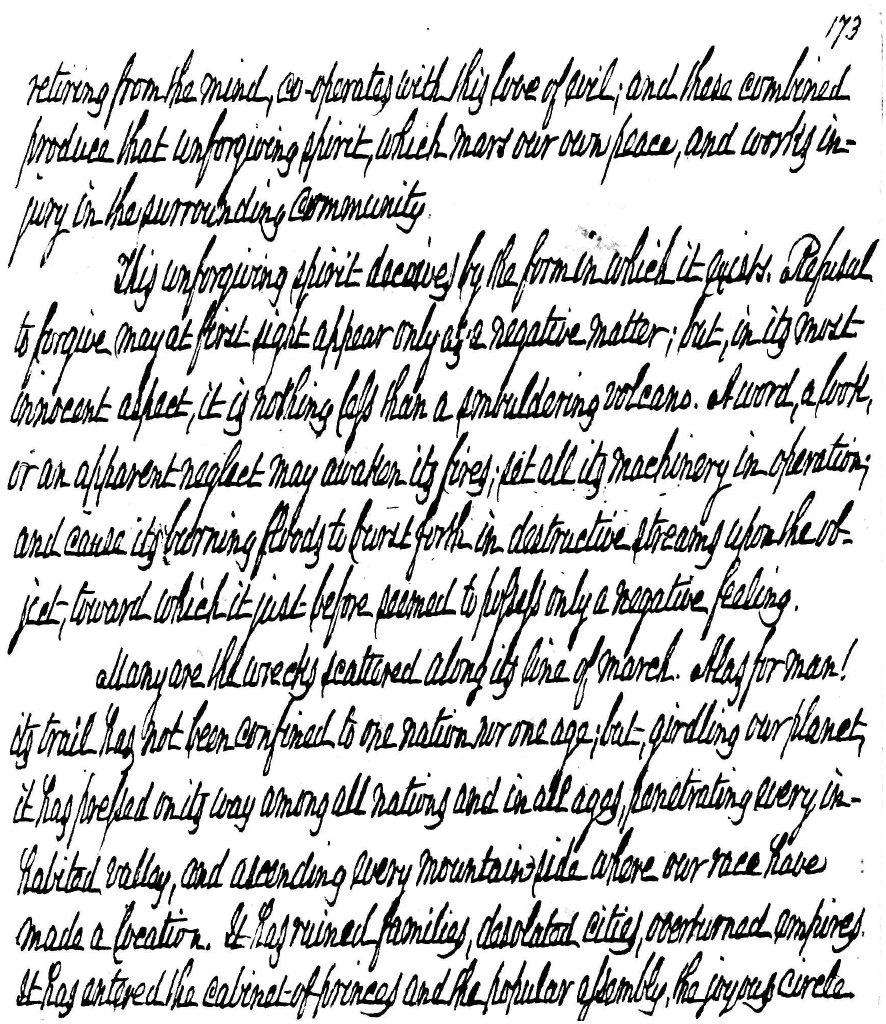
retiring from the mind, co-operates with this love of evil; and these combined produce that unforgiving spirit, which mars our own peace, and works injury the surrounding community.
This unforgiving spirit deceives by the form in which it exists. Refusal to forgive may at first sight appear only as a negative matter; but, in its most innocent aspect, it is nothing less than a smouldering volcano. A word, a look, or an apparent neglect may awaken its fires; set all its machinery in operation; and cause its burning floods to burst forth in destructive streams upon the object, toward which it just before seemed to possess only a negative feeling.
Many are the wrecks scattered along its line of march. Alas for man! its trail has not been confined to one nation nor one age; but, girdling our planet, it has pressed on its way among all nations and in all ages; penetrating every inhabited valley, and ascending every mountain-side where our race have made a location. It has ruined families, desolated cities, overturned empires. It has entered the cabinet of princes and the popular assembly, the joyous circle
Page 6:
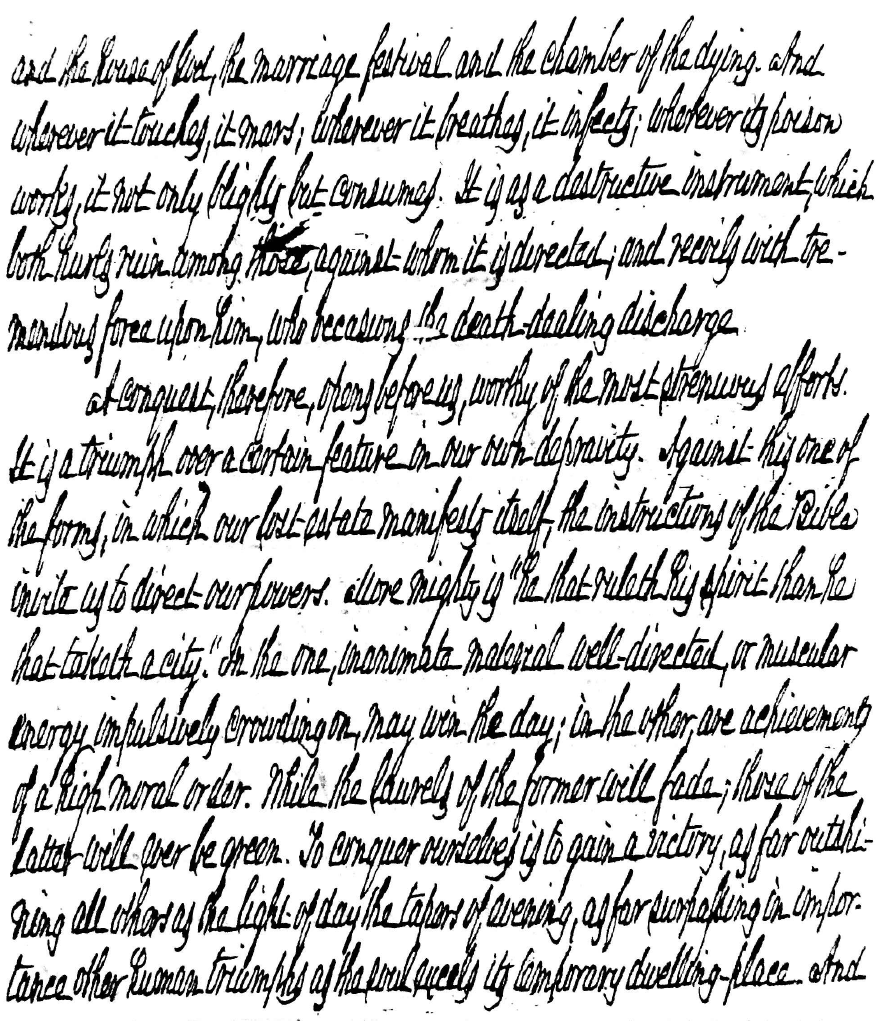
and the house of God, the marriage festival and the chamber of the dying. And whoever it touches, it mars; wherever it breathes, it infects; wherever its poison works, it not only blights but consumes. It is a destructive instrument, which both hurls ruin among those, against whom it is directed; and recoils with tremendous force upon him, who occasions the death-dealing discharge.
A conquest, therefore, opens before us, worthy of the most strenuous efforts. It is a triumph over a certain feature in our own depravity. Against this one of the forms, in which our lost estate manifests itself, the instructions of the Bible invite us to direct our powers. More mighty is “he that ruleth his spirit than he that taketh a city.” In the one, inanimate material well-directed, or muscular energy impulsively crowding on, may win the day; in the other, are achievements of a high moral order. While the laurels of the former will fade; those of the latter will ever be green. To conquer ourselves is to gain a victory, as far outshining all others as the light of day the tapers of evening, as far surpassing in importance other human triumphs as the soul excels its temporary dwelling-place. And
Page 7:
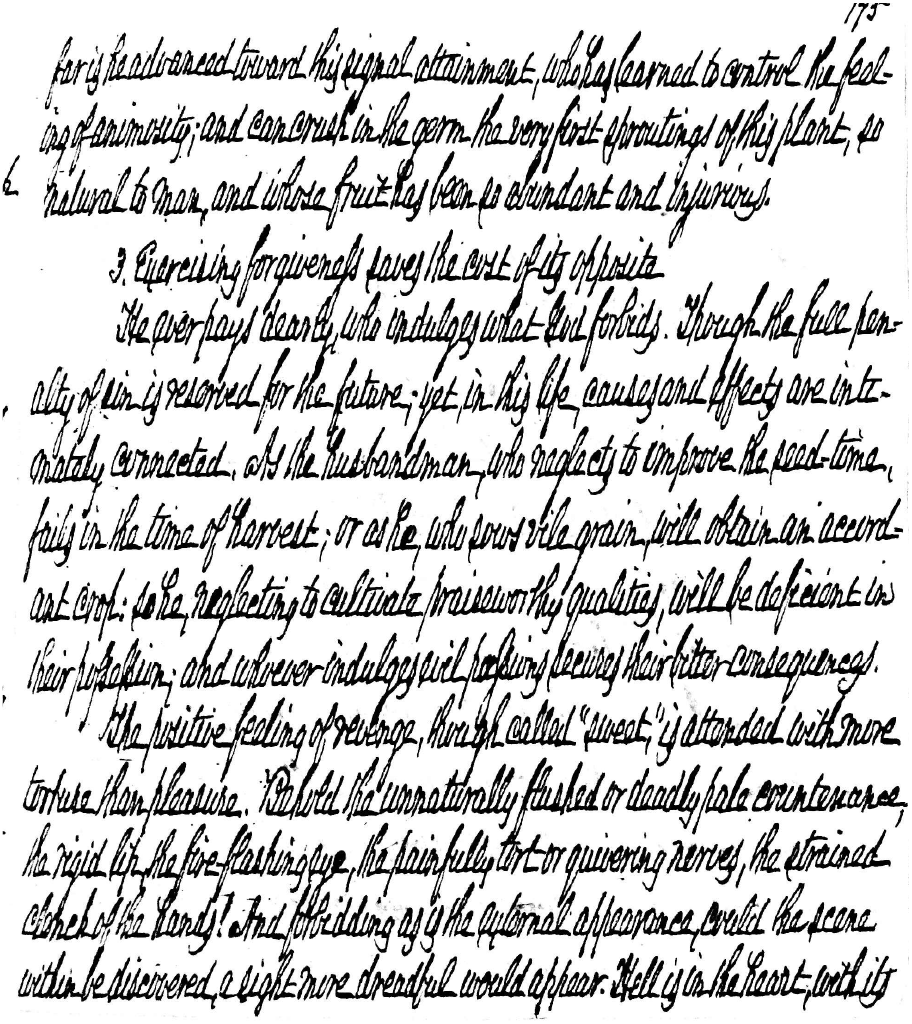
far is he advanced toward this signal attainment, who has learned to control the feeling of animosity; and can crush in the germ the very first sproutings of this plant, so natural to man, and whose fruit has been so abundant and injurious.
3. Exercising forgiveness saves the cost of its opposite.
He overpays dearly, who indulges what God forbids. Though the full penalty of sin is reserved for the future; yet, in this life, causes and effects are intimately connected. As the husbandman, who neglects to improve the seed-time, fails in the time of harvest; or as he, who sows vile grain, will be deficient in their possession; and whoever indulges evil passions secures their bitter consequences.
The positive feeling of revenge, though called “sweet,” is attended with more torture than pleasure. Behold the unnaturally flushed or deadly pale countenance, the rigid lip, the fire-flashing eye, the painfully tort or quivering nerves, the strained clench of the hands! And forbidding as is the external appearance, could the scene within be discovered, a sight more dreadful would appear. Hell is in the heart, with its
Page 8:
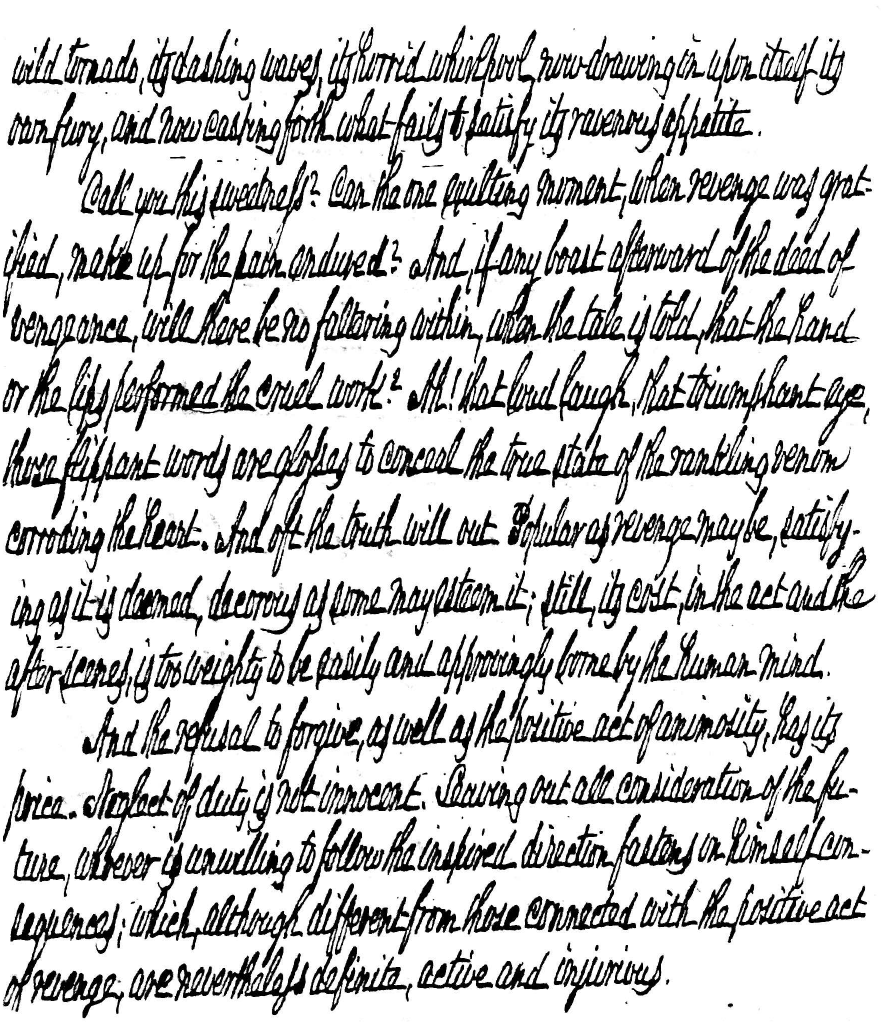
wild tornado, its dashing waves, its horrid whirlpool, now-drawing in upon itself its own fury, and now casting forth what fails to satisfy its ravenous appetite.
Call ye this sweetness? Can the one exulting moment, when revenge was gratified, make up for the pain endured? And, if any boast afterward of the deed of vengeance, will there be no faltering within, when the tale is told, that the hand or the lips, performed the cruel work? Ah! that loud laugh, that triumphant eye, those flippant words ore glosses to conceal the true state of the rankling venom corroding the heart. And oft the truth will out. Popular as revenge may be, satisfying as it is deemed, decorous as some may esteem it; still, its cost, in the act and the after scenes, is too weighty to be easily and approvingly borne by the human mind.
And the refusal to forgive, as well as the positive act of animosity, has its price. Neglect of duty is not innocent. Leaving out all consideration of the future, whoever is unwilling to follow the inspired direction fastens on himself consequences; which, although different from those connected with the positive act of revenge, are nevertheless definite, active and injurious.
Page 9:
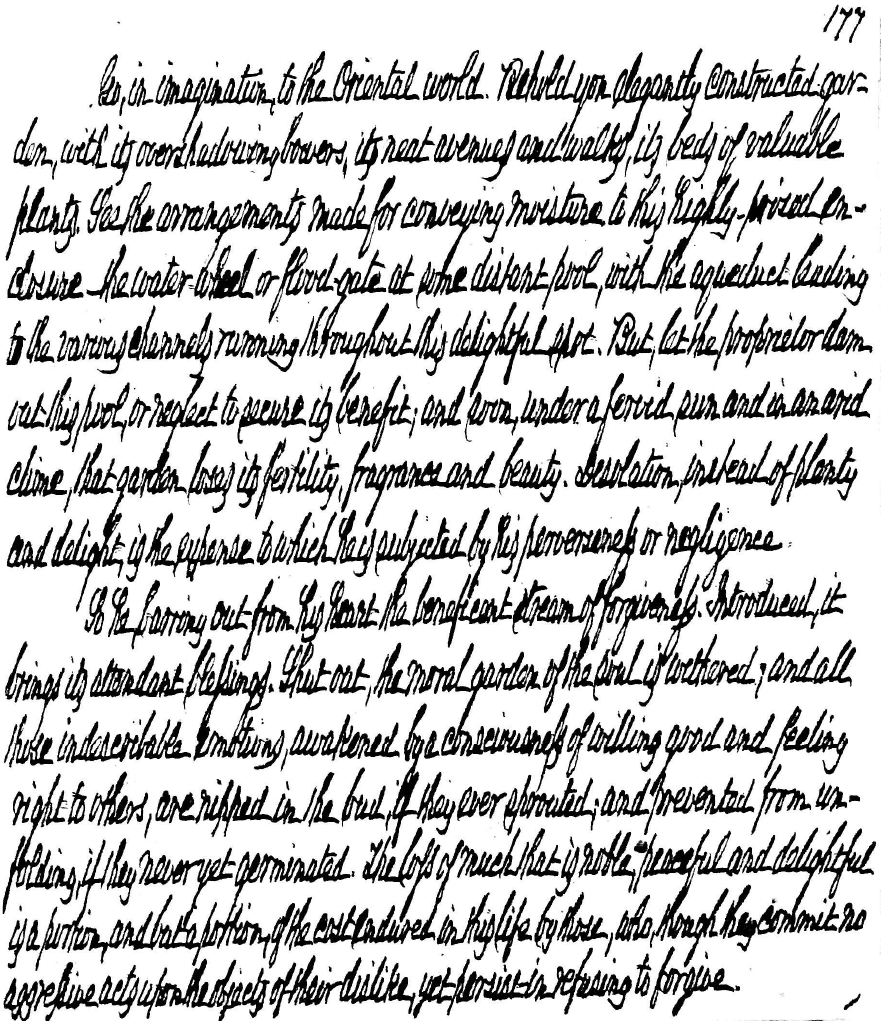
Go, in imagination, to the oriental world. Behold yon elegantly constructed garden, with its overshadowing bowers, its neat avenues and walks, its beds of valuable plants. See the arrangements made for conveying moisture to this highly-prized enclosure the water wheel or flood-gate at some distant pool, with the aqueduct leading to the various channels running throughout this delightful spot. But, let the proprietor dam out this pool, or neglect to secure its benefit; and soon, under a fervid sun and arid clime, that garden loses its fertility, fragrance, and beauty. Desolation, instead of plenty and delight, is the expense to which he is subjected by his perverseness or negligence.
So he, barring out from his heart the beneficent stream of forgiveness. Introduced, it brings its attendant feelings. Shut out, the moral garden of the soul is withered; and all those indescribable emotions, awakened by a consciousness of willing good and feeling right to others, are nipped in the bud, if they ever sprouted; and prevented from unfolding, if they never yet germinated. The loss of much that is noble, peaceful and delightful is a portion, and but a portion, of the cost endured in this life by those, who, though they commit no aggressive acts upon the objects of their dislike, yet persist in refusing to forgive.
Page 10:
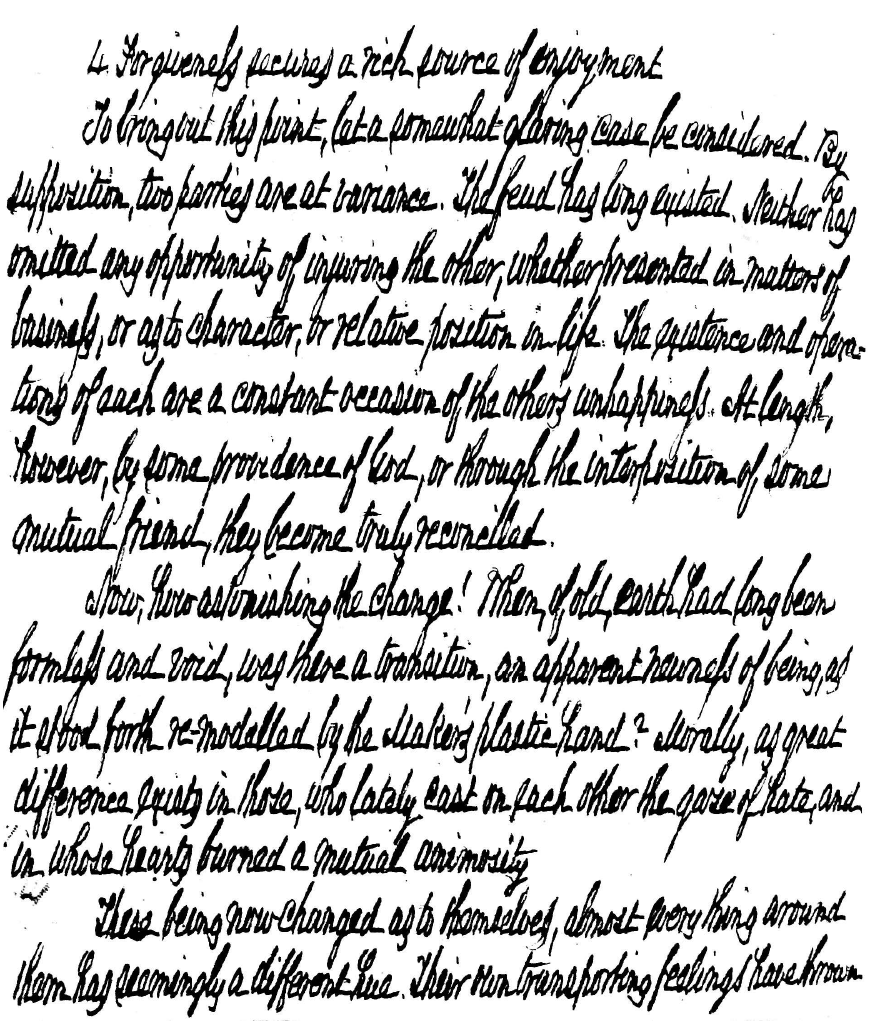
4. Forgiveness secures a rich source of enjoyment.
To bring out this point, let a somewhat glaring case be considered. By supposition, two parties are at variance. The feud has long existed. Neither has omitted any opportunity of injuring the other, whether presented in matters of business, or as to character, or relative position in life. The existence and operations of each are a constant occasion of the other’s unhappiness. At length, however, by some providence of God, or through interposition of some mutual friend, they became truly reconciled.
Now, how astonishing the change! When, of old, earth had long been formless and void, was there a transition, an apparent newness of being, as it stood forth re-modelled by the Maker’s plastic hand? Morally, as great difference exists in those, who lately cast on each other the gaze of hate, and in whose hearts burned a mutual animosity.
These being now-changed as to themselves, almost every thing around them has seemingly a different hue. Their own transporting feelings have thrown
Page 11:
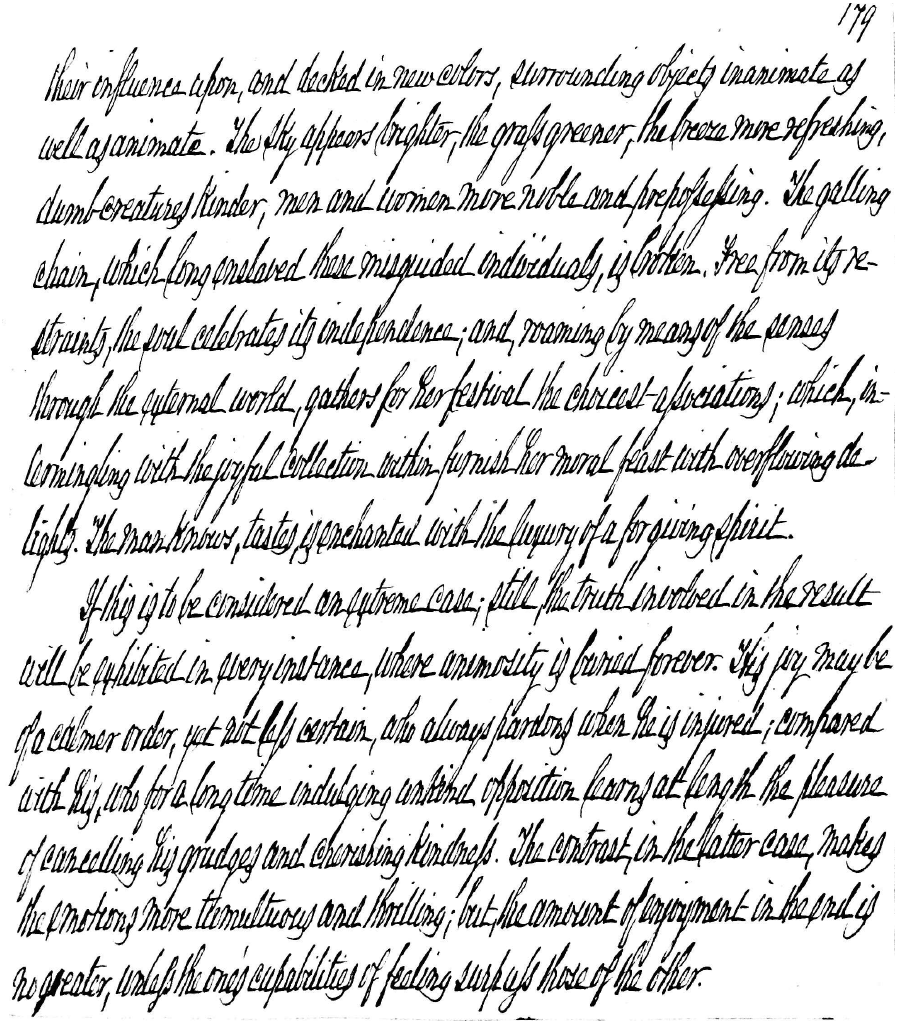
their influence upon, and decked in new colors, surrounding objects inanimate as well as animate. The sky appears brighter, the grass greener, the breeze more refreshing, dumb-creatures kinder, men and women more noble and prepossessing. The galling chain, which long enslaved those misguided individuals, is broken. Free from its restraints, the soul celebrates its independence; and, roaming by means of the senses through the external world, gathers for her festival the choicest associations; which, intermingling with the joyful collection furnish her moral feast with overflowing delights. The man knows, tastes, is enchanted with the luxury of a forgiving spirit.
If this is to be considered an extreme case; still, the truth involved in the result will be exhibited in every instance, where animosity is buried forever. This joy may be of a calmer order, yet not less certain, who always pardons when he is injured; compared with his, who for a long time indulging unkind opposition learns at length the pleasure of cancelling his grudges and cherishing kindness. The contrast, in the latter case, makes the emotions more tumultuous and thrilling; but, the amount of enjoyment in the end is no greater, unless the one’s capabilities of feeling surpass those of the other.
Page 12:
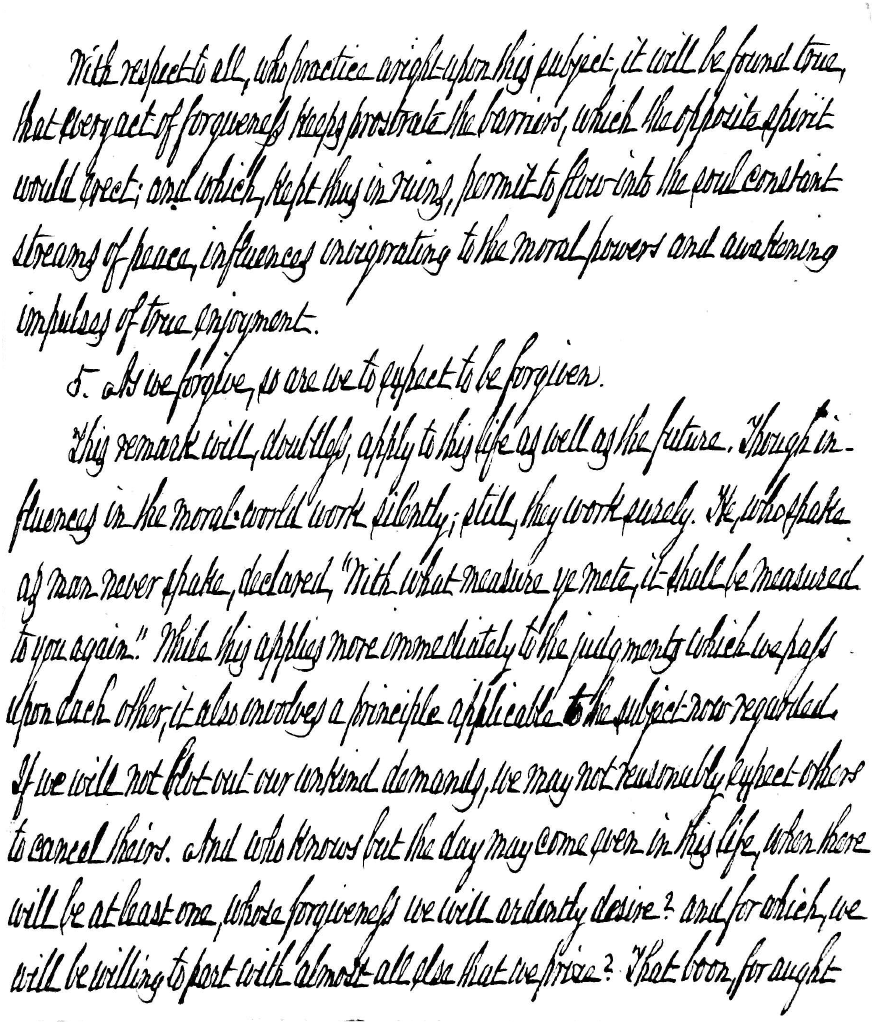
With respect to all, who practice aright upon this subject, it will be found true, that every act of forgiveness keeps prostrate at the barriers, which the opposite spirit would erect; and which, kept thus in ruins, permit to flow into the soul constant streams of peace, influences invigorating to the moral powers and awakening impulses of true enjoyment.
5. As we forgive, so are we to expect to be forgiven.
This remark will, doubtless, apply to this life as well as the future. Though influences in the moral world work silently; still, they work surely. He, who spake as man never spake, declared, “With what measure ye mete, it shall be measured to you again.” While this applies more immediately to the judgements which we pass upon each other, it also involves a principle to the subject now regarded. If we will not blot out our unkind demands, we may not reasonably expect others to conceal theirs. And who knows but the day may come even in this life, when there will be at least one, whose forgiveness we will ardently desire? and for which, we will be willing to part with almost all else that we prize? That boon, for aught
Page 13:
that we can determine, may be denied. And denied, in perfect accordance with the production of results in moral government; which, though not understood fully by us in some of the modes of its operations, fails not to secure sooner or later its legitimate consequences.
When, however, this point is examined in the light of direct effects following given causes, any doubts, which may be entertained, must at once be dispelled. Jehovah has clearly revealed his rule of action in the case of man’s refusing to forgive his fellow. By parables and distinct propositions, this rule is made so plain as completely to debar all question. But, if any one form, in which the truth upon this subject is presented, is more interesting than another, it is that given in the shape of a prayer. We are to pray unto our Maker, “Forgive us, as we forgive those who trespass against us.”
The intimation is plain. As ye thus do, so it will be done unto you. If ye withhold pardon from one, who has interfered with your rights or desires, God will keep it back from you, who have sinned against him far more grievously than it is possible for any mortal to trespass upon his fellow-man. The one is the index of the other. By
Page 14:
our own standard, we will be guaged [sic]. The heart, that will not yield tenderness to others’ fancied or real faults, must not expect of God to grant the favor to it, which it refuses to bestow.
And, can any one be found, who has never disregarded the rights and wishes of Jehovah? Who so innocent as to need no remission? When righteousness is laid to the line, and justice to the plummet; when our delinquencies are brought to the unerring test; when placed in the balance of truth; who is not found wanting? who is not convicted? who is not condemned?
Now, then, shall any appear before him, who has bidden us to pray and hope for forgiveness, according to the proportion in which this favor has been extended unto others? How can any utter, “Forgive me, my Father!” if in his own soul the fire of animosity toward some fellow-being has never yet been quenched? A fire, still full of latent heat, though it may not for a while have blazed out its lurid flames; but which, at any moment and for any cause, may burst forth in its fury, and consume the peace and bright prospects of its unguarded object.
Page 15:
And now, as exercising forgiveness is so clearly reasonable, it is evident 1, that we should not refuse to forgive, even if those who have injured us do not make acknowledgement nor ask forgiveness.
Some have a wrong theory about this feature of this important matter. They admit the general duty to forgive; yet, they insist, that the offender must show them some signs, either that he is convinced of his wrong-doing, or that he wishes to be forgiven. That this is not the proper ground to occupy will appear, if we look at the thing itself, at the dictates of reason, or at the instructions of the Scriptures.
What, then, is implied when it is said, that an offender must make some amends before we extend forgiveness? Two things seem to be involved. One is, that the offended party will not do the offender any positive injury; but the other is, that the offender shall in some way stoop to the offended, and thus enable the offended to triumph. Now, how far short does this come of revenge? The offended party may have too much principle or self-respect to destroy the other’s property, or slander him, or strive to prevent his success in life; yet, he holds him in his feelings at more than an arm’s-length distance, and is determined to have him bend in some way before he
Page 16:
will blot out his fault. If this is not revenge, it virtually amounts to the same thing. It is the only kind of revenge which they take, who respect themselves too much to do actual injury, by word or deed, to those with whom they are at variance. It has not the spirit of true forgiveness. And alas! there is too much of this feeling existing - refusing to forgive, until the offender shall in some way humble himself or make amends to the offended party.
Look at this notion, too, in the light of reason. Sufficient, however, has been already remarked, showing the reasonableness of exercising forgiveness. Yet, if any hold back for the offender to make amends, and if he neglect thus to do, the benefits flowing from forgiveness, which reason endures, are not enjoyed.
And, what saith the Scriptures?
In one place, the Saviour, speaking of offences occurring in society, adds, “Take heed to yourselves: if thy brother trespass against thee, rebuke him; and if he repent, forgive him: and if he trespass against thee seven times in a day, and seven times in a day turn again to thee, saying, I repent; thou shalt for-
Page 17:
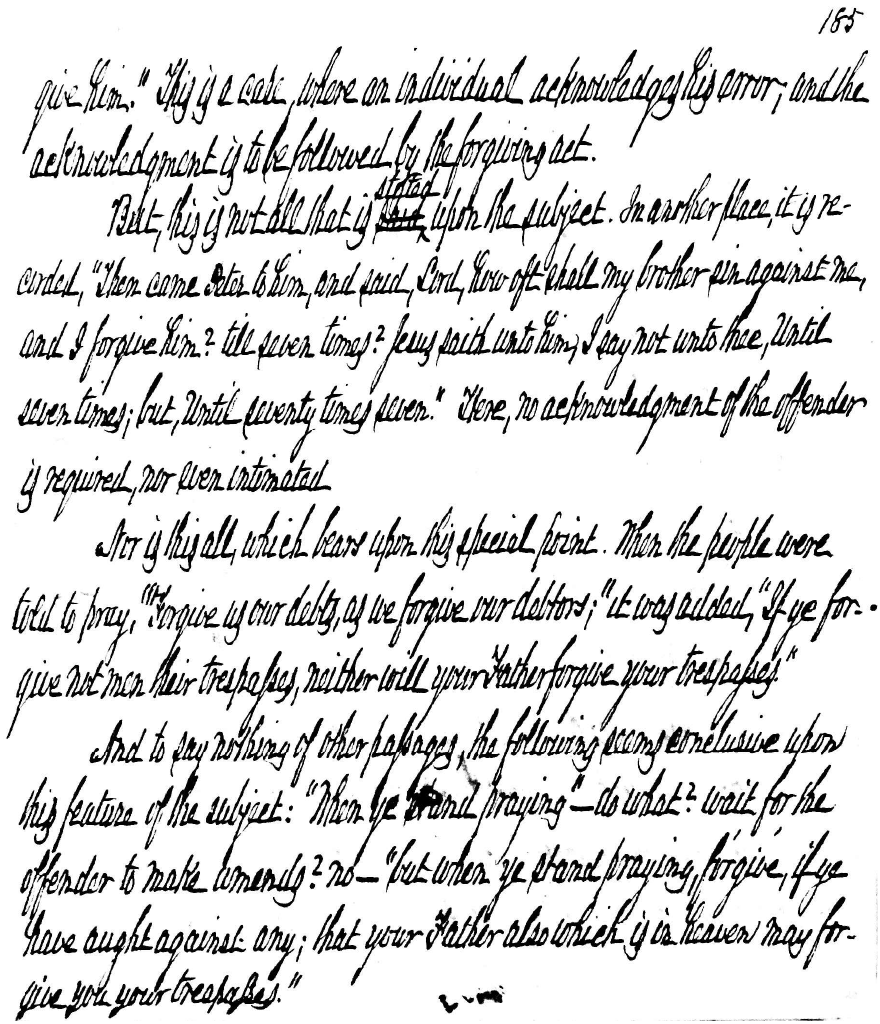
-give him.” This is a case, where an individual acknowledges his error; and the acknowledgement is to be followed by the forgiving act. But, this is not all that is stated upon the subject. In another place, it is recorded, “Then came Peter to him, and said, Lord, how oft shall my brother sin against me, and I forgive him? till seven times? Jesus saith unto him, I say not unto thee, until seven times; but, until seventy times seven.” Here, no acknowledgement of the offender is required, nor even intimated.
Nor is this all, which bears upon this special point. When the people were told to pray, “Forgive us our debts, as we forgive our debtors;” it was added, “If ye forgive not men their tresspasses, neither will your Father forgive your tresspasses.”
And to say nothing of other passages, the following seems conclusive upon this feature of the subject: “When ye stand praying” - do what? wait for the offender to make amends? no - “but when ye stand praying, forgive, if ye have aught against any; that your Father also which is in heaven may forgive you your tresspasses.”
Page 18:
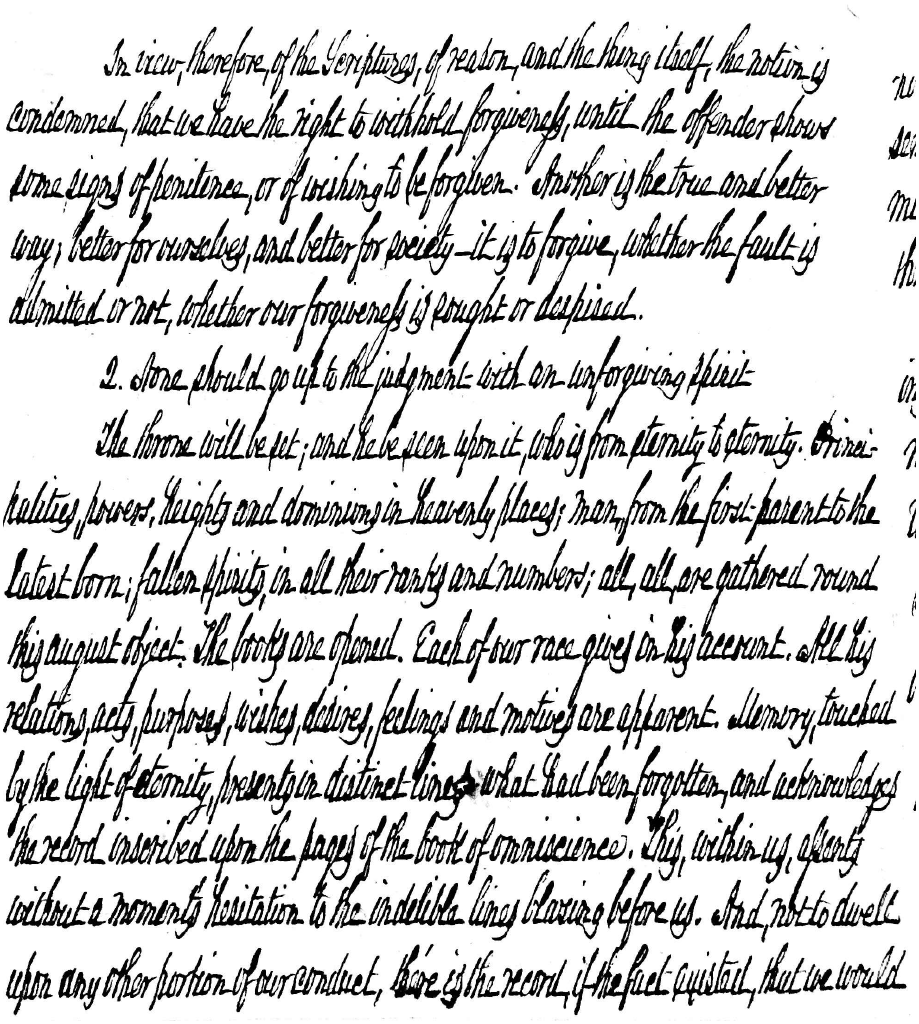
In view, therefore, of the Scriptures, of reason, and the thing itself, the notion is condemned, that we have the right to withhold forgiveness, until the offender shows some signs of penitence, or of wishing to be forgiven. Another is the true and better way; better for ourselves, and better for society - it is to forgive, whether the fault is admitted or not, whether our forgiveness is sought or despised.
2. None should go up to the judgement with an unforgiving spirit.
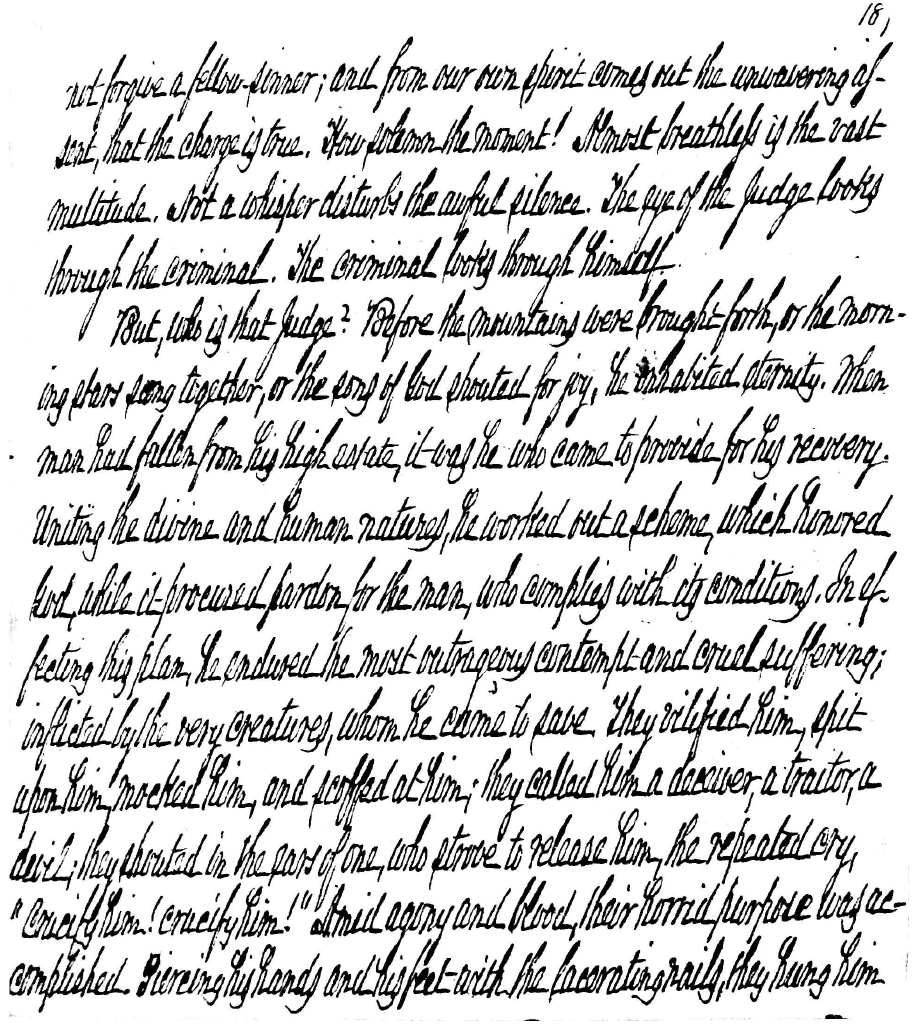
The throne will be set; and he be seen upon it, who is from eternity to eternity. Principalities, powers, heights and dominions in heavenly places; man, from the first parent to the latest born; fallen spirits, in all their ranks and numbers; all, all are gathered round this august object. The books are opened. Each of our race gives in his account. All his relations, acts, purposes, wishes, desires, feelings and motives are apparent. Memory, touched by the light of eternity, presents in distinct lines what had been forgotten, and acknowledges the record inscribed upon the pages of the book of omniscience. This, within us, assents without a moment’s hesitation to the indelible lines blazing before us. And, not to dwell upon any other portion of our conduct, there is the record, if the fact existed, that we would
Page 19:
not forgive a fellow-sinner; and from our spirit comes out the unwavering assent, that the charge is true. How solemn the moment! Almost breathless is the vast multitude. Not a whisper disturbs the awful silence. The eye of the judge looks through the criminal. The criminal looks through himself.
But, who is that judge? Before the mountains were brought forth, or the morning stars sang together, or the sons of God shouted for joy, he inhabited eternity. When man had fallen from his high estate, it was he who came to provide for his recovery. Uniting the divine and human natures, he worked out a scheme, which honored God, while it procured pardon for the man, who complies with its conditions. In effecting this plan, he endured the most outrageous contempt and cruel suffering; inflicted by the very creatures, whom he came to save. They vilified him, spit upon him, mocked him, and scoffed at him; they called him a deceiver, a traitor, a devil; they shouted in the ears of one, who strove to release him, the repeated cry, “Crucify him! crucify him!” Amid agony and blood, their horrid purpose was accomplished. Piercing his hands and his feet with the lacerating nails, they hung him
Page 20:
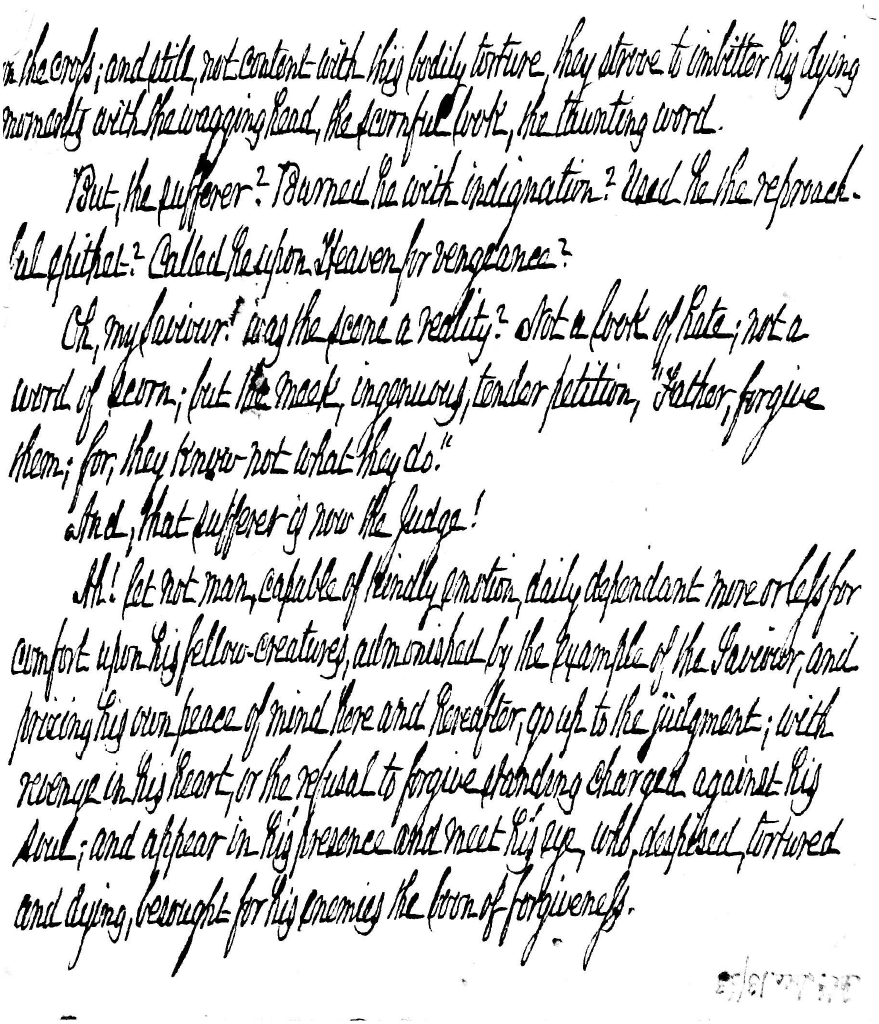
on the cross; and not content with this bodily torture, they strove to imbitter his dying moments with the wagging hand, the scornful look, the taunting word.
But, the sufferer? Burned he with indignation? Used he the reproachful epithet? Called he upon Heaven for vengeance?
Oh, my saviour! Was the scene a reality? Not a look of hate; not a word of scorn; but the meek, ingenuous, tender petition, “Father, forgive them; for, they know not what they do.”
And, that sufferer is now the judge!
Ah! let not man, capable of kindly emotion, daily dependant more or less for comfort upon his fellow-creatures, admonished by the example of the Saviour, and prizing his own peace of mind here and hereafter, go up to the judgement; with revenge in his heart, or the refusal to forgive standing charged against his soul; and appear in his presence and meet his eye, who despised, tortured and dying, besought for his enemies the boon of forgiveness.