Peace
Page 1:
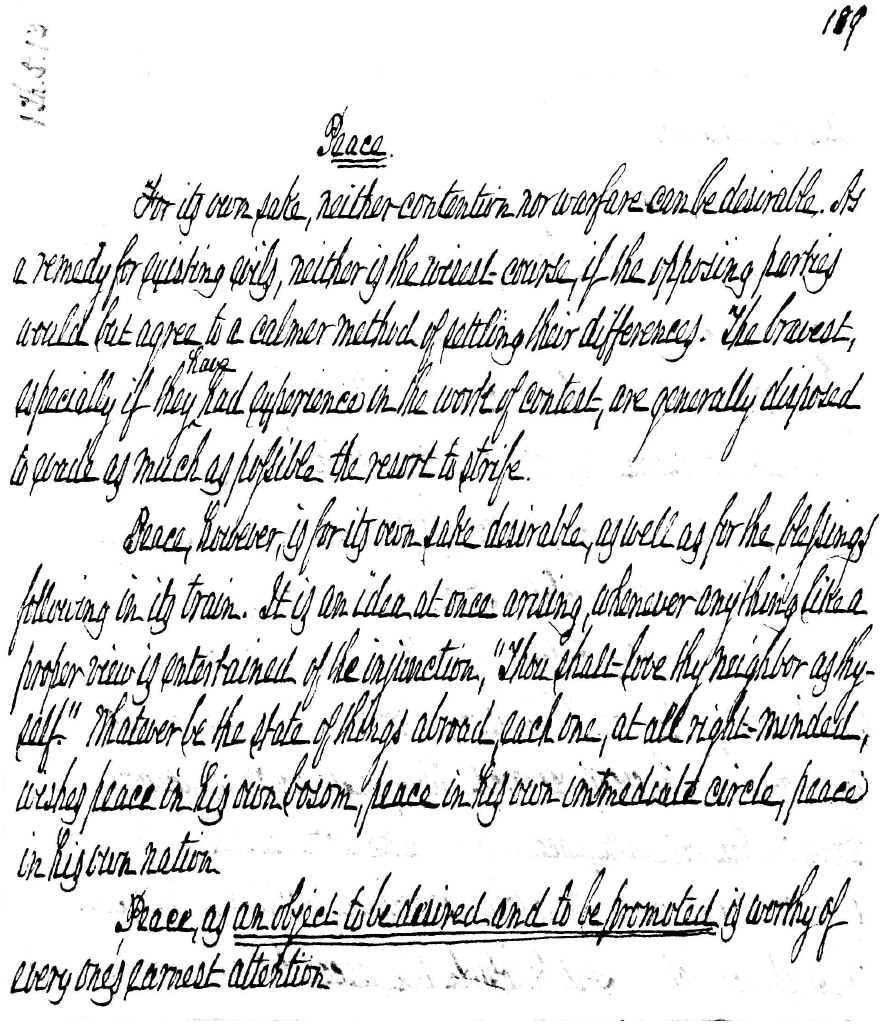
Peace.
For its own sake, neither contention nor warfare can be desirable. As a remedy for existing evils, neither is the wisest course, if the opposing parties would but agree to a calmer method of settling their differences. The bravest, especially if they have had experience in the work of contest, are generally disposed to evade as much as possible the resort to strife.
Peace, however, is for its own sake desirable, as well as for the blessings following in its train. It is an idea at once arising, whenever anything like a proper view is entertained of the injunction, "Thou shalt love thy neighbor as thyself." Whatever be the state of things abroad, each one, at all right-minded, wishes peace in his own bosom, peace in his own immediate circle, peace in his own nation.
Peace, as an object to be desired and to be promoted is worthy of every one’s earnest attention.
Page 2:
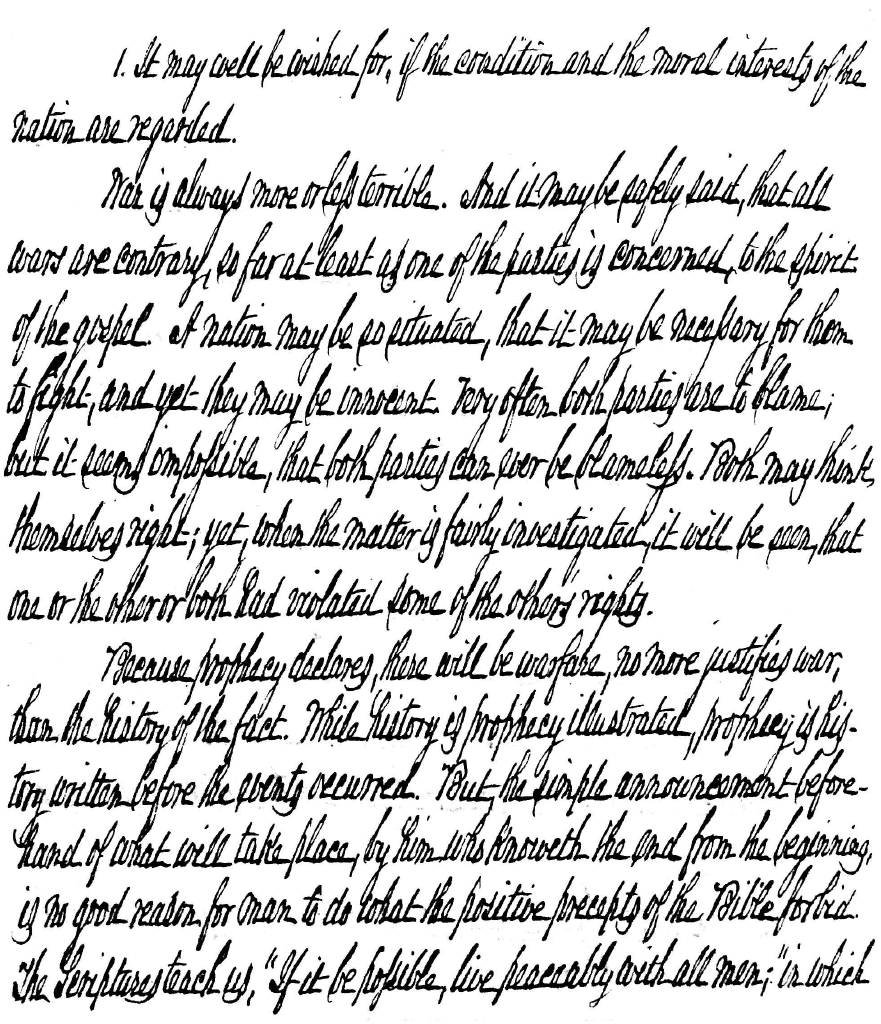
1. It may well be wished for, if the condition and the moral interests of the nation are regarded.
Man is always more or less terrible. And it may be safely said, that all wars are contrary, so far at least as one of the parties is concerned, to the spirit of the gospel. A nation may be so situated, that it may be necessary for them to fight, and yet they may be innocent. Very often both parties are to blame; but it seems impossible, that both parties can ever be blameless. Both may think themselves right; yet, when the matter is fairly investigated, it will be seen, that one or the other or both had violated some of the other’s rights.
Because prophecy declares, there will be warfare, no more justifies war, than the history of the fact. While history is prophecy illustrated, prophecy is history written before the events occurred. But, the simple announcement beforehand of what will take place, by him who knoweth the end from the beginning, is no good reason for man to do what the positive precepts of the Bible forbid. The Scriptures teach us, “If it be possible, live peaceably with all men;” in which
Page 3:
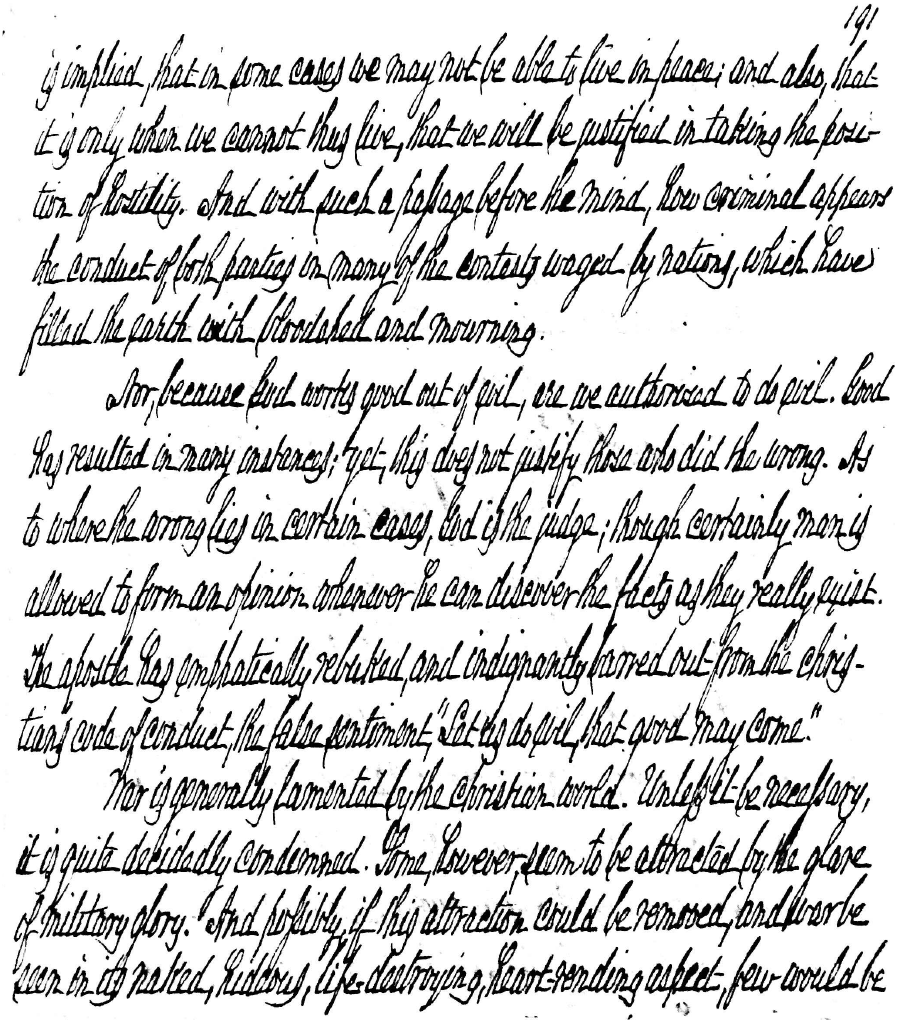
is implied that in some cases we may not be able to live in peace; and also, that it is only when we cannot thus live, that we will be justified in taking the position of hostility. And with such a passage before the mind, how criminal appears the conduct of both parties in many of the contests waged by nations, which have filled the earth with bloodshed and mourning.
Nor, because God works good out of evil, are we authorized to do evil. Good has resulted in many instances; yet, this does not justify those who did wrong. As to where the wrong lies in certain cases, God is the judge; though certainly man is allowed to form an opinion whenever he can discover the facts as they really exist. The apostle has empathetically rebuked, and indignantly barred out from the christian’s code of conduct, the false sentiment, “Let us do evil, that good may come.”
War is generally lamented by the christian world. Unless it be necessary, it is quite decidedly condemned. Some, however, seem to be attracted by the glare of military glory. And possibly, if this attraction could be removed, and war be seen in its naked, hideous, life-destroying, heart-rending aspect, few would be
Page 4:
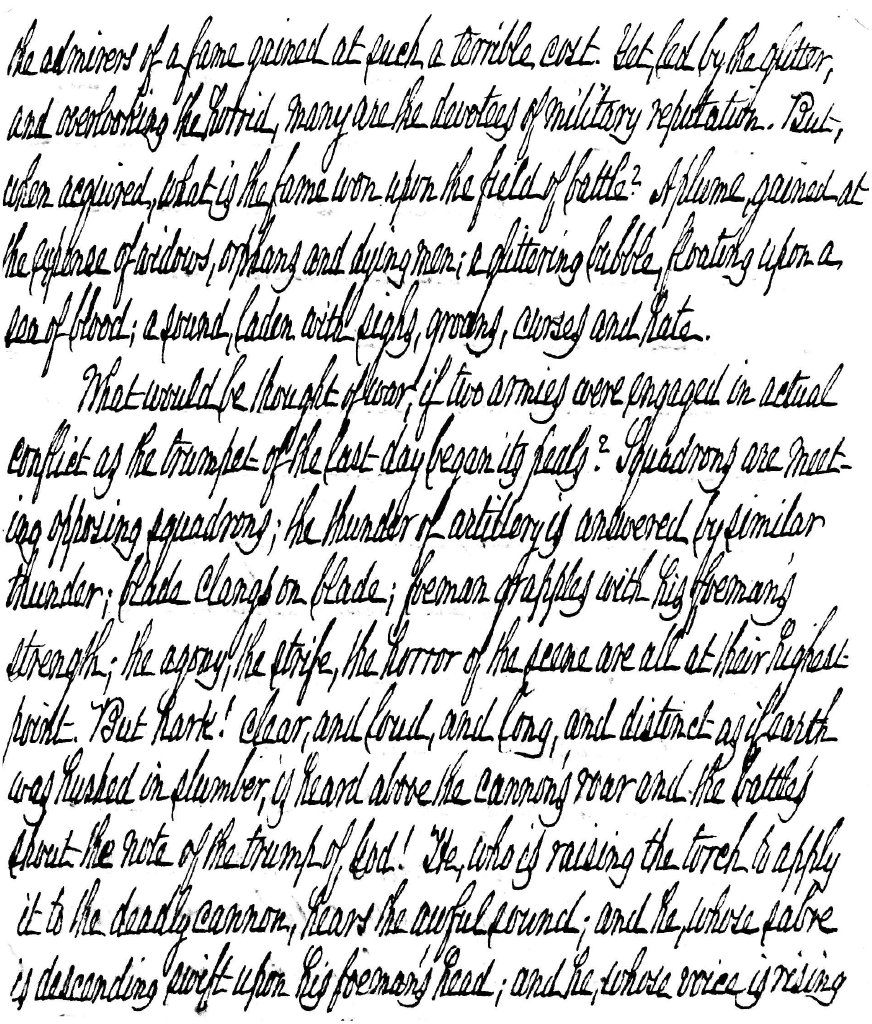
the admirers of a fame gained at such a terrible cost. Yet, led by the glitter, and overlooking the horrid, many are the devotees of military reputation. But, when acquired, what is the fame won upon the field of battle? A plume gained at the expense of widows, orphans and dying men; a glittering bubble, floating upon a sea of blood; a sound, laden with sighs, groans, curses and hate.
What would be thought of war, if two armies were engaged in actual conflict as the trumpet of the last day began its peals? Squadrons are meeting opposing squadrons; the thunder of artillery is answered by similar thunder; blade clangs on blade; foeman grapples with his foeman's strength; the agony, the strife, the horror of the scene are all at their highest point. But hark! Clear and loud, and long, and distinct as if earth was hushed in slumber, is heard above the cannon’s roar and the battle’s shout the note of the trump of God! He, who is raising the torch to apply it to the deadly cannon, hears the awful sound; and he, whose sabre is descending swift upon his foeman’s head; and he, whose voice is rising
Page 5:
above the tumult, bidding his comrades on to the charge; as well as they who just fallen, are closing their eyes upon the scenes of earth, and they who have already entered the spirit-world. Sudden as the lightning’s flash, all is still, save the thrilling tones, which summon man to the bar of God.
Ah! who would wish any, in whom he felt special interest, to be among these hostile bands? Who would desire to be the bravest and most successful in those embattled hosts? Who would be pleased to drop his burnished steel, as it had just entered his opponent’s heart, and thence forthwith away to the judgment-bar?
Warfare is indeed terrible. And looked at only in the light of the present life, peace may be truly and earnestly desired by all people - peace, that their fields be not laid waste, their homes battered down or consumed, their families lacking bread, their commercial operations thwarted, their friends torn from them by compulsion, themselves exposed to the calamities existing when war rages within the precincts of a nation.
Page 6:
2. Peace is to be prized in one’s immediate neighborhood.
Contention puts almost all things out of their proper place. It is like a shock given to the edifice of society, which sets every door ajar, removes every window-frame from its due proportions, throws every floor out of its level, destroys the regularity of every pannel, and fills every wall with fissures. It is not content with eating its own poisonous food, but it is active in distributing to others a portion of what makes itself so bitter. It is too restless to be satisfied, if others are quiet; too unhappy to be willing to be alone in brewing over its own irritated feelings; too greedy to remain at ease, without attempting to make others the victims of its voracious appetite. “As coals are to burning coals, and wood for fire, so is a contentious man to kindle strife.”
And when the untamed spirit is unbridled, none can tell where it may not wander, what breast it will not invade, what home it will not imbitter, what friends it may not separate, what sorrows it will not occasion, what blood it will not cause to be poured out, what quarrels it will not entail upon the succeeding generation. “The beginning of strife is as when one letteth out water.”
Page 7:
3. Peace in one’s own bosom is desirable. It is not a mere negative quality. Though the absence of turbulence within is preferable to commotion with its anxiety or doubts or remorse; yet, freedom from these is not all that exists, when the spirit may be said to be in a truly peaceful condition. The serenity has a charm, which is appreciated; a fragrance, which is perceptible; a luxury, which is enjoyed. The soul has its high-day: delighted with its own associations; enraptured with the hue of its peculiar feelings; regaled by the imagination, which imparts keenness to the intellect, and when chastened increases the commendable pleasure of the sensibilities.
Life is truly wearisome, where the opposite of peace prevails. The man has no pillow; where he may place his aching head, or calm his throbbing heart. Whatever be the cause of commotion, the inward condition casts its influence upon outward objects. Every thing is regarded with suspicion. To one, who is peevish, fretful, morose, society has a sour aspect, and even nature fails to have an attractive appearance. Though kind words generally win confidence; yet, these may be heard,
Page 8:
and possibly no corresponding response be obtained. Though generous deeds are apt to be appreciated; yet while the character of the act cannot be questioned, the intention will very likely be thrown out, that some selfish end is in view, or the motive will not bear inspection. And offence is easily taken. Well nigh every thing is misconstrued. The turbulence within prompts the thought, that what is without is also in a quarrelsome mood. Like the raging sea, casting up mire and dirt, the eye fails to see aright through the troubled element; and the heart, burdened by its own restlessness, may fancy, if not wish, the condition of others, however they may seem, to be equally unhappy.
For his own sake, as well as for others, every one may be an earnest desirer for the indwelling of peace within his own bosom. So far, at least, he may certainly love his own welfare. That may be sought, which will lead to put away the practice of the code of the Ishmaelite; and which, so far as the natural can resemble the spiritual, will conform to that of the despised Nazarene. Next to spiritual peace, man should seek for quiet to reign in the home of his own heart.
Page 9:
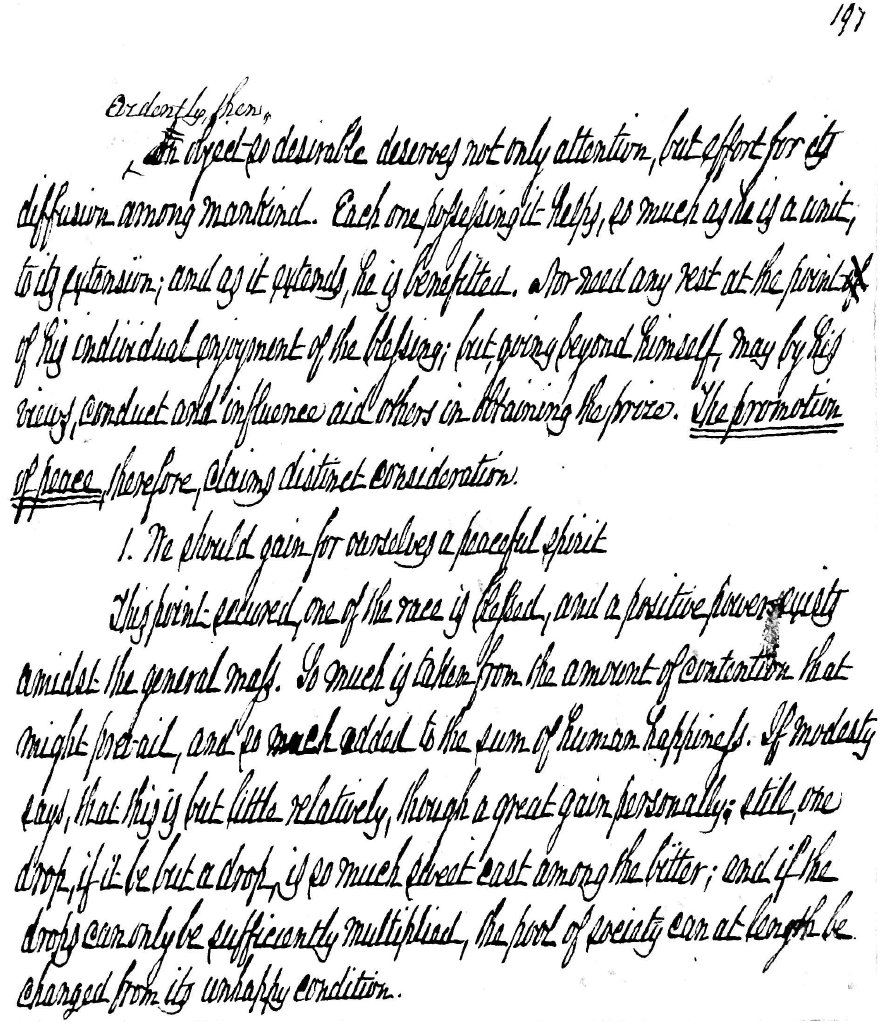
Ardently, then, an object so desirable deserves not only attention, but effort for its diffusion among mankind. Each one possessing it keeps, so much as he is a writ, to its extension; and as it extends, he is benefited. Nor need any rest at the point of his individual enjoyment of the blessing; but going beyond himself, may by his views, conduct and influence aid others in obtaining the prize. The promotion of peace, therefore, claims distinct consideration.
1. We should gain for ourselves a peaceful spirit.
This point secured, one of the race is blessed, and a positive power exists amidst the general mass. So much is taken from the amount of contention that might prevail, and so much added to the sum of human happiness. If modesty says, that this is but little relatively, though a great gain personally; still, one drop, if it be but a drop, is so much sweet cast among the bitter; and if the drops can only be sufficiently multiplied, the pool of society can at length be changed from its unhappy condition.
Page 10:
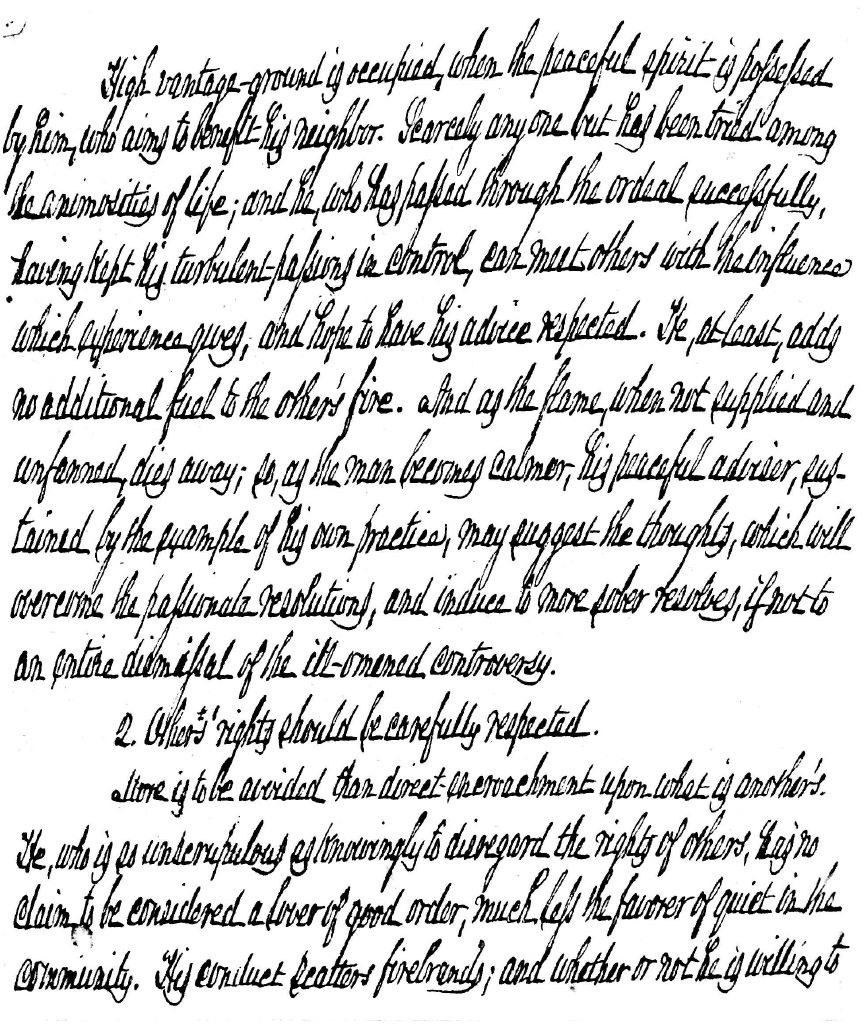
High vantage-ground is occupied, when the peaceful spirit is possessed by him, who aims to benefit his neighbor. Scarcely any one but has been told among the animosities of life; and he, who has passed through the ordeal successfully, having kept his turbulent passions in control, can meet others with the influence which experience gives, and hope to have his advice respected. He, at least, adds no additional fuel to the other’s fire. And as the flame, when not supplied and unfanned, dies away; so, as the man becomes calmer, his peaceful adviser, sustained by the example of his own practice, may suggest the thoughts, which will overcome the passionate resolutions, and induce to more sober resolves, if not to an entire dismissal of the ill-omened controversy.
2. Others’ rights should be carefully respected.
More is to be avoided than direct encroachment upon what is another’s. He, who is so unscrupulous as knowingly to disregard the rights of others, has no claim to be considered a lover of order, much less the favorer of quiet in the community. His conduct scatters firebrands; and whether or not he is willing to
Page 11:
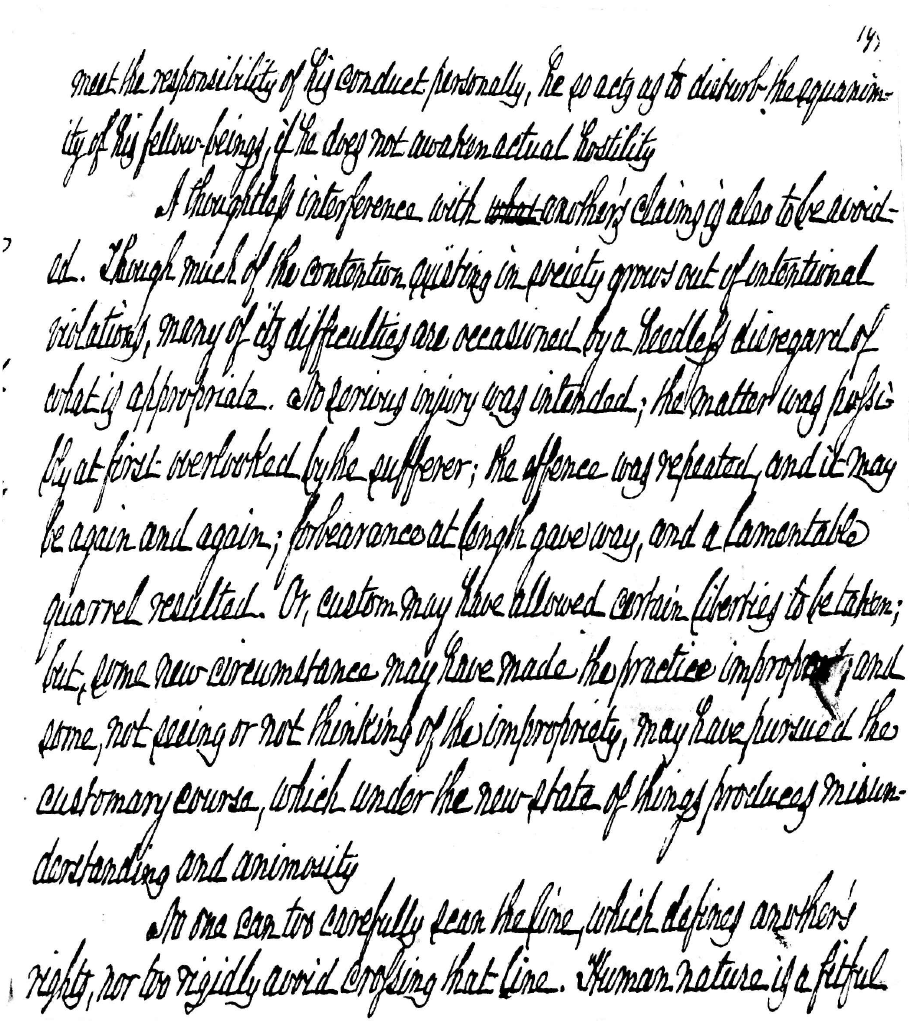
meet the responsibility of his conduct personally, he so acts as to disturb the equanimity of his fellow-beings, if he does not awaken actual hostility.
A thoughtless interference with another’s claims is also to be avoided. Though much of the contention existing in society grows out of intentional violations, many of its difficulties are occasioned by a heedless disregard of what is appropriate. No serious injury was intended; the matter was possibly at first overlooked by the sufferer; the offence was repeated, and it may be again and again; forbearance at length gave way, and a lamentable quarrel resulted. Or, custom may have allowed certain liberties to be taken; but, some new circumstance may have made the practice improper; and some, not seeing or not thinking of the impropriety, may have pursued the customary course, which under the new state of things produces misunderstanding and animosity.
No one can too carefully scan the line, which defines another’s rights, nor too rigidly avoid crossing that line. Human nature is a fitful
Page 12:
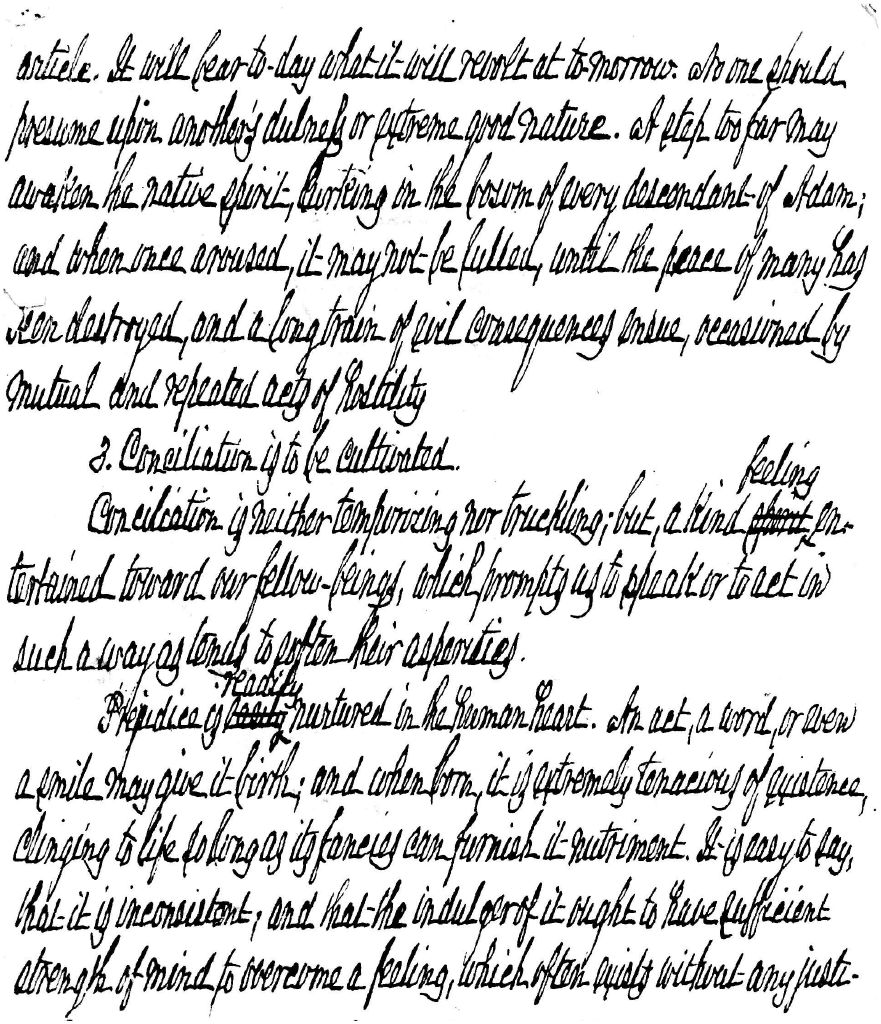
article. It will fear to-day what it will revolt at tomorrow. No one should presume upon another’s dulness or extreme good nature. A step too far may awaken the native spirit, lurking in the bosom of every descendant of Adam; and when once aroused, it may not be lulled, until the peace of many has been destroyed, and a long train of evil consequences ensue, occasioned by mutual and repeated acts of hostility.
2. Conciliation is to be cultivated.
Conciliation is neither temporizing nor truckling; but, a kind feeling entertained toward our fellow-beings, which prompts us to speak or act in such a way as tends to soften their asperities.
Prejudice is readily nurtured in the human heart. An act,a word, or even a smile may give it birth; and when born, it is extremely tenacious of existence, clinging to life so long as its fancies can furnish it nutriment. It is easy to say, that it is inconsistent; and that the indulger of it ought to have sufficient strength of mind to overcome a feeling, which often exists without any justi- [sic]
Page 13:
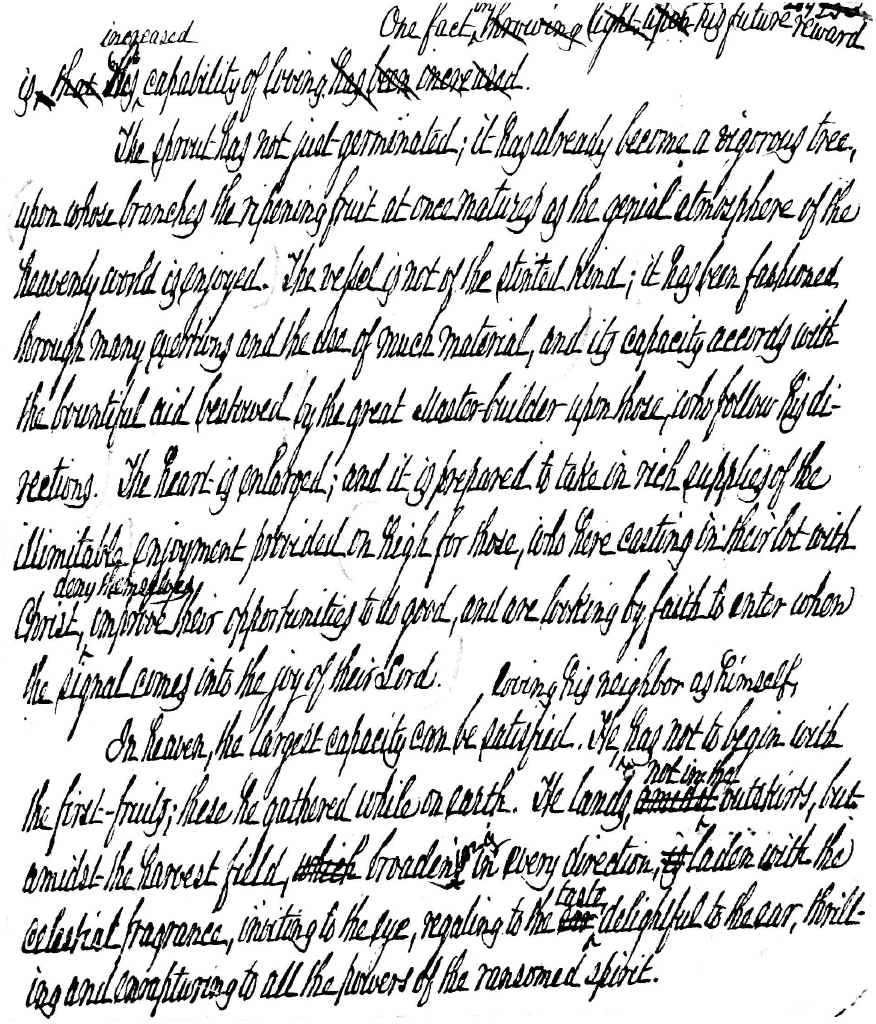
One fact, in his future reward is increased capability of loving.
The sprout has not just germinated; it has already become a vigorous tree, upon whose branches the ripening fruit at once matures as the genial atmosphere of the heavenly world is enjoyed. The vessel is not of the stinted kind; it has been fashioned through many exertions and the use of much material, and its capacity accords with the bountiful aid bestowed by the great Master-builder upon those, who follow his directions. The heart is enlarged; and it is prepared to take in rich supplies of the illimitable enjoyment provided on high for those, who here casting in their lot with Christ, deny themselves, improve their opportunities to do good, and are looking by faith to enter when the signal comes into the joy of their Lord.
In heaven, the largest capacity can be satisfied. He, loving his neighbor as himself, has not to begin with the first-fruits; these he gathered while on earth. He lands, not in the outskirts, but amidst the harvest field, broadening in every direction, laden with the celestial fragrance, inviting to the eye, regaling to the taste, delightful to the ear, thrilling and enrapturing to all the powers of the ransomed spirit.
Page 14:
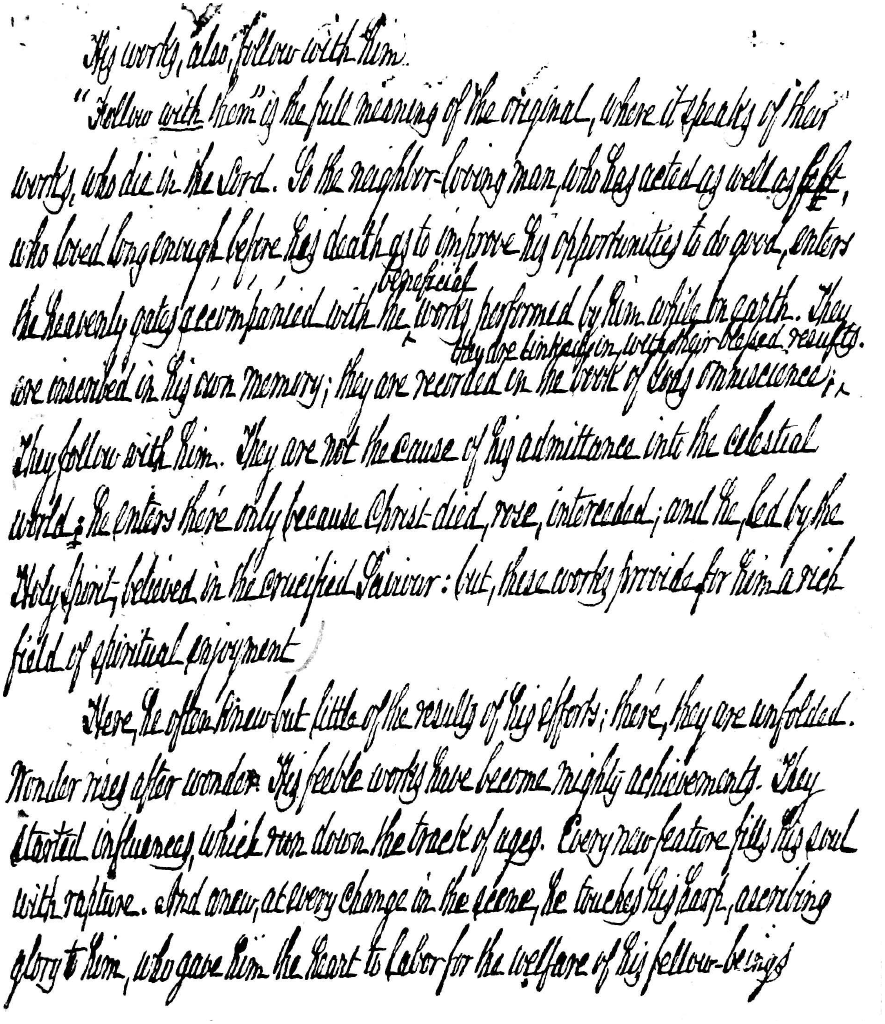
His works, also, follow with him.
“Follow with them” is the full meaning of the original, where it speaks of their works, who die in the Lord. So the neighbor-loving man, who has acted as well as who loved long enough before his death as to improve his opportunities to do good, enters the heavenly gates accompanied with the beneficial works, performed by him while on earth. They are inscribed in his own memory; they are recorded in the book of God’s omniscience; they are linked in with their blessed results. They follow with him. They are not the cause of his admittance into the celestial world: he enters there only because Christ died, rose, interceded; and he, led by the Holy Spirit, believed in the crucified Saviour: but, these works provide for him a rich field of spiritual enjoyment.
Here, he often knew but little of the results of his efforts; there, they are unfolded. Wonder rises after wonder. His feeble works have become mighty achievements. They started influences, which run down the track of ages. Every new feature fills his soul with rapture. And anew, at every change in the scene, he touches his harp, ascribing glory to him, who gave him the heart to labor for the welfare of his fellow-beings.
Page 15:
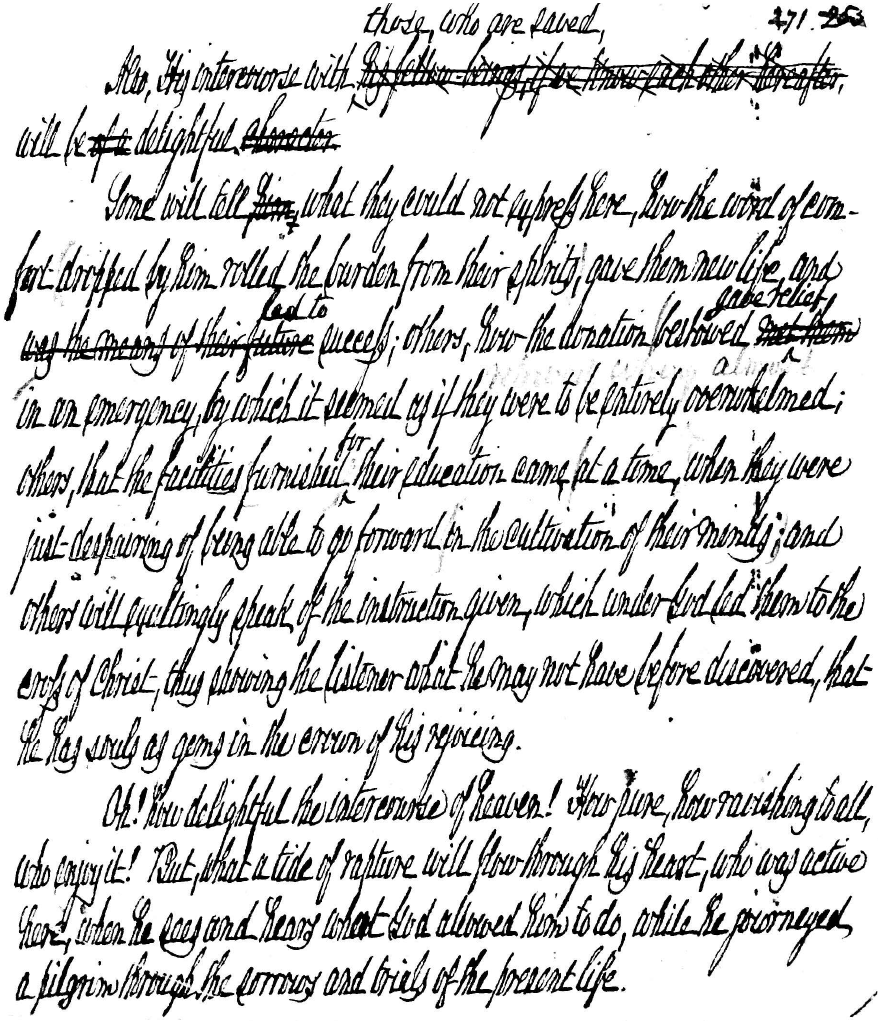
Also, his intercourse with those, who are saved, will be delightful.
Some will tell what they could not express here, how the word of comfort dropped by him rolled the burden from, their spirits, gave them new life, and led to success; clothes, how the donation bestowed gave relief, in an emergency, by which it seemed as if they were to be entirely overwhelmed; others, that the faculties furnished for their education came at a time, when they were just despairing of being able to go forward in the cultivation of their minds; and others will exultingly speak of the instruction given, which under God led them to the cross of Christ, thus showing the listener what he may not have before discovered, that he has souls as gems in the crown of his rejoicing.
Oh! how delightful the inheritance of heaven! How pure, how ravishing to all, who enjoy it! But, what a tide of rapture will flow through his heart, who was active here, when he sees and hears what God allowed him to do, while he journeyed, a pilgrim through the sorrows and trials of the present life.
Page 16:
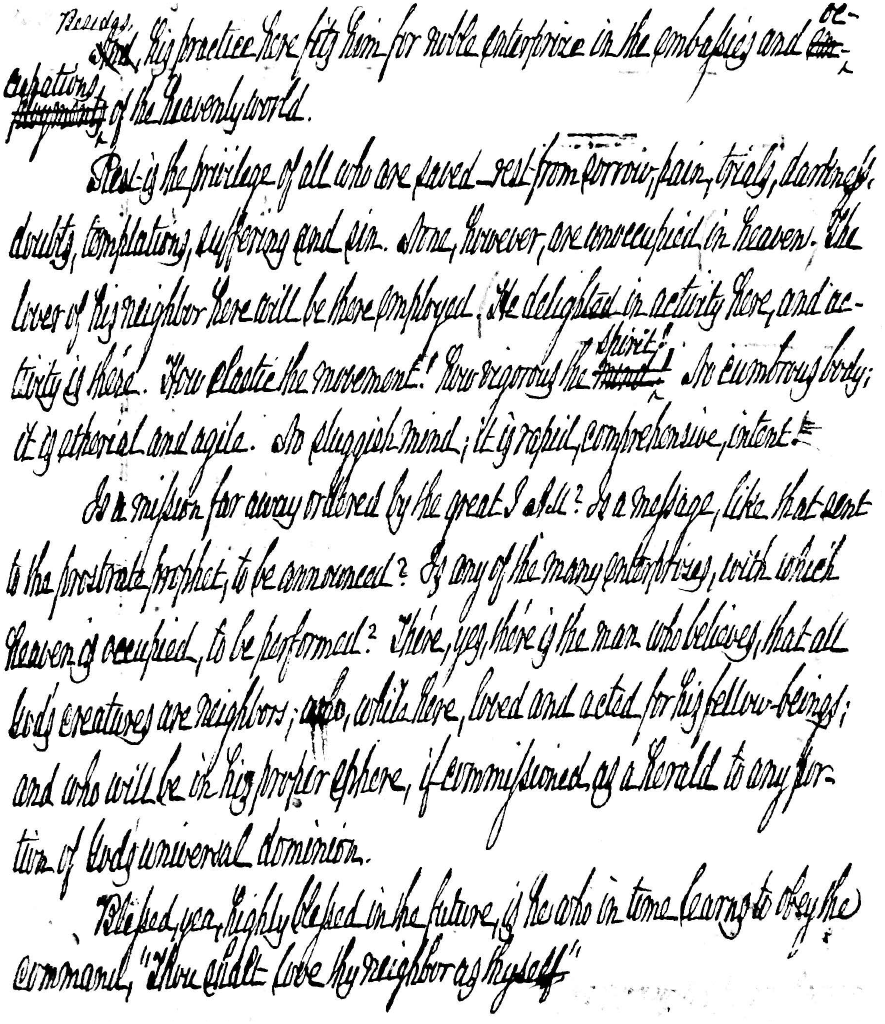
Besides, his practice here fits him for noble enterprise in the embassies and occupations of the heavenly world.
Rest is the privilege of all who are saved - rest from sorrow, pain, trials, darkness, doubts, temptations, suffering and sin. None, however, are unoccupied in heaven. The lover of his neighbor here will there be employed. He delighted in activity here, and activity is there. How elastic the movement! how vigorous the spirit! No cumbrous body; it is etherial [sic] and agile. No sluggish mind; it is rapid, comprehensive, intent.
Is a mission away ordered by the great I AM? Is a message, like that sent to the prostrate prophet, to be announced? Is any of the many enterprises, with which heaven is occupied, to be performed? There, yes, there is the man who believes, that all God’s creatures are neighbors; who, while here, loved and acted for his fellow-beings; and who will be in his proper sphere, if commissioned as a herald to any portion of God’s universal dominion.
Blessed, yea, highly blessed in the future, is he who in time learns to obey the command, “Thou shalt love thy neighbor as thyself.”