1 Cor 15:55
Note: The first paragraph, meaning the section beginning with “no cares distract” and ending with “for ever and ever,” is crossed out in the original journal.
Page 1:
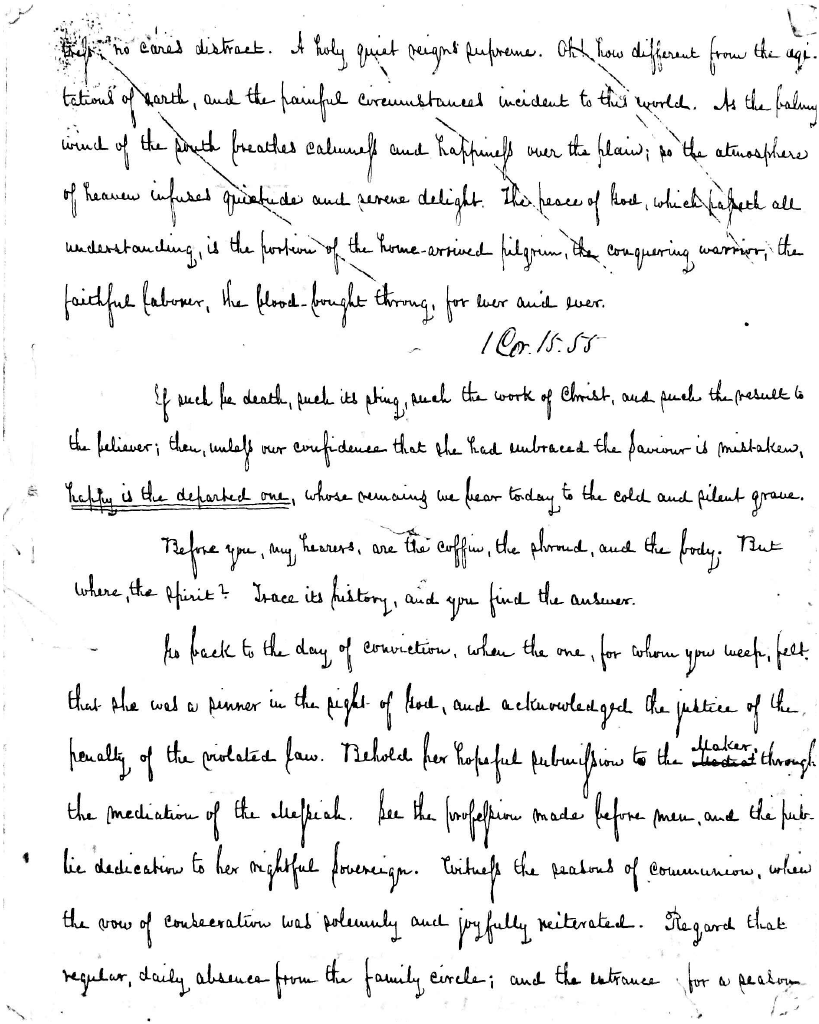
…; no cares distract. A holy quiet reigns supreme. Oh! how different from the agitations of earth, and the painful circumstances incident to this world. As the balmy wind of the south breathes calmness and happiness over the plain; so the atmosphere of heaven infuses quietude and serene delight. The peace of God, which passeth all understanding, is the portion of the home-arrived pilgrim, the conquering warrior, the faithful laborer, the blood-bought throng, for ever and ever.
1 Cor 15.55
If such be death, such its sting, and such the work of Christ, and such the result to the believer; then, unless our confidence that she had embraced the Saviour is mistaken, happy is the departed one, whose remains we bear today to the cold and silent grave.
Before you, my hearers, are the coffin, the shroud, and the body. But where, the spirit? Trace its history, and you find the answer.
Go back to the day of conviction, when the one, for whom you weep, felt that she was a sinner in the sight of God, and acknowledged the justice of the penalty of the violated law. Behold her hopeful submission to the Maker, through the mediation of the Messiah. See the profession made before men, and the public dedication to her rightful Sovereign. Witness the seasons of communion, when the vow of consecration was solemnly and joyfully reiterated. Regard that regular, daily absence from the family circle; and the entrance for a season
Page 2:
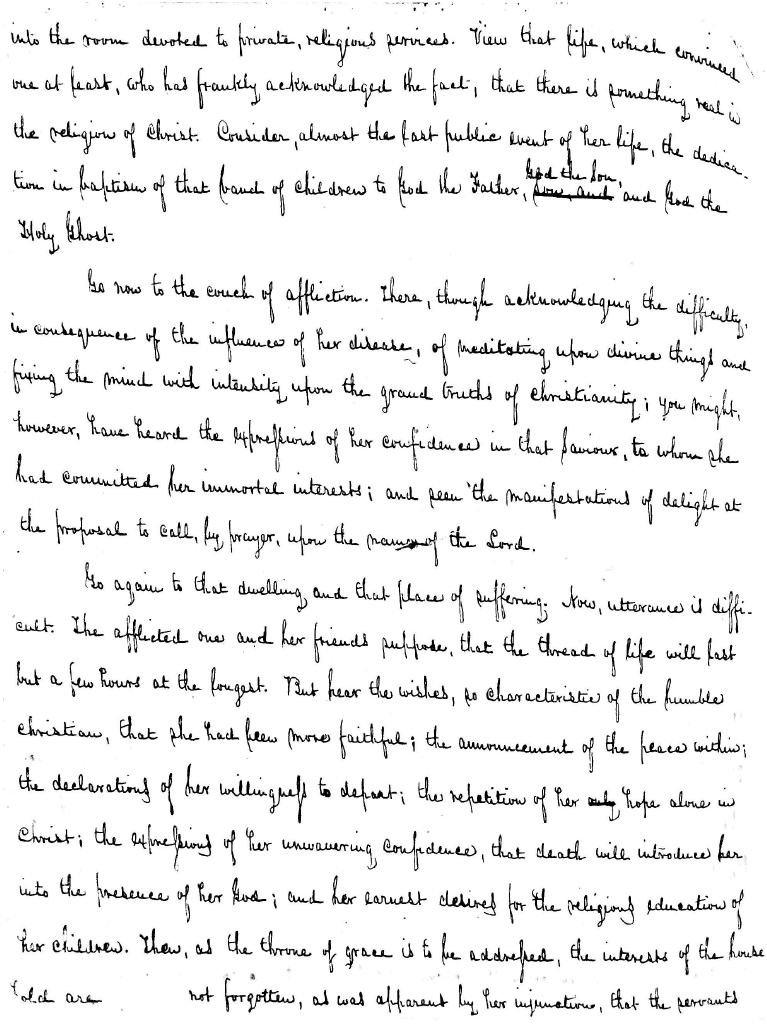
Into the room devoted to private, religious services. View that life, which convinced one at least, who has frankly acknowledged the fact, that there is something real in the religion of Christ. Consider, almost the last public event of her life, the dedication in baptism of that band of children to God the Father, God the Son, and God the Holy Ghost.
Go now to the couch of affliction. There, though acknowledging the difficulty, in consequence of the influence of her disease, of meditating upon divine things and fixing the mind with intensity upon the grand truths of christianity; you might, however, have heard the expressions of her confidence in that Saviour, to whom she had committed her immortal interests; and seen the manifestations of delight at the proposal to call, by prayer, upon the name of the Lord.
Go again to that dwelling and that place of suffering. Now, utterance is difficult. The afflicted one and her friends suppose, that the thread of life will last but a few hours at the longest. But hear the wishes, so characteristic of the humble christian, that she had been more faithful; the announcement of the peace within; the declarations of her willingness to depart; the reflection of her hope alone in Christ; the expressions of her unwavering confidence, that death will introduce her into the presence of her God; and her earnest desires for the religious education of her children. Then, as the throne of grace is to be addressed, the interests of the household are … not forgotten, as well as apparent by her injunction, that the servants
Page 3:
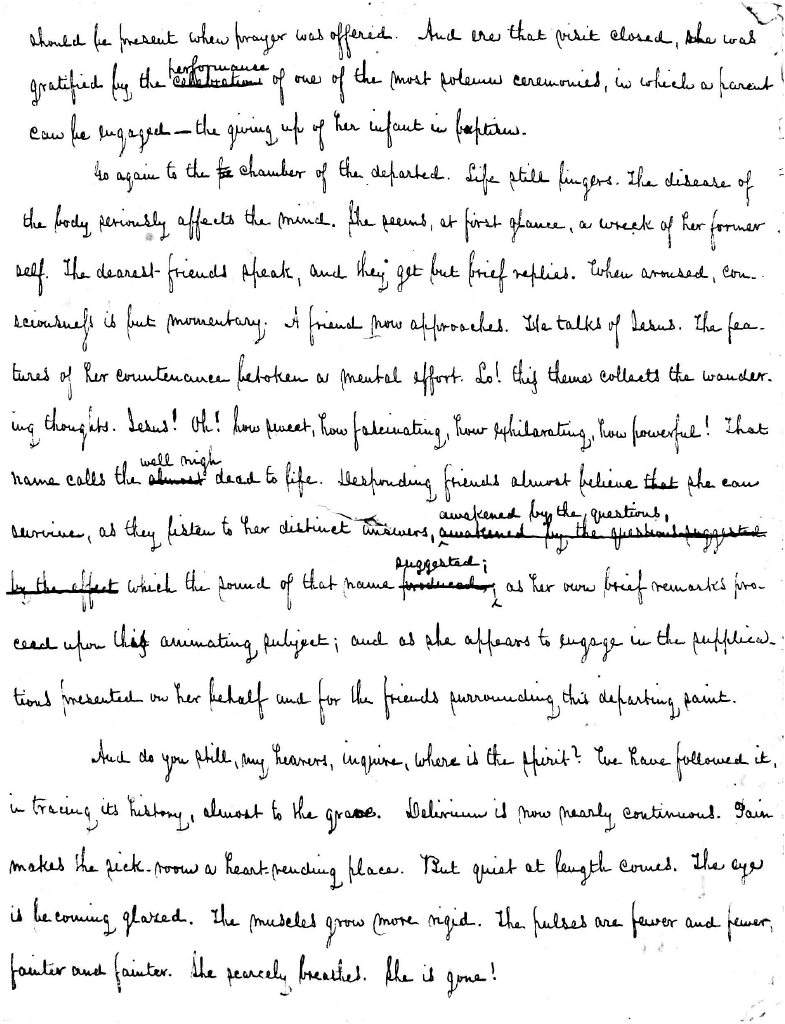
Should be present when prayer was offered. And ere that visit closed, she was gratified by the performance of one of the most solemn ceremonies, in which a parent can be engaged - the giving up of her infant in baptism.
Go again to the chamber of the departed. Life still lingers. The disease of the body seriously affects the mind. She seems, at first glance, a wreck of her former self. The dearest friends speak, and they get but brief replies. When aroused, consciousness is but momentary. A friend now approaches. She talks of Jesus. The features of her countenance betoken a mental effort. Lo! this theme collects the wandering thoughts. Jesus! Oh! how sweet, how fascinating, how exhilarating, how powerful! That name calls the well nigh dead to life. Desponding friends almost believe she can survive, as they listen to her distinct answers, awakened by the questions, which the sound of that name suggested; as her own brief remarks proceed upon this animating subject; and as she appears to engage in the supplications presented on her behalf and for the friends surrounding this departing saint.
And do you still, my hearers, inquire, where is the spirit? We have followed it, in tracing its history, almost to the grave. Delirium is now nearly continuous. Pain makes the sick-room a heart-rending place. But quiet at length comes. The eye is becoming glazed. The muscles grow more rigid. The pulses are fewer and fewer, fainter and fainter. She scarcely breathed. She is gone!
Page 4:
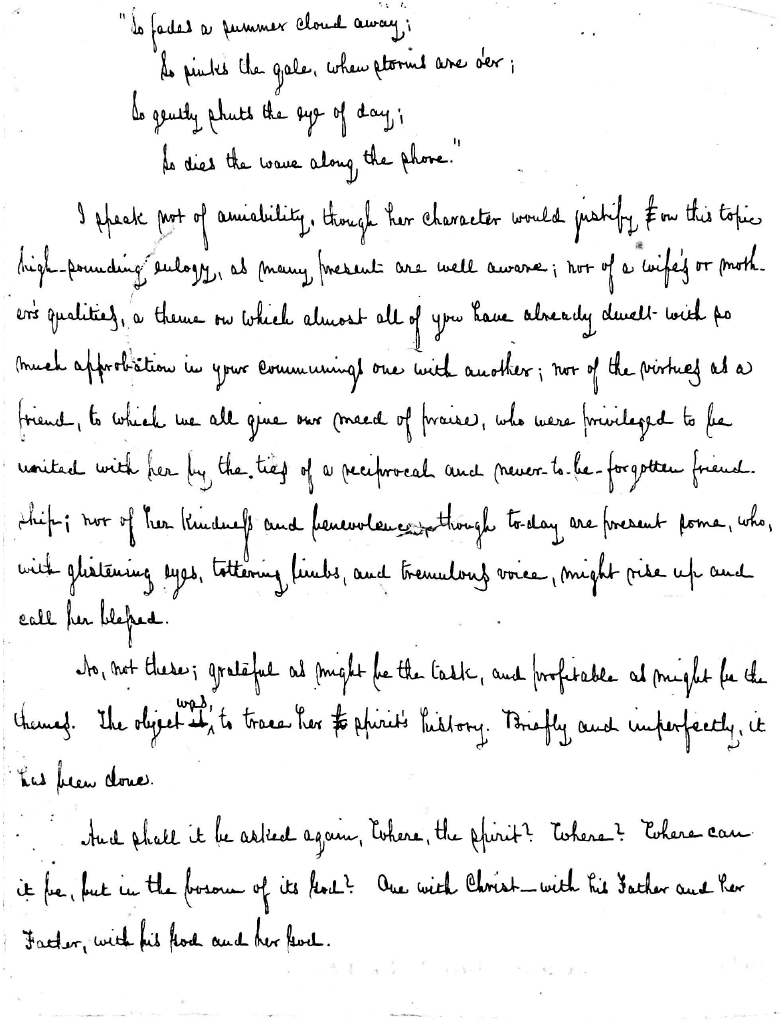
“So fades a summer cloud away;
So sinks the gale, when storms are o’er;
So gently shuts the eye of day;
So dies the wave along the shore.”
I speak not of amiability, though her character would justify on this topic high-sounding eulogy, as many present are well aware; not of a wife’s or mother’s qualities, a theme on which almost all of you have already dwelt with so much approbation in your communings one with another; nor of the virtues as a friend, to which we all give our meed of praise, who were privileged to be united with her by the ties of a reciprocal and never-to-be-forgotten friendship; nor of her kindness and benevolence, though to-day are present some, who, with glistening eyes, tottering limbs, and tremulous voice, might rise up and call her blessed.
No, not these; grateful as might be the task, and profitable as might be the themes. The object was, to trace her spirit’s history. Briefly and imperfectly, it has been done.
And shall it be asked again, where, the spirit? Where? Where can it be, but in the bosom of its God? One with Christ - with his Father and her Father, with his God and her God.
Page 5:
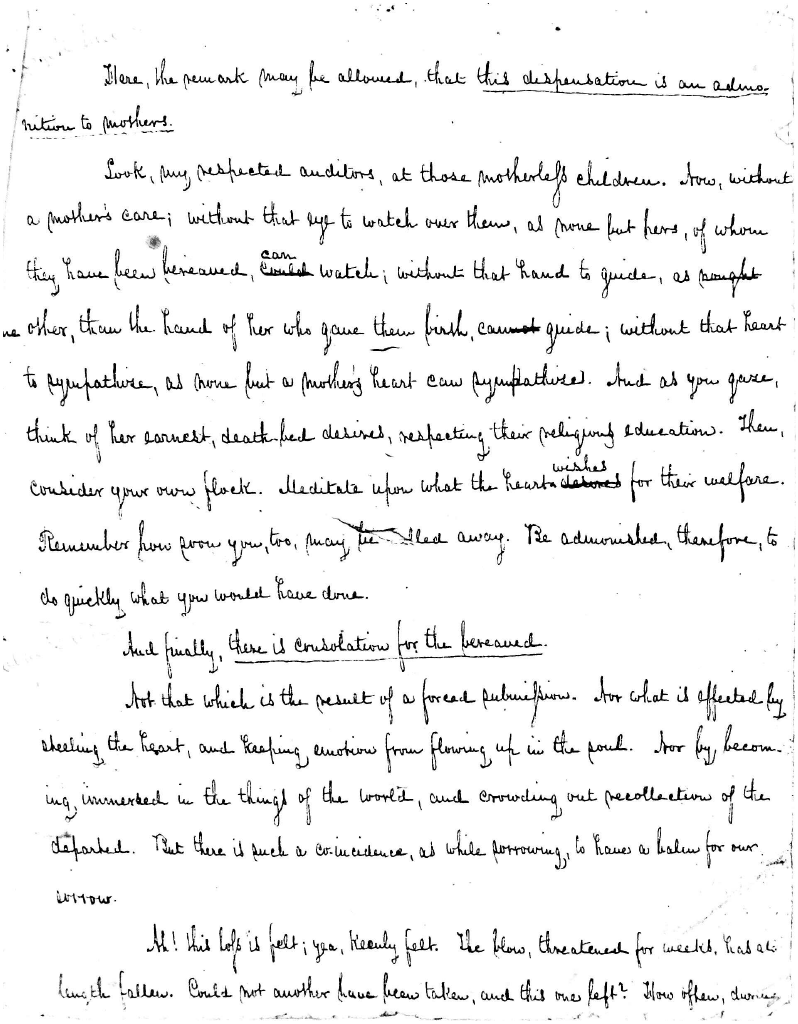
Here, the remark may be allowed that this dispensation is an admonition to mothers.
Look, my respected auditors, at those motherless children. Now, without a mother’s care; without that eye to watch over them, as none but hers, of whom they have been bereaved, can watch; without that hand to guide; without that heart to sympathize, as none but a mother’s heart can sympathize. And as you gaze, think of her earnest, death-bed desires, respecting their religious education. Then, consider your own flock. Meditate upon what the heart wishes for their welfare. Remember how soon you, too, may be …lled away. Be admonished, therefore, to do quickly what you would have done.
And finally, there is consolation for the bereaved.
Not that which is the result of a forced submission. Nor what is effected by steelingthe heart, and keeping emotion from flowing up in the soul. Nor by becoming immersed in the things of the world, and crowding out the recollection of the departed. But there is such a coincidence, as while sorrowing, to have a balm for our sorrow.
Ah! this loss is felt; yea, keenly felt. The blow, threatened for weeks, has at length fallen. Could not another have been taken and this one left? How often, during
Page 6:
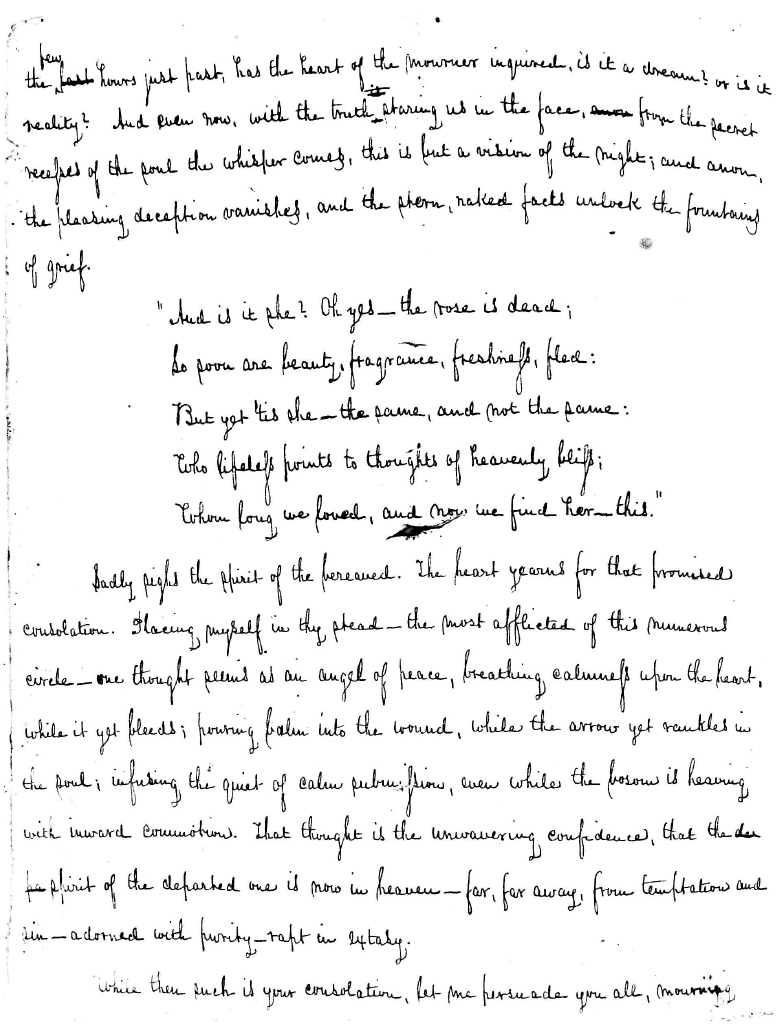
The few hours just past, has the heart of the mourner inquired, is it a dream? Or is it reality? And even now, with the truth staring us in the face, from the secret recesses of the soul the whisper comes, this is but a vision of the night; and anon, the pleasing deception vanishes, and the stern, naked facts unlock the fountains of grief.
“And is she? Oh yes - the rose is dead;
So soon are beauty, fragrance, freshness, fled:
But yet ‘tis she - the same, and not the same:
Who lifeless points to thoughts of heavenly bliss;
Whom long we loved, and now we find her - this.”
Sadly sighs the spirit of the bereaved. The heart yearns for that promised consolation. Placing myself in thy stead - the most afflicted of this numerous circle - one thought seems as an angel of peace, breathing calmness upon the heart, while it yet bleeds; pouring balm into the wound, while the arrow yet rankles in the soul; infusing the quiet of calm submission, even while the bosom is heaving with inward commotion. That thought is the unwavering confidence, that the spirit of the departed one is now in heaven - far, far, away, from temptation and sin - adorned with purity - rapt in ecstasy.
While then such is your consolation, let me persuade you all, mourning
Page 7:
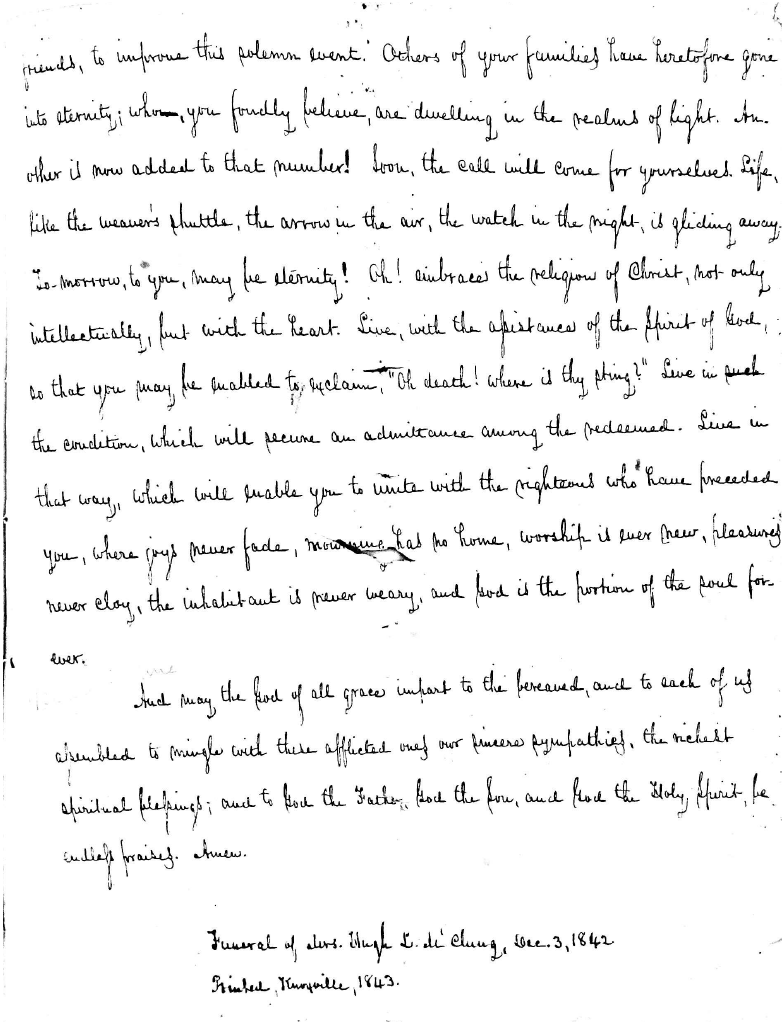
friends, to improve this solemn event. Others of your families have heretofore gone into eternity; who, you fondly believe, are dwelling in the realms of light. Another is now added to that number! Soon, the call will come for yourselves. Life, like the weaver’s shuttle, the arrow in the air, the watch in the night, is gliding away. To-morrow, to you, may be eternity! Oh! embrace the religion of Christ, not only intellectually, but with the heart. Live, with the assistance of the Spirit of God, so that you may be enabled to exclaim, “Oh death! Where is thy sting?” Live in the condition, which will secure an admittance among the redeemed. Live in that way, which will enable you to unite with the righteous who have preceded you, where joys never fade, mourning has no home, worship is ever new, pleasures never clay, the inhabitant is never weary, and God is the portion of the soul forever.
And may the God of all grace impart to the bereaved, and to each of us assembled to mingle with these afflicted ones our sincere sympathies, the richest spiritual feelings; and to God the Father, God the Son, and God the Holy Spirit, be endless praises. Amen.
Funeral of Mrs. Hugh L. McClung, Dec 3, 1842
Printed, Knoxville, 1843.