Truth
Page 1:
Truth
Only a portion of this important subject can now be considered. The distinctions cannot be dwelt upon, in detail, between physical, moral, and metaphysical truths. Far less must an attempt be made to answer the great question, “What is truth?” propounded by a prominent individual to one who, though a prisoner, was the mighty Lord. Only that phase of the subject is to be regarded, where man comes in contact with his neighbor; and looked at in this aspect, a suitable definition of truth is conformity to reality and promise.
… Some truth is due to our neighbor.
One … of trying to excuse falsehood is by taking the ground, that we are not under obligation to convey instruction to another; and consequently, if he be so foolish as to be misled by what is said, the fault is due to his folly rather than to ourselves. It is granted, that we are not bound to
Page 2:
attempt to impart all the information, which we possess on every subject unto others. Some might not be able to comprehend what was uttered; others would not be edified by it, though they understand it; and others might be injured by it more than benefitted; still, man’s condition is such, that it is often appropriate to make known either what he is ignorant of, or show more clearly what he imperfectly understands. Is he be traveling a road away from the destination sought with a peaceable intention; if he be reaching into danger, to which his object ought not to expose him; if the roof of his dwelling be on the point of taking fire; the relation which he occupies as a fellow-being demands, that the proper information be conveyed, provided that a suitable opportunity be presented. And if he can be duly reached, what relates to his soul ought not to be withheld, whether he is ignorant of the first principles of the gospel, or, having learned the way of life, gropes in darkness, which might be scattered by the friendly aid of another’s voice.
Page 3:
2. When professedly imparting information or relating occurrences, the signs, words, and deeds should accord with the truth.
The peculiarities of the domain of poetry need not embarrass those, who wish to order their conversation aright. The poetic privilege of employing tropes and emblems may be readily granted to its legitimate sphere: and yet, the duty insisted upon of making our statements consistent with what is proposed to be described. A professed history, embellished with figures, though attractive to the reader, has to be carefully analyzed, that the gloss and the true material may be distinguished. No attempt need be made to degrade the imagination, which is such an important power in the mental world, while it is perseveringly claimed, that the yea be yea and the nay be nay, when avowed facts are described, or statements of specific points presented.
A sign may convey thought as certainly as a word; the manner of utterance affects what is spoken; an action often signifies more than speech.
Page 4:
It is due to another, that he be not misled either by the tone, the gesture or the conduct. Silence is not always criminal; for in some cases, it is our privilege: yet when the position is taken of imparting information, nothing in the manner ought to make a wrong impression upon the hearer or beholder. When he is looking for truth, he should not be furnished with falsehood.
3. What is known to be false is not to be used as if true.
Such is the perverseness of society, that often there is floating through it what is not reliable. Nor can every one always escape from repeating or alluding to these unfounded rumors. Often, however, their character is well-known. Either by positive evidence; or marks so satisfactory that the judgment is fully persuaded of their falseness, they are shown t…e undeserving of confidence. Better would it be, that they should receive no further circulation; but, if they cannot be passed by wholly unnoticed, they ought in no case receive such treatment or be so repeated as to give them the semblance of truthfulness.
Page 5:
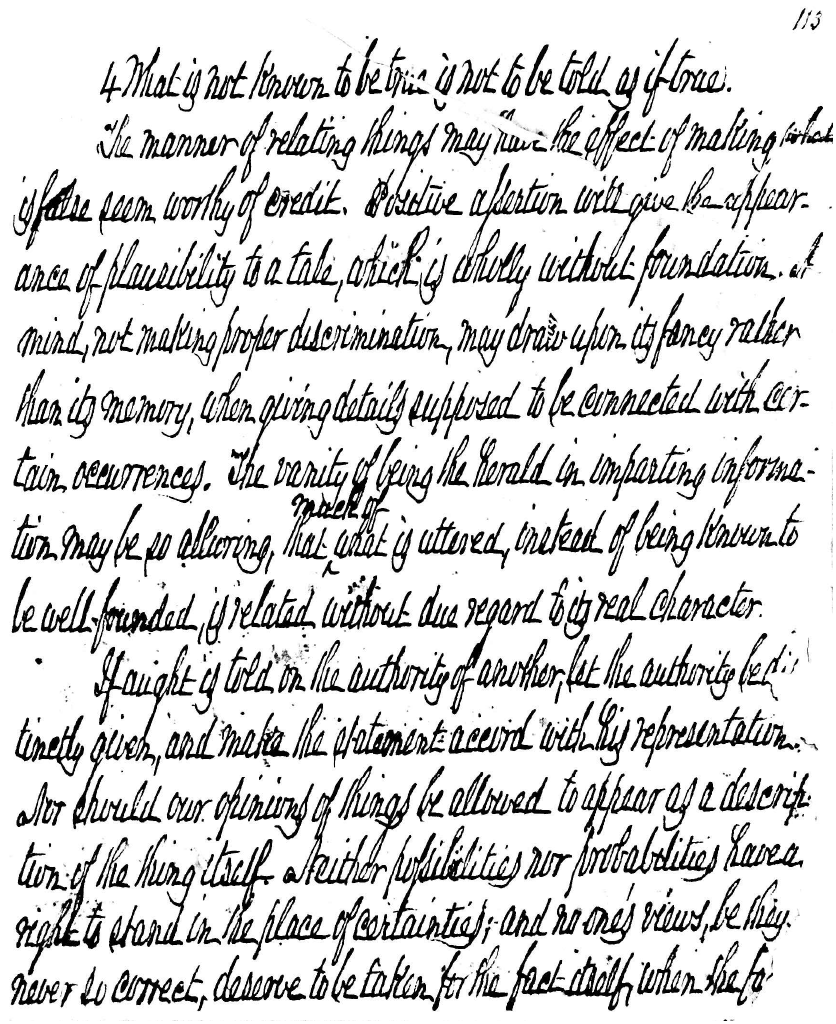
4. What is not known to be true is not to be told as if true.
The manner of relating things may have the effect of making what is false seem worthy of credit. Positive assertion will give the appearance of plausibility to a tale, which is wholly without foundation. A mind, not making proper discrimination, may draw upon its fancy rather than its memory, when giving details supposed to be connected with certain occurrences. The vanity of being the herald in imparting information may be so alluring, that much of what is uttered, instead of being known to be well-founded, is related without due regard to its real character.
If aught is told on the authority of another, let the authority be distinctly given, and make the statement accord with his representation. Nor should our opinions of things be allowed to appear as a description of the thing itself. Neither possibilities nor probabilities have a right to stand in the place of certainties; and no one's views, be they never so correct, deserve to be taken for the fact itself, when the fact …
Page 6:
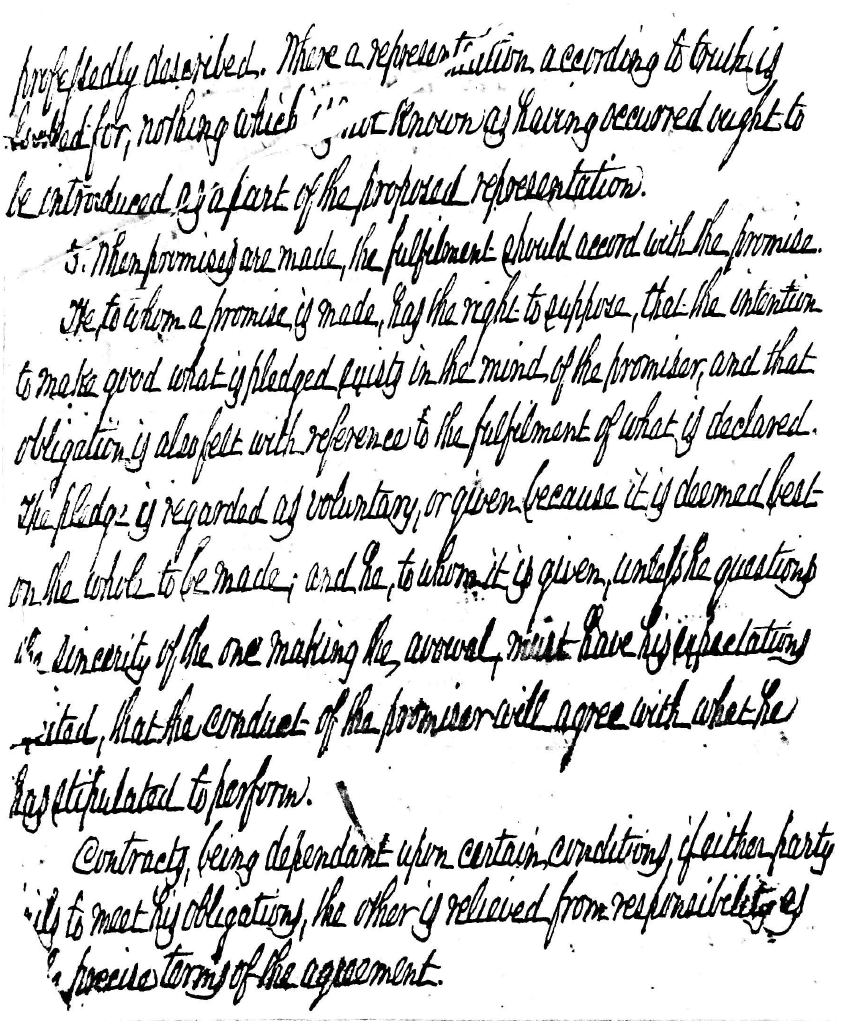
professedly described. Where a representation according to truth is looked for, nothing which is not known as having occurred ought to be introduced as a part of the proposed representation.
5. When promises are made, the fulfillment should accord with the promise.
He to whom a promise is made, has the right to suppose, that the intention to make good what is pledged exists in the mind of the promiser, and that obligation is also felt with reference to the fulfillment of what is declared. The pledge is regarded as voluntary, or given because it is deemed best on the whole to be made; and he, to whom it is given, unless questions the sincerity of the one making the avowal, must have his expectations … -ited, that the conduct of the promiser will agree with what he has stipulated to perform.
Contracts, being dependent upon certain conditions, if either party fails to make his obligations, the other is relieved from responsibilities … the precise terms of the agreement.
Page 5:
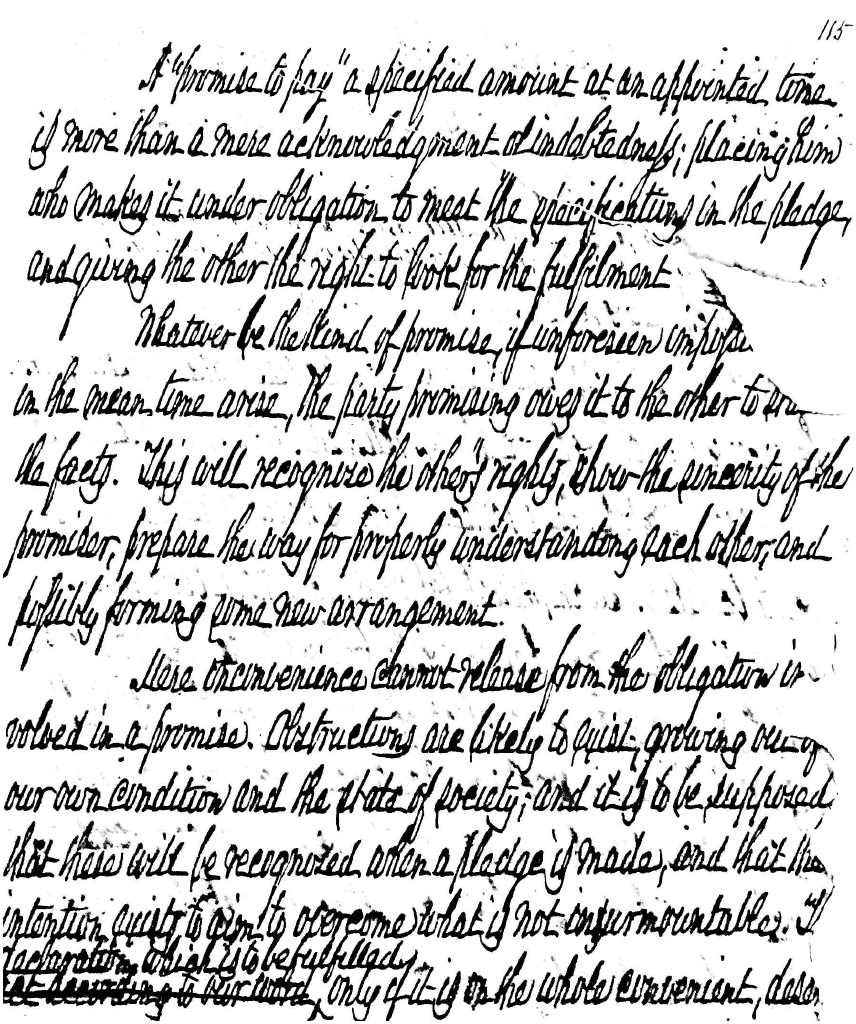
A “promise to pay” a specified amount at an appointed time is more than a mere acknowledgment of indebtedness; placing him who makes it under obligation to meet the specifications in the pledge, and giving the other the right to look for the fulfillment.
Whatever be the kind of promise; if unforeseen imposs- … in the meantime arise, the party promising owes it to the other to … the facts. This will recognize his other's rights, show the sincerity of the promiser, prepare the way for properly understanding each other, and possibly forming some new arrangement.
Mere inconvenience cannot release from the obligation involved in a promise. Obstructions are likely to exist, growing out of our own condition and the state of society; and it is to be supposed that these will be recognized when a pledge is made, and that the intention exists to aim to overcome what is not insurmountable. … declaration of which is to be fulfilled only if it is on the whole convenient, des- …
Page 8:
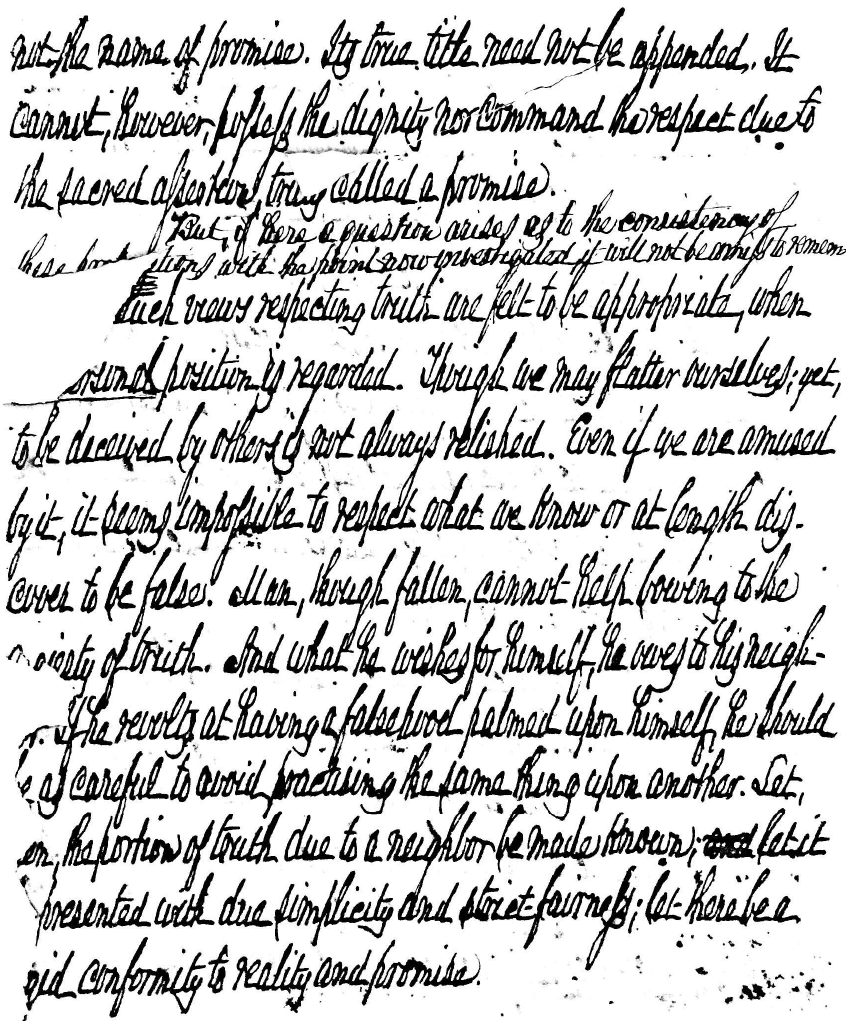
not the name of promise. Its true title need not be appended. It cannot however profess the dignity nor command the respect due to the sacred assertion truly called a promise.
But, if here a question arises as to the consistency of … -tions with the point now investigated, it will not be amiss to remember … such views respecting truth are felt to be appropriate, when … -sonal position is regarded. Though we may flatter ourselves, yet to be deceived by others is not always relished. Even if we are amused by it, it seems impossible to respect what we know or at length discover to be false. Man, though fallen, cannot help bowing to the … -sty of truth. And what he wishes for himself, he owes to his neighbor. If he revolts at having a falsehood palmed upon himself, he should be as careful to avoid practising the same thing upon another. Let, … -en, the portions of truth due to a neighbor be made known; let it … presented with due simplicity and strict fairness; let there be a … -id conformity to reality and promise.