Order of Duty
Page 1:
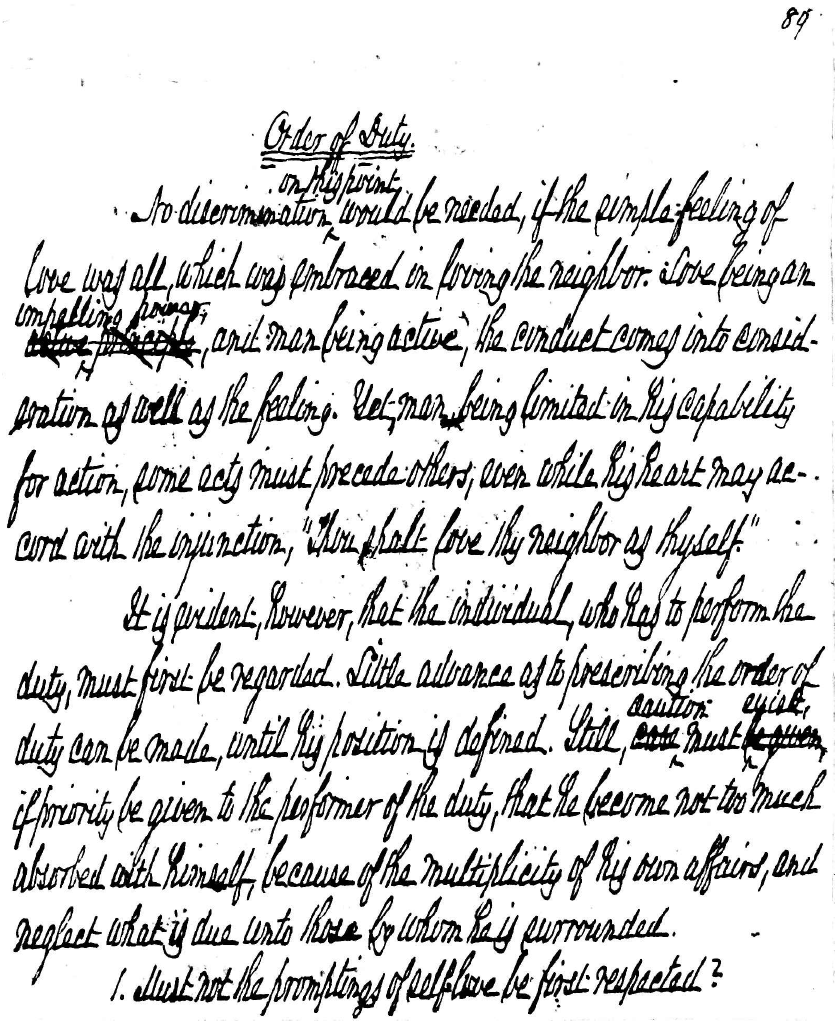
No discrimination on this point would be needed, if the simple feeling of love was all which was embraced in loving the neighbor. Love being an impelling power, and man being active, the conduct comes into consideration as well as the feeling. Yet, man being limited in his capability for action, some acts must precede others, even while his heart may accord with the injunction, “Thou shalt love thy neighbor as thyself.”
It is evident, however, that he, an individual, who has to perform the duty, must first be regarded. Little advance as to prescribing the order of duty can be made, until his position is defined. Still, caution must exist, if priority be given to the performer of the duty, that he become not so much absorbed with himself, because of the multiplicity of his own affairs, and neglect what is due unto those by whom he is surrounded.
1. Must not the promptings of self-love be first respected?
Page 2:
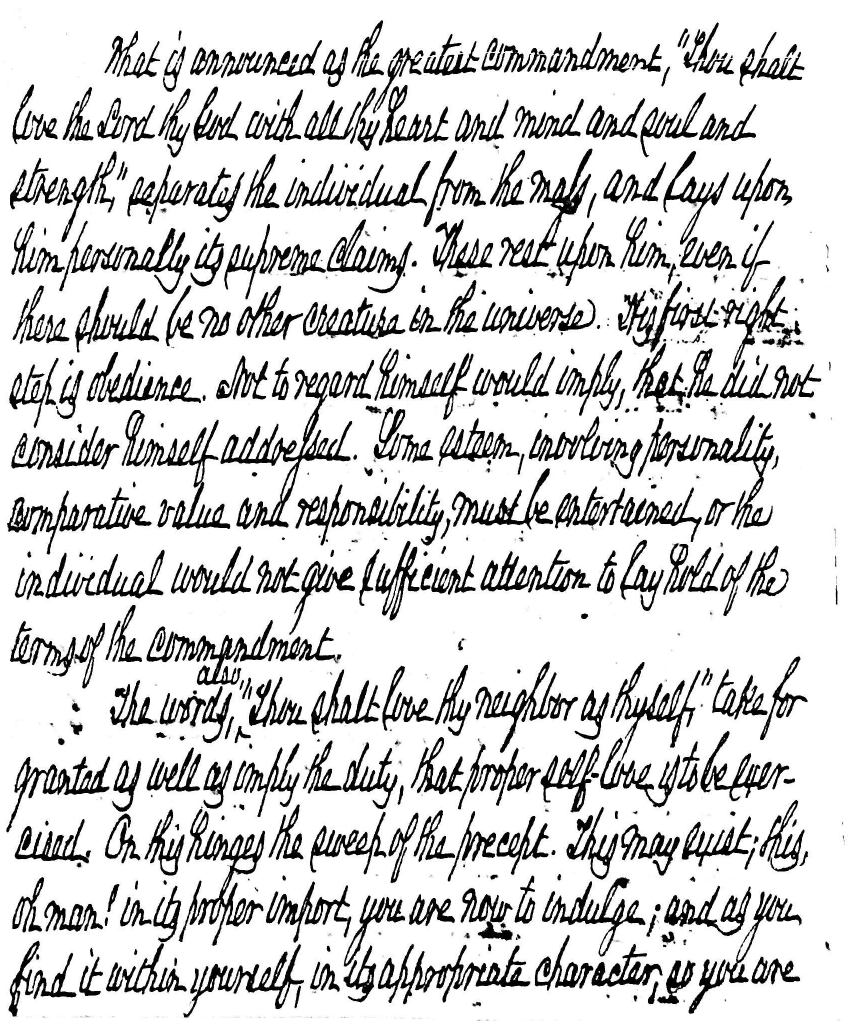
What is announced as the greatest commandment, “thou shalt love the Lord thy God with all thy heart and mind and soul and strength,” separates the individual from the mass, and lays upon him personally its Supreme claims. These rest upon him, even if there should be no other creature in the universe. His first right step is obedience. Not to regard himself would imply, that he did not consider himself addressed. Some esteem, involving personality, comparative value and responsibility, must be entertained, or the individual would not give sufficient attention to lay hold of the terms of the commandment.
The words also, “thou shalt love thy neighbor as thyself” take for granted as well as amply the duty, that proper self-love is to be exercised. On this hinges the sweep of the precept. This may exist; this, oh man! in its proper import, you are now to indulge; and as you find it within yourself, in its appropriate character, as you are
Page 3:
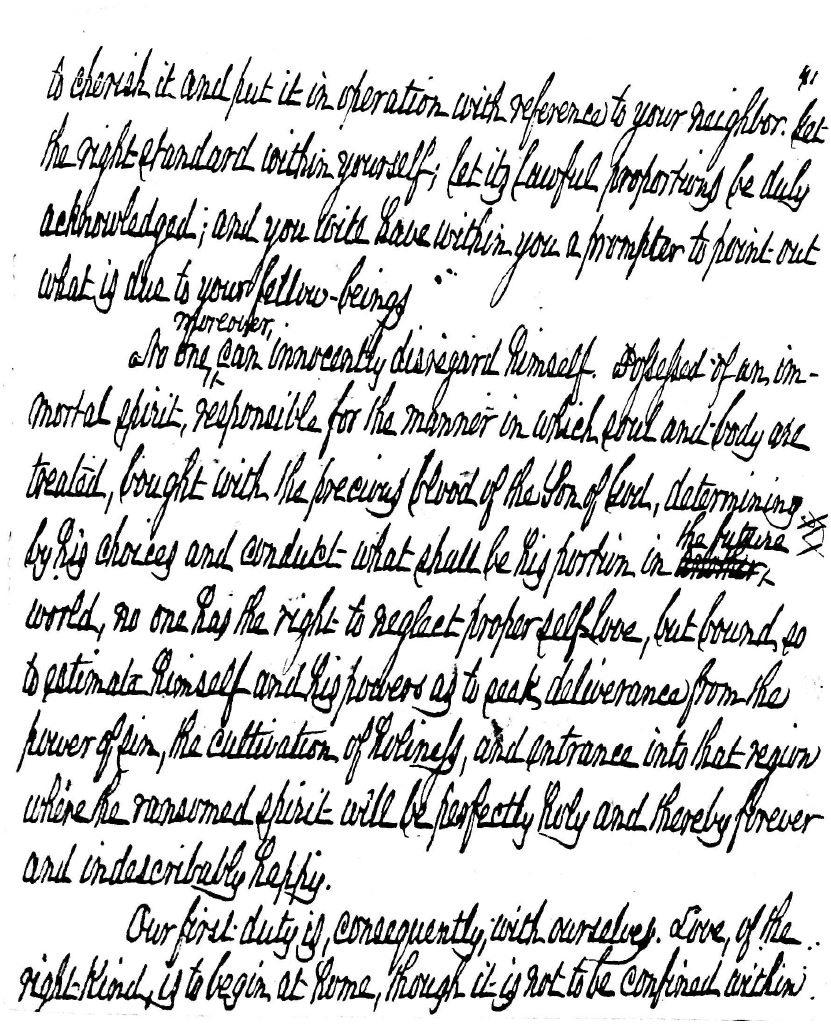
to cherish it and put it in operation with reference to your neighbor. Let the right standard within yourself; let its lawful proportions be duly acknowledged; and you write have within you a prompter to point out what is due to your fellow-being.
No one, moreover, can innocently disregard himself. Possessed of an immortal spirit, responsible for the manner in which soul and body are treated, bought with the precious blood of the Son of God, determining by his choices and conduct what shall be his position in the future world, no one has the right to neglect proper self-love, but bound so to estimate himself and his powers as to seek deliverance from the power of him, the cultivation of holiness, and entrance into that region where the ransomed spirit will be perfectly holy and thereby forever and indescribably happy.
Our first duty is, consequently, with ourselves. Love, of the right kind, is to begin at home, though it is not to be confined within
Page 4:
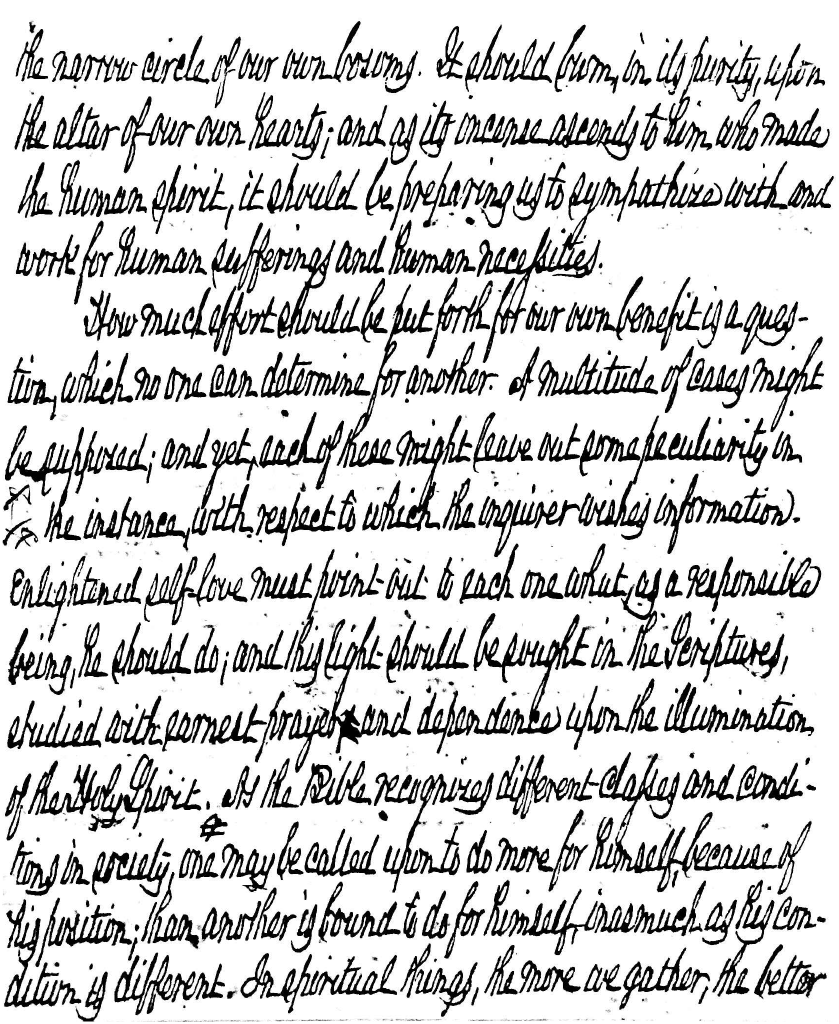
The narrow circle of our own bosoms. It should burn, in its purity, upon the altar of our own hearts; and as its incense ascends to him who made the human spirit, it should be preparing us to sympathize with and work for human sufferings and human necessities.
How much effort should be put forth for our own benefit is a question, which no one can determine for another. A multitude of cases might be supposed; and yet, and of these might leave out some peculiarity in the instance, with respect to which the inquirer wishes information. Enlightened self-love must point out to each one what, as a responsible being, he should do; and this light should be sought in the Scriptures, studied with earnest thought and dependence upon the illumination of the Holy Spirit. As the Bible recognizes different classes and conditions in society, one may be called upon to do more for himself, because of his position; than another is bound to do for himself, inasmuch as his condition is different. In spiritual things, the more we gather, the better
Page 5:
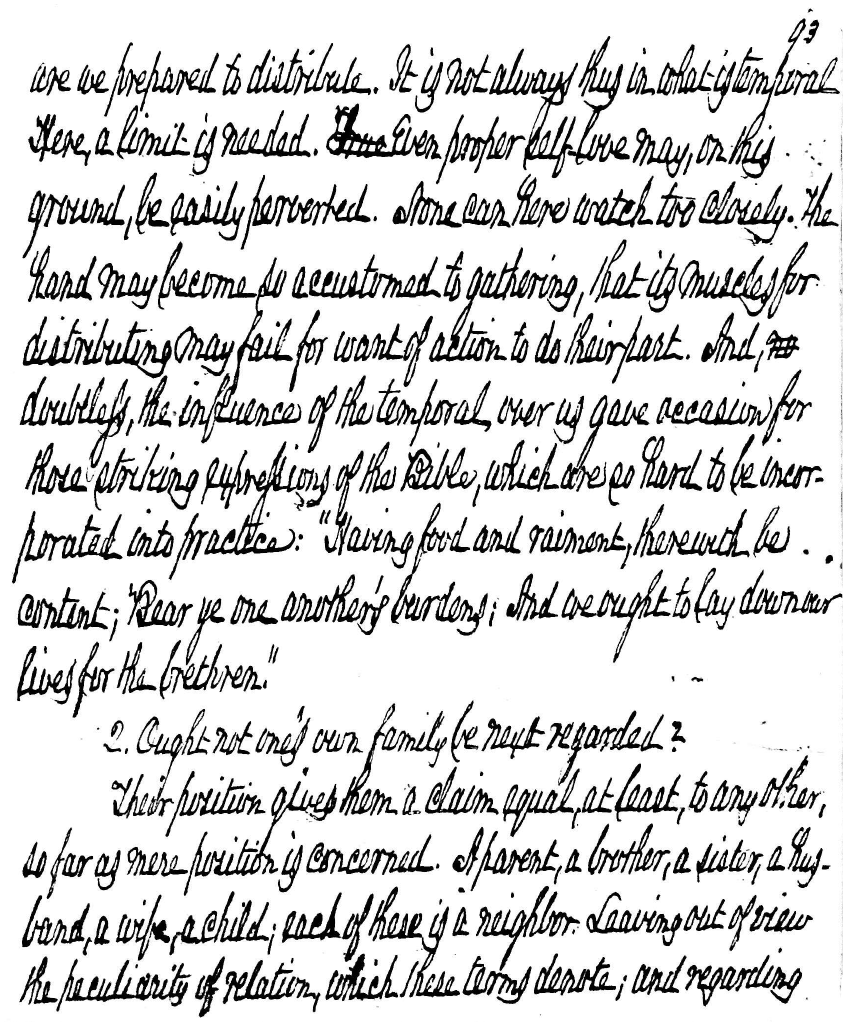
are we prepared to distribute. It is not always thus in what is temporal. Here, a limit is reached. Even proper self-love may, on this ground, be easily perverted. Some can here watch too closely. The hand may become so accustomed to gathering, that its muscles for distributing may fail for want of action to do their part. And doubtless, the influences of the temporal over us gave occasion for those striking expressions of the Bible, which are so hard to be incorporated into practice: “Having food and raiment, therewith be content; Bear ye one another’s burdens; And we ought to lay down our lives for the brethren.”
2. Ought not one’s own family be next regarded?
Their position gives them a claim equal, at least, to any other, so far as mere position is concerned. A parent, a brother, a sister, a husband, a wife, a child; each of these is a neighbor. Leaving out of view the peculiarity of relation, which these terms denote; and regarding
Page 6:
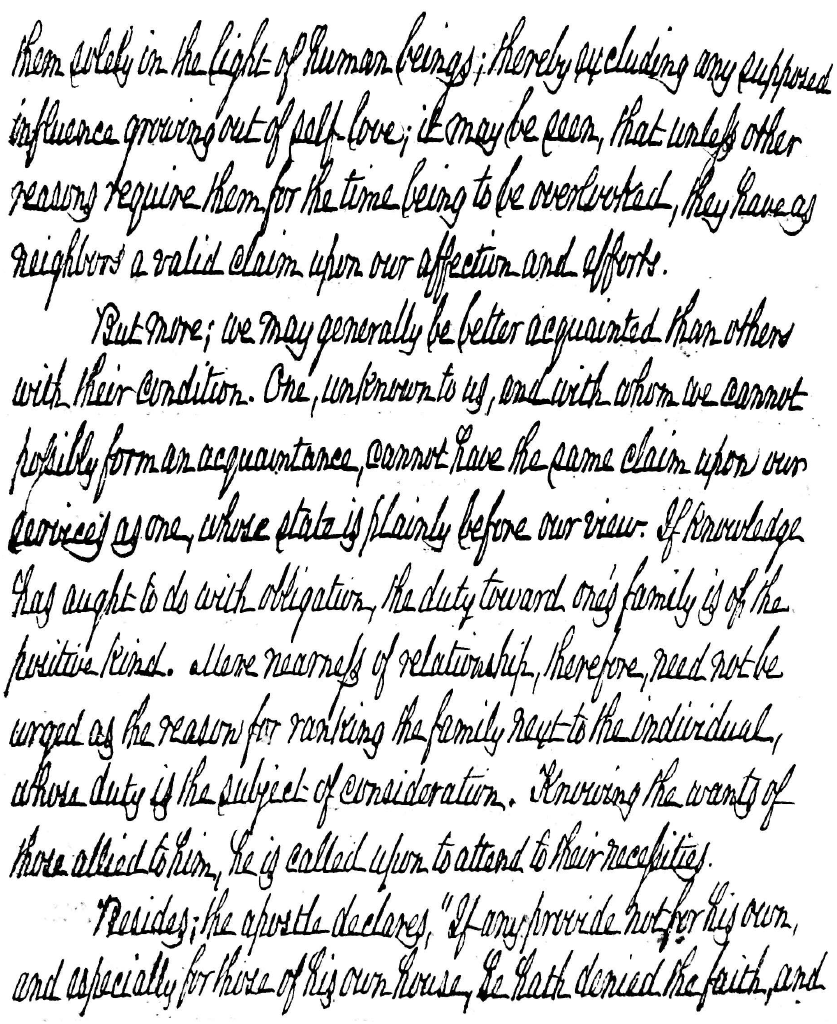
them solely in the light of human beings; thereby excluding any supposed influence growing out of self love; it may be seen, that unless other reasons require them for the time being to be overlooked, they have as neighbors of valid claim upon our affection and efforts.
But more; we may generally be better acquainted than others with their condition. One, unknown to us, and with whom we cannot possibly form an acquaintance, cannot have the same claim upon our services as one, whose state is plainly before our view. If knowledge has aught to do with obligation, the duty towards one’s family is of the positive kind. Mere nearness of relationship, therefore, need not be urged as the reason for ranking the family next to the individual, whose duty is the subject of consideration. Knowing the wants of those allied to him, he is called upon to attend to their necessities.
Besides; the apostle declares, “If any provide not for his own, and especially for those of his own house, he hath denied the faith, and
Page 7:
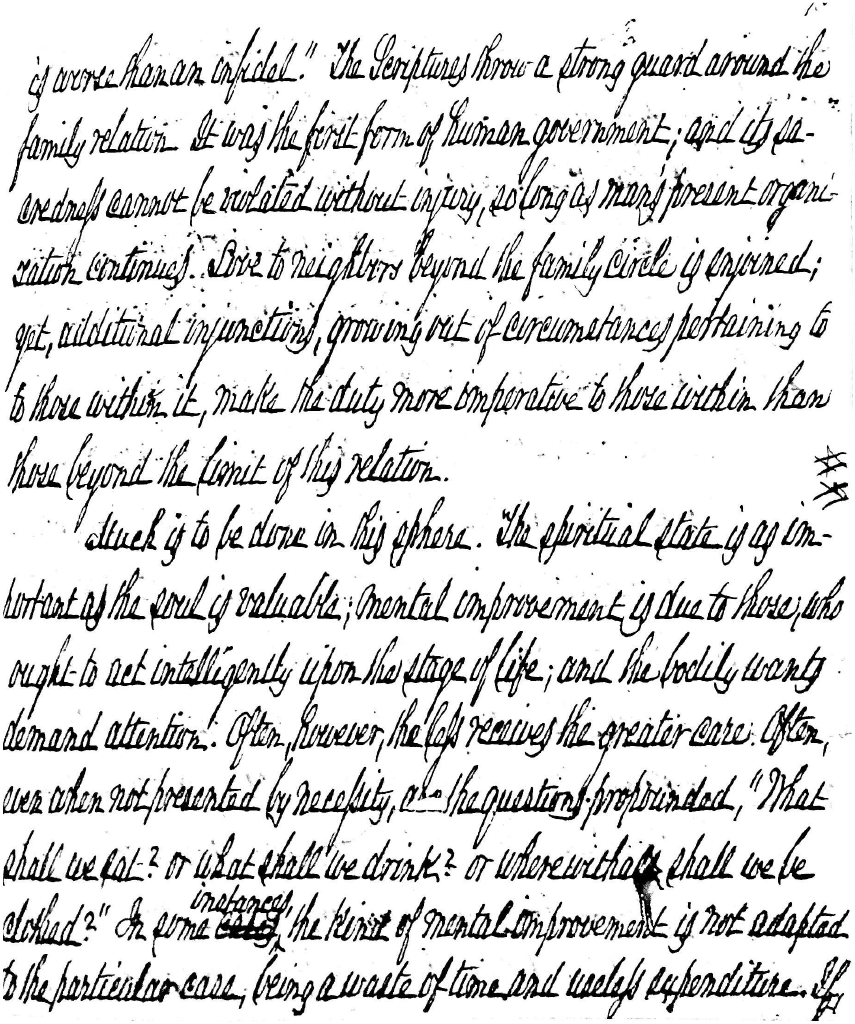
Is worse than an infidel.” The Scriptures throw a strong guard around the family relation. It was the first form of human government; and its sacredness cannot be violated without injury, so long as man's present organization continues. Love to neighbors beyond the family circle is enjoined; yet, additional injunctions, growing out of circumstances pertaining to those within it, make the duty more imperative to those within than those beyond the limit of this relation.
Much is to be done in this sphere. The spiritual state is as important as the soul is valuable; mental improvement is due to those, who ought to act intelligently upon the stage of life; and the bodily wants demand attention. Often, however, the less receives the greater care. Often, even when not presented by necessity, are the questions propounded, “What shall we eat? or what shall we drink? or wherewithal shall we be clothed?” In some instances, the kind of mental improvement is not adapted to the particular case, being a waste of time and useless expenditure. If,
Page 8:
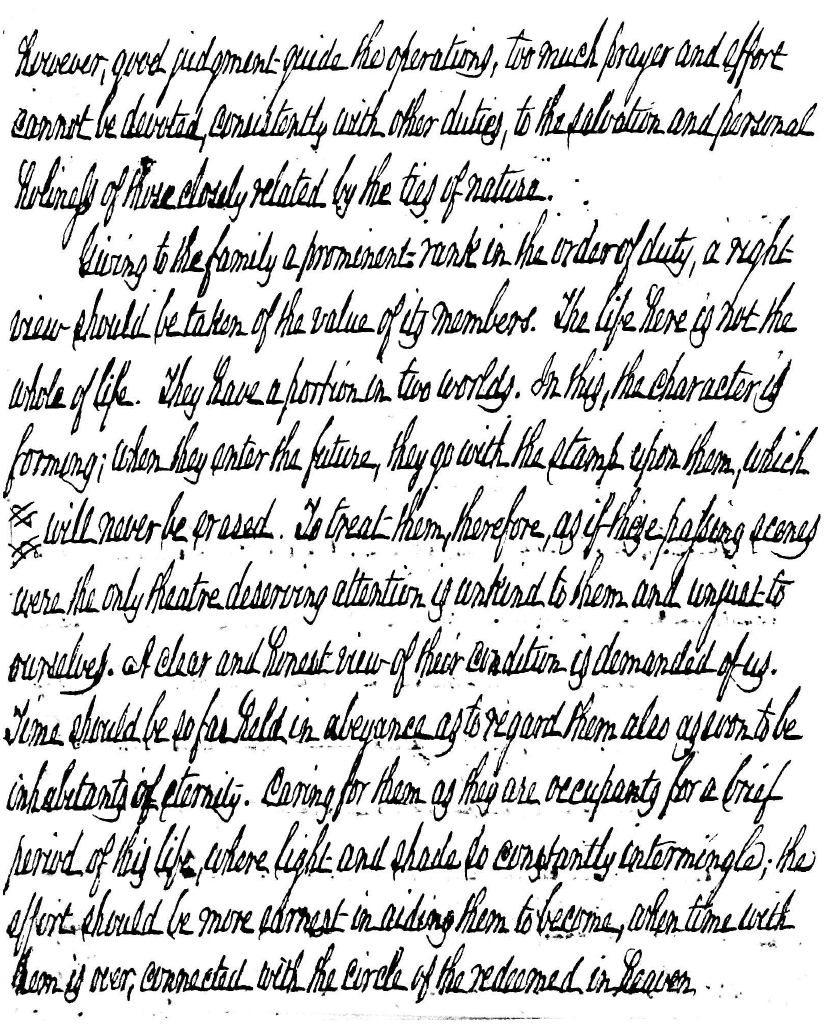
However good judgment guide the operations, too much prayer and effort cannot be devoted, consistently with other duties, to the salvation and personal holiness of those closely related by the ties of nature.
Giving to the family a prominent rank in the order of duty, a right view should be taken of the value of its members. The life here is not the whole of life. They have a portion in two worlds. In this, the character is forming; when they enter the future, they go with the stamp upon them, which will never be erased. To treat them, therefore, as if these passing scenes were the only theatre deserving attention is unkind to them and unjust to ourselves. A clear and honest view of their condition is demanded of us. Time should be so far held in abeyance as to regard them also as soon to be inhabitants of eternity. Caring for them as they are occupants for a brief period of this life, where light and shade so constantly intermingle; the effort should be more earnest in aiding them to become, when time with them is over, connected with the circle of the redeemed in Heaven.
Page 9:
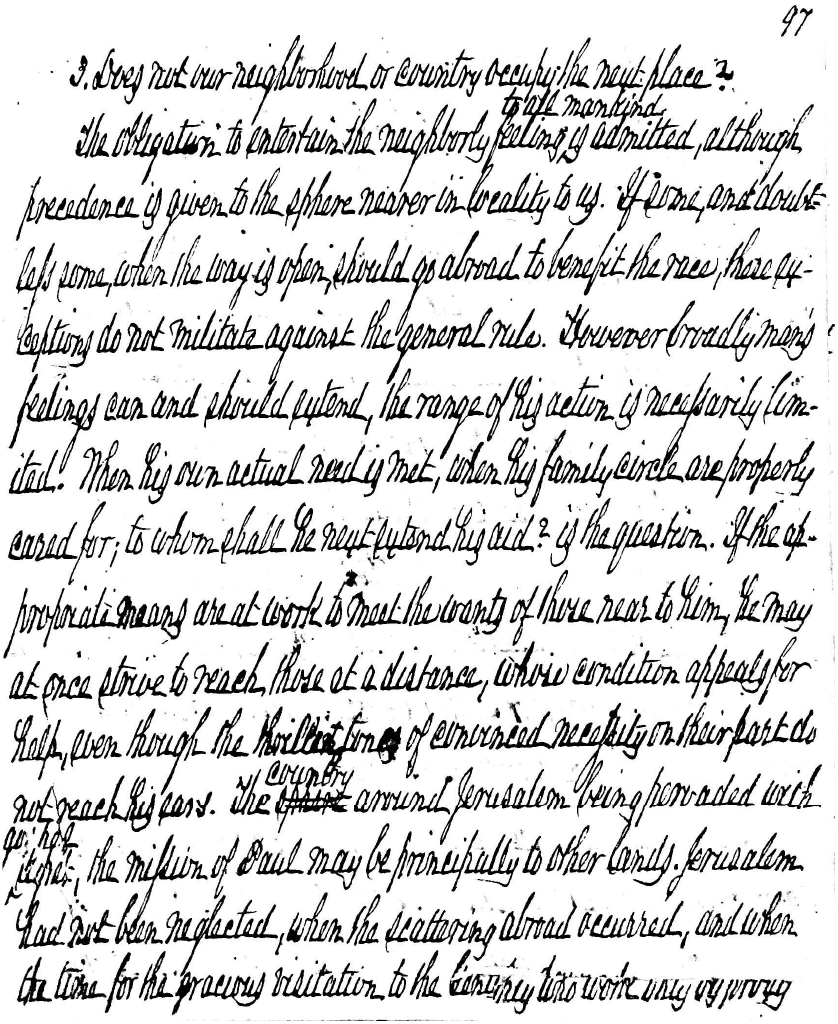
3. Does not our neighborhood, or country occupy the next place?
The obligation to entertain the neighborly feeling, is admitted, although precedence is given to the sphere nearer in locality to us. If some, and doubtless some, when the way is open, should go abroad to benefit the race, these exceptions do not militate against the general rule. However broadly man’s feelings can and should extend, the range of his action is necessarily limited. When his own actual need is met, when his family circle are properly cared for; to whom shall be next extend his aid? is the question. If the appropriate means are at work to meet the wants of those near to him, he may at once strive to reach those at a distance, whose condition appeals for help, even though the thrilling tones of convinced necessity on their part do not reach his ears. The country around Jerusalem being pervaded with gospel …; the mission of Paul may be principally to other lands. Jerusalem had not been neglected, when the scattering abroad occurred, and when the time for the gracious visitation to the …
Page 10:
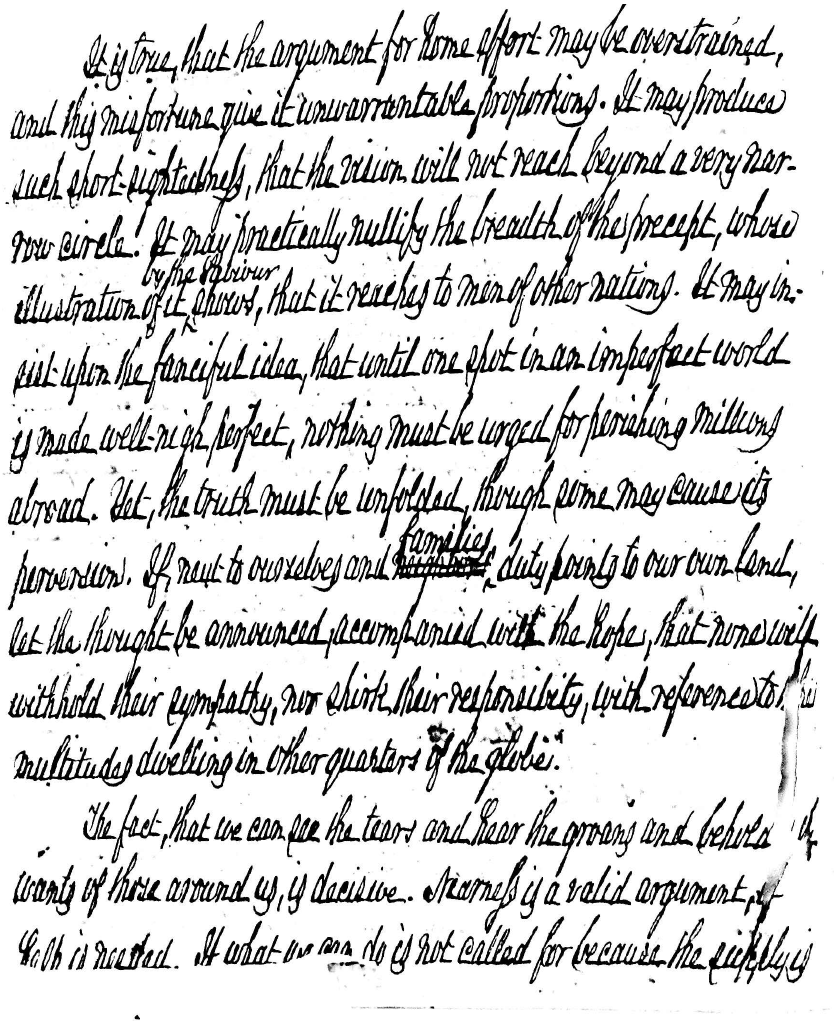
It is true, that the argument for home effort may be overstrained, and this misfortune give it unwarrantable proportions. It may produce such short-sightedness, that the vision will not reach beyond a very narrow circle. It may practically nullify the breadth of the precept, whose illustration of it by the savior shows, that it reaches to men of other nations. It may insist upon the fanciful idea, that until one spot in an imperfect world is made well-nigh perfect, nothing must be urged for perishing millions abroad. Yet, the truth must be unfolded, though some may cause its perversion. If, next to ourselves and families, duty points to our own land, let the thought be announced, accompanied with the hope, that none will withhold their empathy, nor shirk their responsibility, with reference to the multitudes dwelling in other quarters of the globe.
The fact, that we can see the tears and hear the groans and behold the wants of those around us, is decisive. Nearness is a valid argument, … both is needed. If what we can do is not caledl for because the supply is
Page 11:
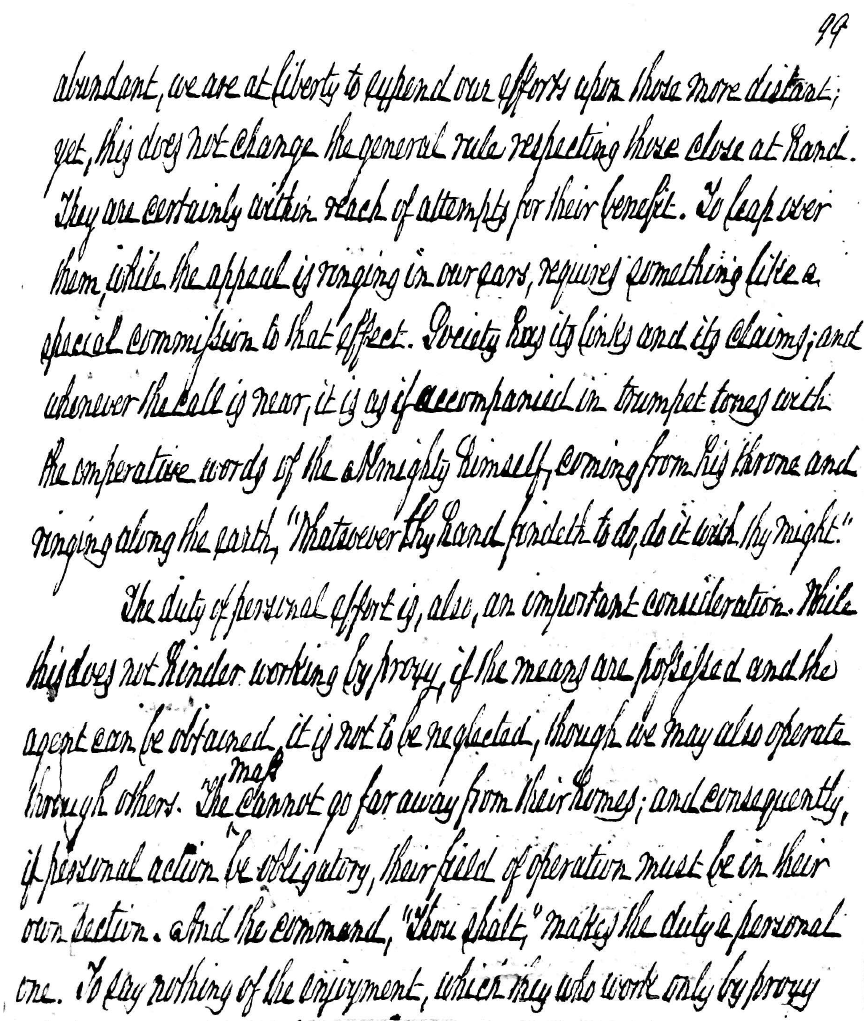
abundant, we are at liberty to expend our efforts upon those more distant; yet, this does not change the general rule respecting those close at hand. They are certainly within reach of attempts for their benefit. To leap over them, while the appeal is ringing in our ears, requires something like a special commission to that effect. Society has its limits and its claims; and whenever the call is near, it is as if accompanied in the trumpet tones with the imperative words of the Almighty himself, coming from his throne and ringing along the earth,”Whatever thy hand findeth to do, do it with thy might.”
The duty of personal effort is, also, an important consideration. While this does not hinder working by proxy, if the means are possessed and the agent can be obtained, it is not to be neglected, though we may also operate through others. The mass cannot go far away from their homes; and consequently, if personal action be obligatory, their field of operation must be in their own section. And the command, “thou shalt,” makes the duty a personal one. To say nothing of the enjoyment, which they who work only by proxy
Page 12:
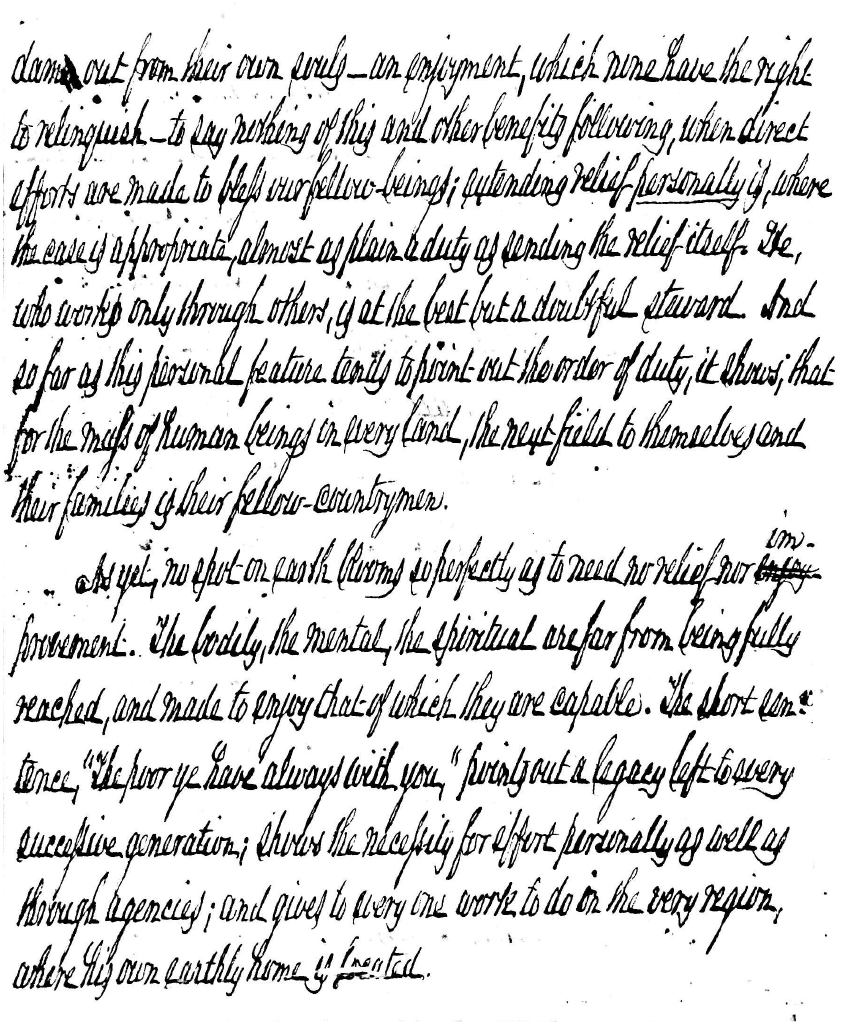
… out from their own souls - an enjoyment, which none have the right to relinquish - to say nothing of this, and other benefits following, when direct efforts are made to bless our fellow-beings; extending relief personally is, where the case is appropriate, almost as plain a duty as sending the relief itself. He, who works only through others, is at the best but a doubtful steward. And so far as this personal feature tends to point out the order of duty, it shows, that for the mass of human beings in every land, the next field to themselves and their families is their fellow-countrymen.
As yet, no spot on earth blooms so perfectly as to need no relief nor improvement. The bodily, the mental, the spiritual are far from being fully reached, and made to enjoy that of which they are capable. The short sentence, “The poor ye have always with you,” points out a legacy left to every successive generation; shows the necessity for effort personally as well as through agencies; and gives to every one work to do in the very region, where his own earthly home is located.
Page 13:
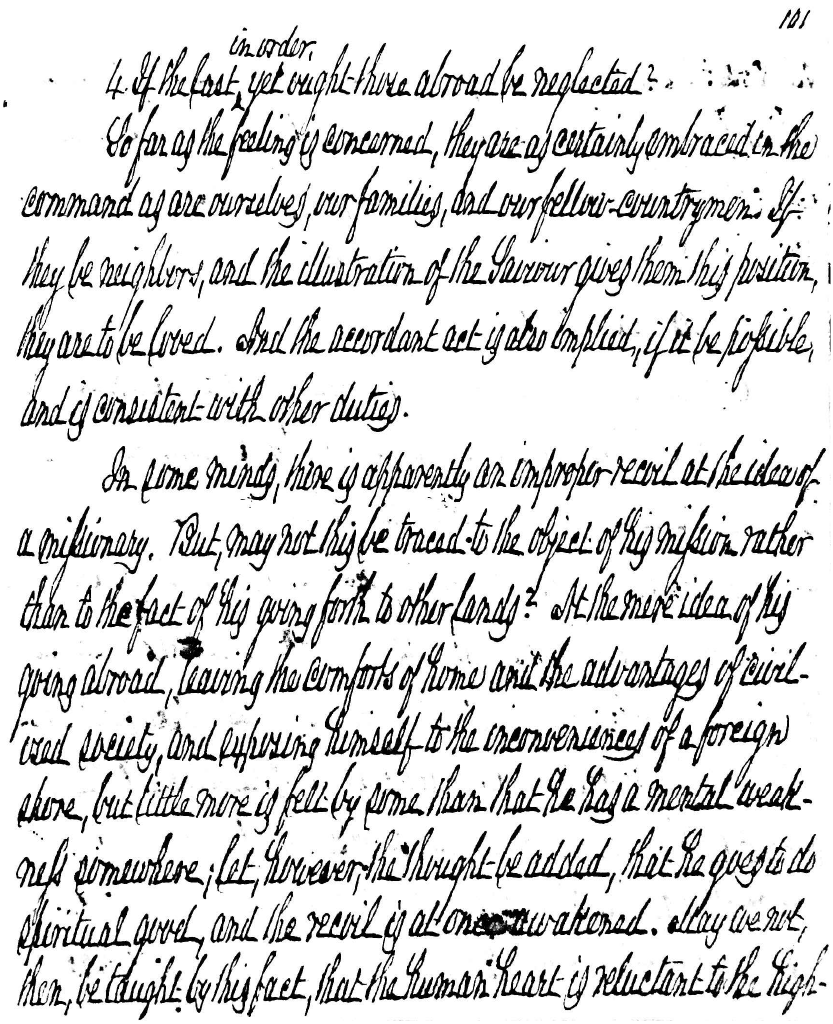
4. If the last in order, yet ought those abroad be neglected?
So far as the feeling is concerned, they are as certainly embraced in the command as are ourselves, our families, and our fellow-countrymen. If they be neighbors, and the illustration of the Saviour gives them this position, they are to be loved. And the accordant act is also implied, if it be possible, and is consistent with other duties.
In some minds, there is apparently an improper recoil at the idea of a missionary. But, may not this be traced to the object of his mission, rather than to the fact of his going forth to other lands? At the mere idea of his going abroad, leaving the comforts of home and the advantages of civilized society, and exposing himself to the inconveniences of a foreign shore, but little more is felt by some than that he has a mental weakness somewhere; let, however, the thought be added, that he goes to do spiritual good, and the recoil is at once awakened. May we not, then, be taught by his act, that the human heart is reluctant to the high-
Page 14:
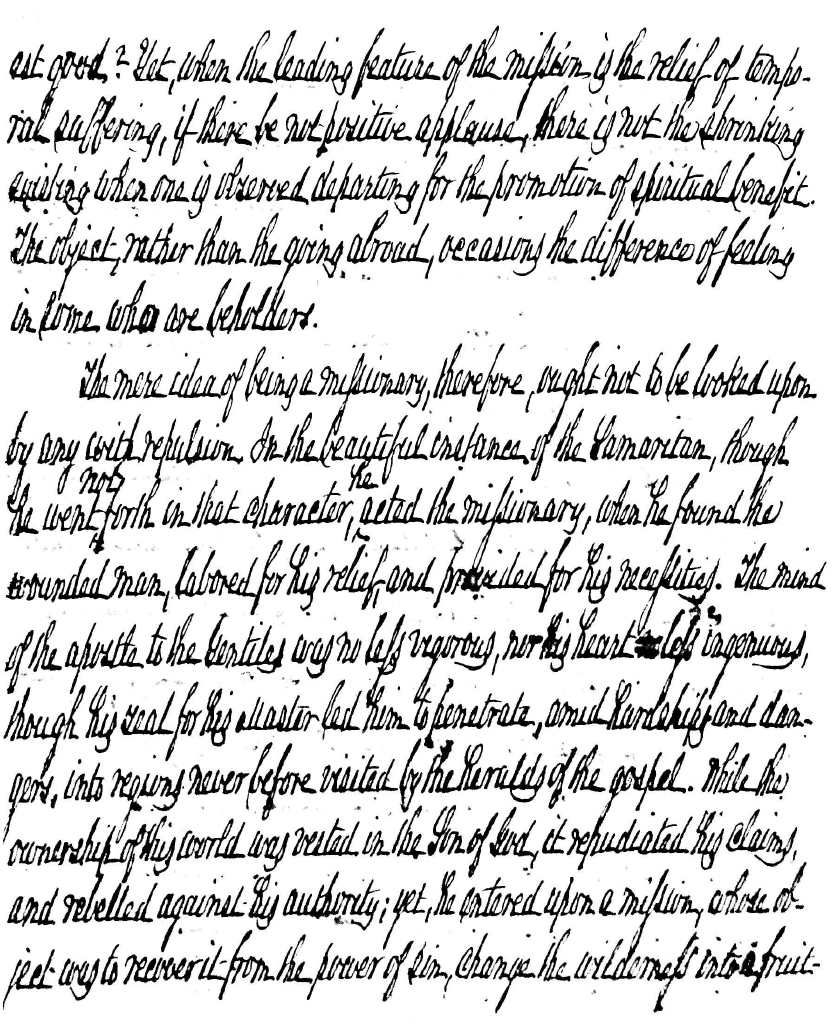
-est good? Yet, when the leading feature of the mission is the relief of temporal suffering, if there be not positive applause, there is not the shrinking quieting when one is observed departing for the promotion of spiritual benefit. The objects, rather than the going abroad, occasions the difference of feeling in some who are beholders.
The mere idea of being a missionary, therefore, ought not to be looked upon by any with repulsion. In the beautiful instance of the Samaritan, though he went not forth in that character, he acted the missionary, when he found the wounded man, labored for his relief, and provided for his necessities. The mind of the apostle to the Gentiles was no less vigorous, nor his heart less ingenuous, though his zeal for his master led him to penetrate, amid hardships and dangers, into regions never before visited by the heralds of the gospel. While the ownership of this world was vested in the Son of God, it repudiated his claims, and rebelled against his authority; yet, he entered upon a mission, whose object was to recover it from the power of sin, change the wilderness into a fruit-
Page 15:
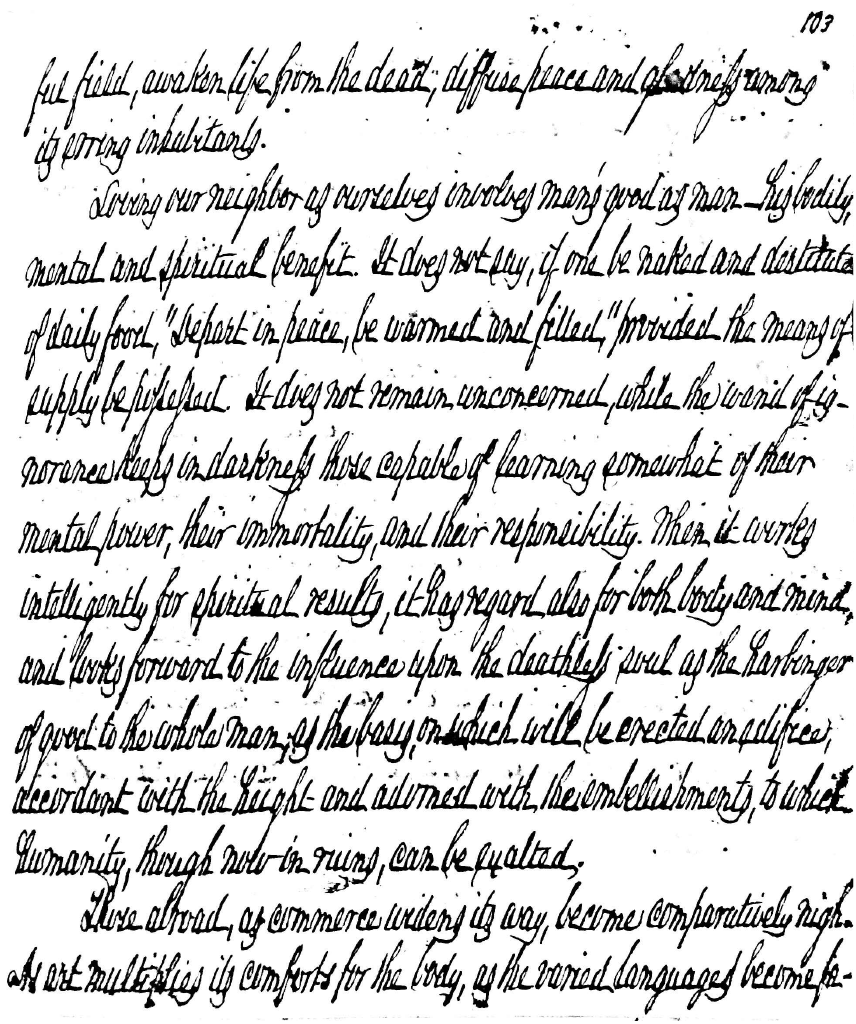
-ful field, awaken life from the dead, diffuse peace and …ness among its erring inhabitants.
Loving our neighbor as ourselves involves man's good as man - his bodily, mental and spiritual benefit. It does not say, if one be naked and destitute of daily food, “Depart in peace, be warmed and filled,” provided the means of supply be possessed. It does not remain unconcerned, while the wand of ignorance keeps in darkness those capable of learning somewhat of their mental power, their immortality, and their responsibility. Then it works intelligently for spiritual results, it has regard also for both body and mind, and works forward to the influence upon the deathless soul as the harbinger of good to the whole man, as the basis, on which will be erected an edifice, accordant with the height and adorned with the embellishments, to which humanity, though now in ruins, can be exalted.
Those abroad, as commerce widens its way, become comparatively nigh. As art multitudes its comforts for the body, as the varied languages become fa-
Page 16:
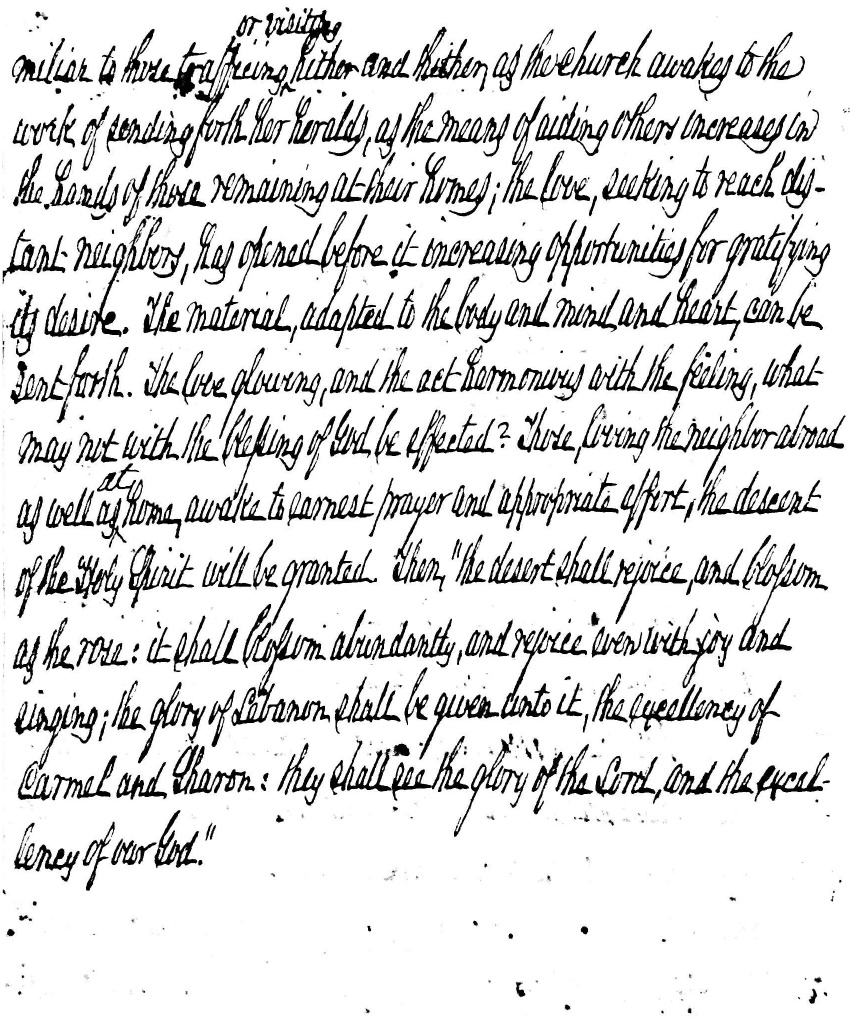
-miliar to those to …ing or visiting either and hither, as the church awakes to the work of sending forth her heralds, as the means of aiding others increases in the hearts of those remaining at their homes; the love, seeking to reach distant neighbors, has opened before it increasing opportunities for gratifying its desire. The material, adapted to the body and mind and heart, can be sent forth. The love glowing, and the act harmonious with the feeling, what may not with the blessing of God be effected? Those, loving the neighbor abroad and as well as at home, awake to earnest prayer and appropriate effort, the descent of the Holy Spirit will be granted. Then, “the desert shall rejoice and blossom as the rose: it shall blossom abundantly, and rejoice even with joy and singing; the glory of Lebanon shall be given unto it, the excellency of Carmel and Sharon: they shall see the glory of the Lord, and the excellency of our God.”