The Duty Relatively Considered
Page 1:
The Duty Relatively Considered
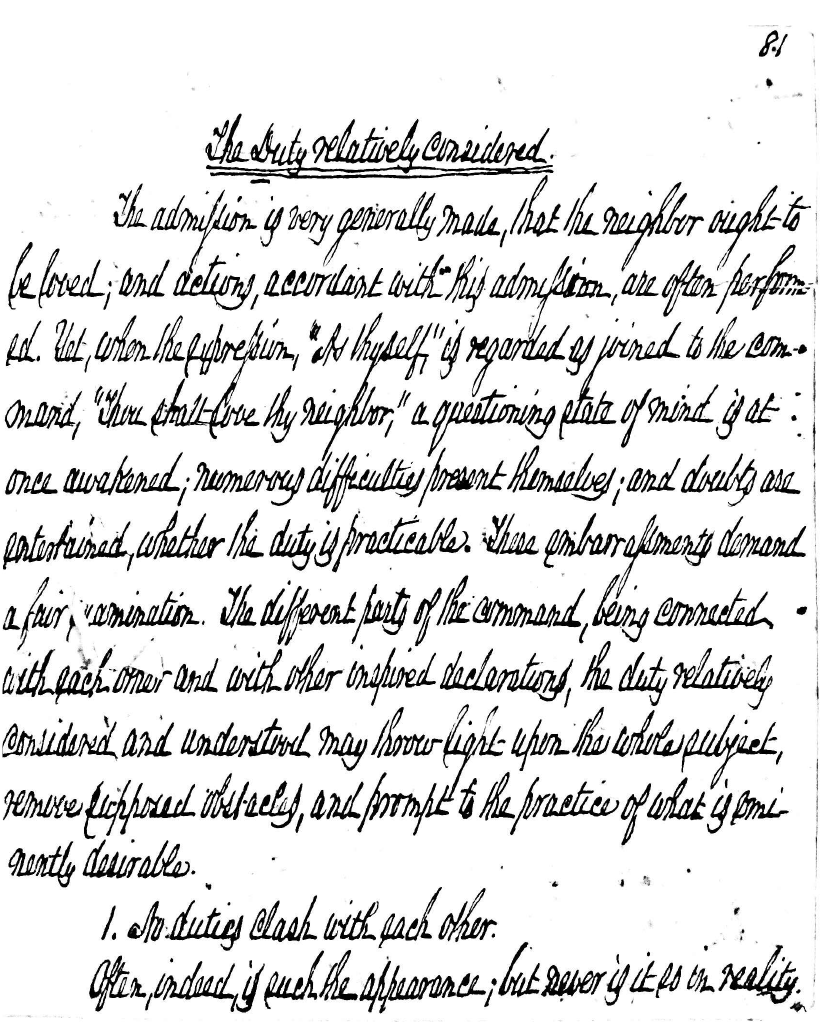
The admission is very generally made, that the neighbor ought to be loved; and actions, accordant with this admission, are often performed. Yet, when the expression “as himself” is regarded as joined to the command, “Thou shalt love thy neighbor,” a questioning state of mind is at once awakened; numerous difficulties present themselves; and doubts are entertained, whether the duty is practicable. These embarrassments demand a fair examination. The different parts of the command, being connected with each other and with other inspired declarations, the duty relatively considered and understood may throw light upon the whole subject 1 remove supposed obstacles, and prompt to the practice of what is eminently desirable.
1. As duties clash with each other.
Often, indeed, is such the appearance; but never is it as in reality.
Page 2:
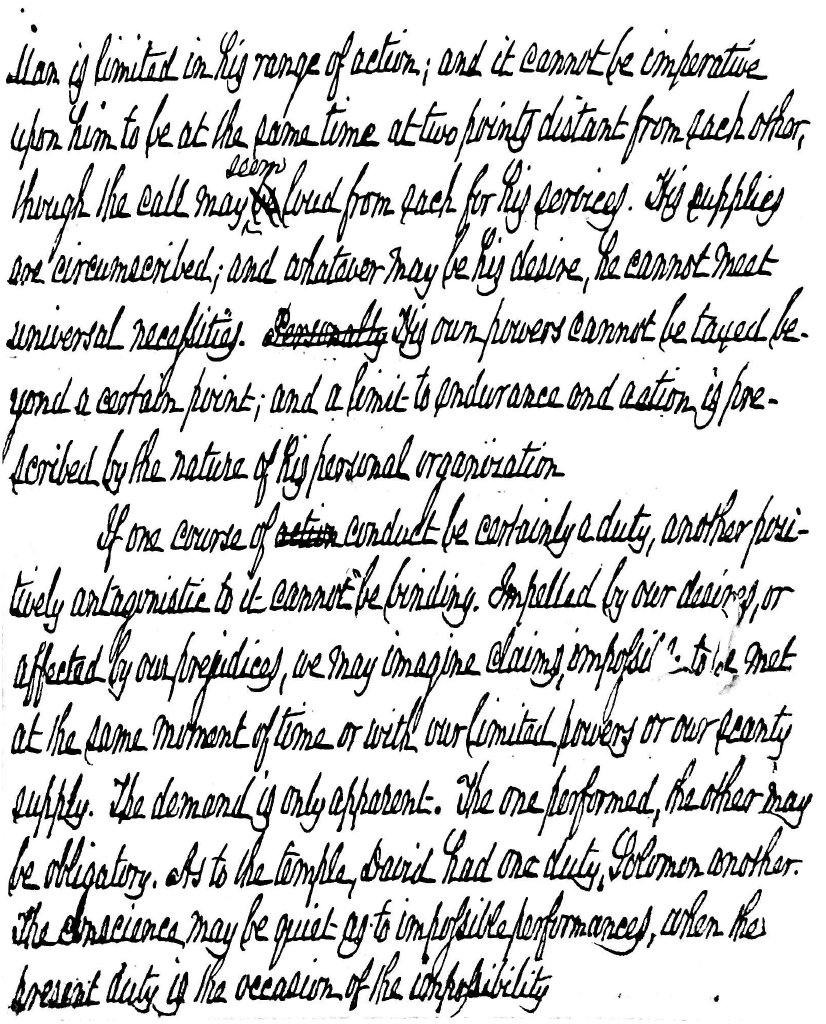
Man is limited in his range of action; and it cannot be imperative upon him to be at the same time at two points distant from each other, though the call may seem loud from each for his services. His supplies are circumscribed; and whatever may be his desire, he cannot meet universal necessities.
His own powers cannot be taxed beyond a certain point; and a limit to endurance and action is prescribed by the nature of his personal organization.
If one course of conduct be certainly a duty, another positively antagonistic to it cannot be binding. Impelled by our desires, or affected by our prejudices, we may imagine claims, impossible to be met at the same moment of time, or with our limited powers or our scanty supply. The demand is only apparent. The one performed, the other may be obligatory.
As to the temple, David had one duty, Solomon another. The conscience may be quiet as to impossible performances, when the present duty is the occasion of the impossibility.
Page 3:
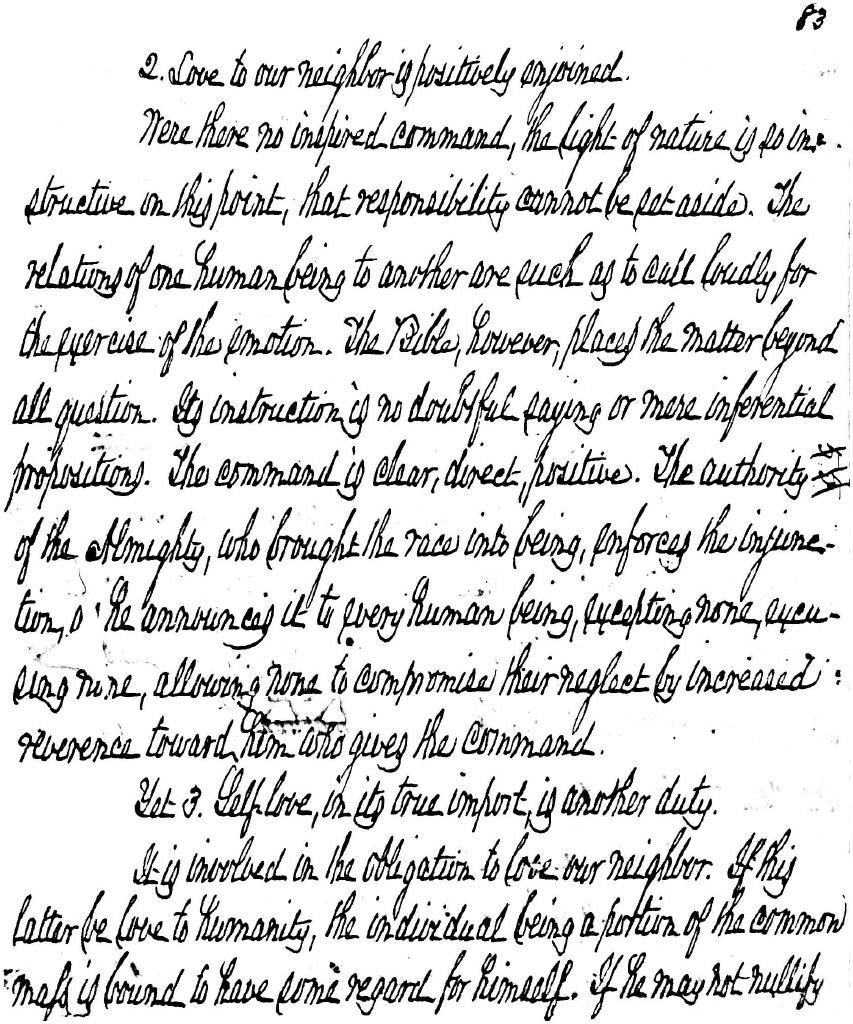
2. Love to our neighbor is positively enjoined.
Were there no inspired command, the light of nature is so instructive on this point; that responsibility cannot be set aside. The relations of one human being to another are such as to call loudly for the exercise of the emotion. The Bible, however, places the matter beyond all question. Its instruction is no doubtful saying or more inferential propositions. The command is clear, direct, positive. The authority of the Almighty, who brought the race into being, enforces injunction, ... he announces it to every human being, excepting none, excusing none, allowing none to compromise their neglect by increased reverence toward him who gives the command.
Yet 3. Self love, in its true import, is another duty.
It is involved in the obligation to love our neighbor. If this latter be love to humanity, the individual being a portion of the command mass is bound to have some regard for himself. If he may not nullify
Page 4:
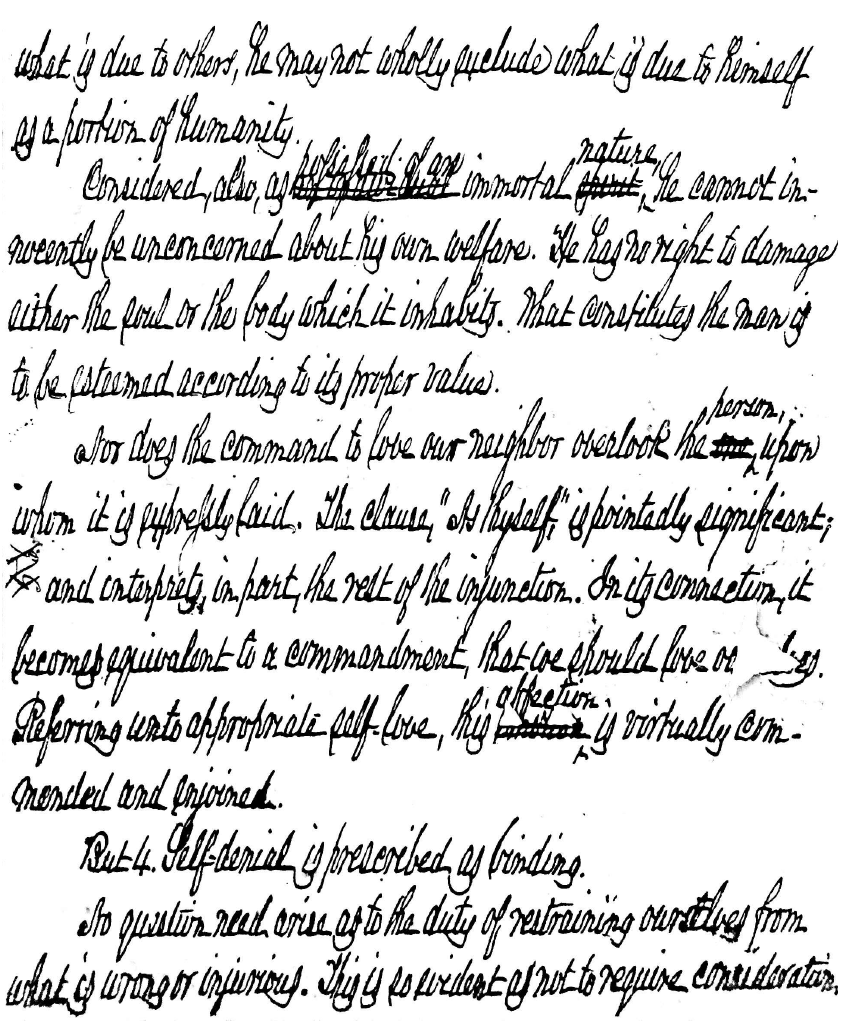
what is due to others, he may not wholly exclude what is due to himself as a portion of humanity.
Considered also as possessed of an immortal nature, he cannot innocently be unconcerned about his own welfare. He has no right to damage either the soul or the body which it inhabits. What constitutes the man is to be esteemed according to its proper value.
Nor does the command to love our neighbor overlook the person upon whom it is expressly laid. The clause, "As thyself," is pointedly significant; and interprets, in part, the rest of the injunction. In its connection, it becomes equivalent to a commandment, that we should love ourselves. Referring unto appropriate self-love, this affection is virtually commanded and enjoined.
But 4. Self-denial is prescribed as binding.
No question need arise as to the duty of restraining ourselves from what is wrong or injurious. This is so evident as not to require consideration.
Page 5:
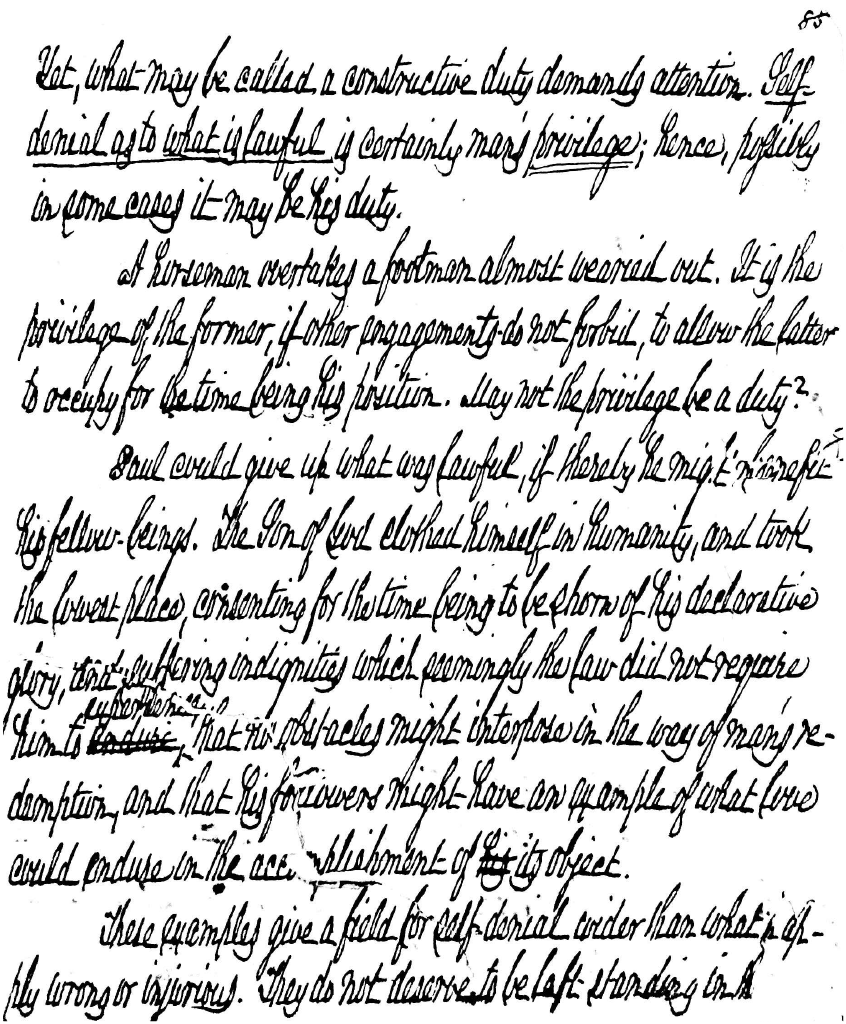
Yet, what may be called a constructive duty demands attention. Self-denial as to what is lawful, is certainly man's privilege; hence, possibly in some cases it may be his duty.
A horseman overtakes a footman almost wearied out. It is the privilege of the former, if other engagements do not forbid, to allow the latter to occupy for the time being his position. May not the privilege be a duty?
Paul could give up what was lawful, if thereby he might benefit his fellow-beings. The Son of God clothed Himself in humanity, and took the lowest places, consenting for the time being to be shorn of His declarative glory, and suffering indignities which seemingly His law did not require Him to experience, that no obstacles might interpose in the way of man's redemption, and that His followers might have an example of what love could endure in the accomplishment of its object.
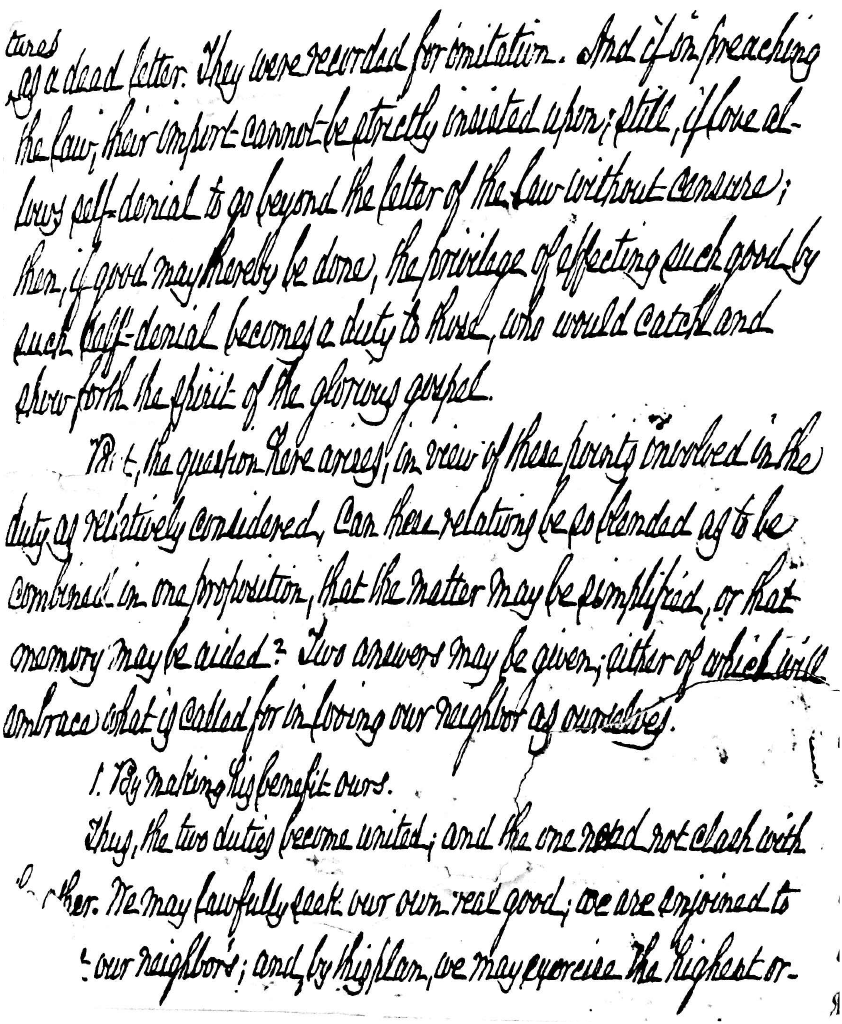
These examples give a field for self-denial wider than what is simply wrong or injurious. They do not deserve to be left standing in the …
Page 6:
… as a dead letter. They were recorded for imitation. And if in preaching the law, their import cannot be strictly insisted upon; still, if love allows self-denial to go beyond the letter of the law without censure; then, if good may thereby be done, the privilege of effecting such good by such self-denial becomes a duty to those, who would catch and show forth the spirit of the glorious gospel.
But, the question here arises; in view of these points involved in the duty as relatively considered, can these relations be as blended as to be combined in one proposition, that the matter may be simplified, or that memory may be aided? Two answers may be given; either of which will embrace what is called for in loving our neighbor as ourselves.
1. By making his benefit ours.
Thus, the two duties become united; and the one need not clash with the other. We may lawfully seek our own real good; we are enjoined to … at our neighbor's; and, by this plan, we may exercise the highest or-
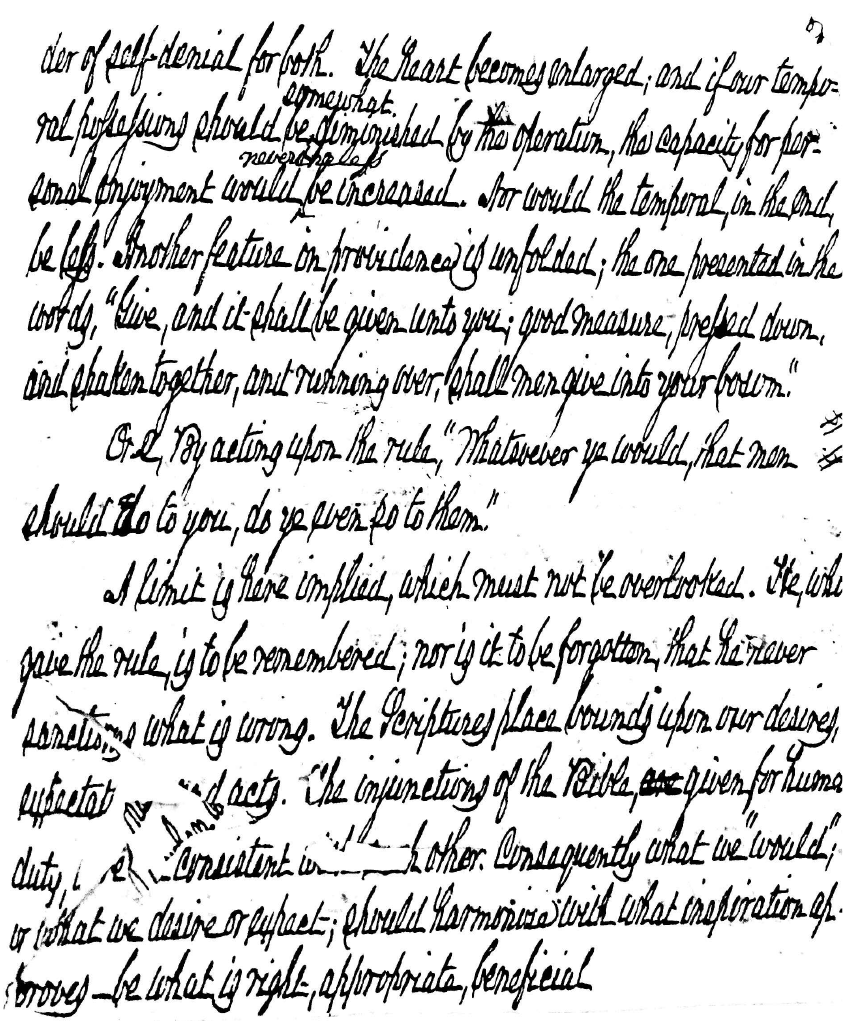
Page 7:
-der of self-denial for both. The heart becomes enlarged; and if our temporal professions should be somewhat diminished by no operation, the capacity for personal enjoyment would nevertheless be increased. Nor would the temporal, in the end, be less. Another feature in providence is unfolded; the one presented in the words, “Give and it shall be given unto you; good measure, pressed down, and shaken together, and running over, shall men give into your bosom.”
Or 2, By acting upon the rule “Whatsoever ye would, that men should do unto you, do you even so unto them.”
A limit is here implied, which must not be overlooked. He who gave the rule is to be remembered; nor is it to be forgotten, that he never sanctions what is wrong. The Scriptures place bounds upon our desires, expectations and acts. The injunctions of the Bible, given for humanity, are all consistent with each other. Consequently what we would, or what we desire or expect; should harmonize with what inspiration approves - be what is right, appropriate, beneficial.
Page 8:
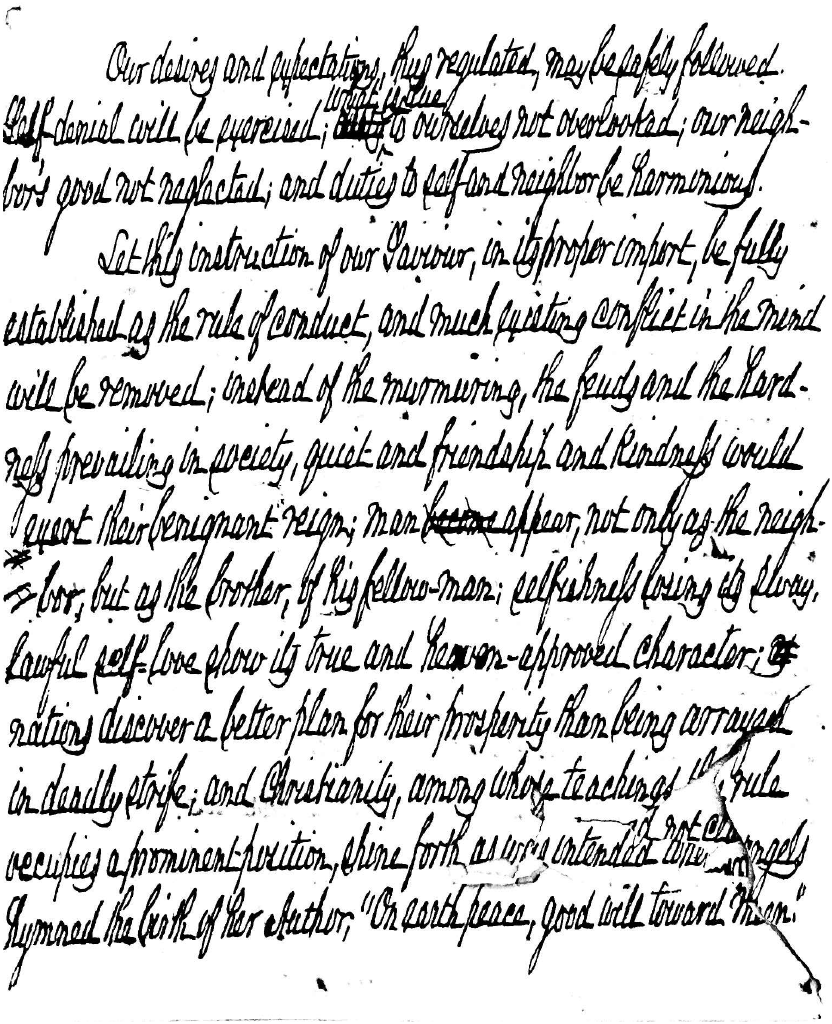
Our desires and expectations, thus regulated, may be safely followed.
Self-denial will be exercised; what is due to ourselves not overlooked, our neighbor's good not neglected; and duties to self and neighbor be harmonious.
Let this instruction of our Saviour, in its proper import, be fully established as the rule of conduct, and much exciting conflict in the mind will be removed; instead of the murmurings, the feuds and the hardness prevailing in society, quiet and friendship and kindness would exert their benignant reign; men appear, not only as the neighbor, but as the brother, of his fellow-man: selfishness losing its sway, lawful self-love shows its true and heaven-approved character: nations discover a better plan for their prosperity than being arrayed in deadly strife; and Christianity, among whose teachings the rule occupies a prominent position, shine forth as was intended when angels hymned the birth of her Author: "On earth peace, good will toward men."